Through the first year of President Donald Trump’s second term, tensions between his administration and the Vatican — now with the first U.S.-born pope — had simmered.
Days after the one-year mark of Trump returning to office, an unusual meeting between the two sides took place that has now turned up the temperature of the public discussion about the relationship. Following expressions of concern by Pope Leo XIV and Vatican officials over the administration’s actions in Venezuela, Minneapolis and elsewhere, Pentagon officials on Jan. 22 hosted a top Vatican diplomat, Cardinal Christophe Pierre, then the Holy See’s ambassador to the United States, for a rare visit. It is not typical for a church official to meet with the Defense Department instead of the State Department or White House.
During the discussion, the small group of Pentagon and Vatican officials discussed their differing views of current events, according to people on both sides with knowledge of the conversation.
What is less clear is how adversarial the meeting was.
One senior Vatican official familiar with internal assessments of the meeting called it “unusual” and not “a walk in the park.” It was “a frank and direct dialogue on issues where the distance between the Vatican and the United States is evident and clear,” said the official, who spoke on the condition of anonymity to discuss sensitive internal assessments.
The Vatican and government statements portray the encounter as far more mild than some news coverage and social media chatter since news of the meeting was first reported this week by the Free Press. That story framed the meeting as Pierre having been “summoned” by Elbridge Colby, a Catholic serving as Defense Department undersecretary for war policy.
Since then, the narrative of a hostile dressing-down of church officials by U.S. military leaders has dominated some corners of liberal social media platforms. The criticism has prompted harsh pushback from conservative Catholics.
Critics of the Trump administration latched on to a claim in the story that a U.S. official in the meeting “went so far as to invoke the Avignon Papacy,” the era in the 1300s when the French crown used military power to dominate the papal authority. Tweets condemning U.S. officials have been shared by the thousands, with Trump detractors pointing to the report of the meeting as evidence of a red line crossed by the administration.
On Wednesday, when Vice President JD Vance, a Catholic who is close with Colby, was asked by The Washington Post for his opinion, he said he had not seen the reporting about the meeting.
“I’d like to actually talk to Cardinal Christophe Pierre, and frankly, to our people, to figure out what actually happened,” said Vance, who acknowledged he had “met” Pierre previously. The Apostolic Nunciature to the United States, or Vatican Embassy, is across the street from the vice president’s home at the Naval Observatory in Northwest Washington.
Soon after Vance weighed in, Pentagon officials dismissed the story as “highly exaggerated and distorted,” saying in a statement that the two sides had “a respectful and reasonable discussion.”
The Apostolic Nunciature did not offer any disagreement in its assessment, saying it was “grateful” for opportunities to meet with U.S. officials “to discuss areas of mutual concern.”
The effort by U.S. officials to quell the controversy suggested the extent to which an administration that has often seemed to disregard outside views appears concerned about perceptions that it is at odds with a new and popular U.S.-born pope.
Brian Burch, the U.S. ambassador to the Holy See, released a statement Thursday after speaking with Pierre. He said the Cardinal called aspects of the story “fabrications,” including the “threat of Avignon.” Burch said Pierre described the meeting as “frank and cordial.” The Apostolic Nunciature had no additional response to Burch’s statement. Pierre did not respond to a request for comment.
On Friday morning, as international attention to the issue spread, the Vatican issued a statement:
“As confirmed by His Eminence Christophe Pierre, former Apostolic Nuncio to the United States, his meeting with Mr. Elbridge Andrew Colby was part of the Papal Representative’s regular mission and provided the opportunity for an exchange of views on matters of mutual interest. The narrative offered by some media outlets about this meeting is completely untrue.”
In the flurry of statements, the Defense Department released photos on Thursday of the meeting. The pictures showed Pierre and Colby smiling together and shaking hands, and sitting around a small table with associates. Seated next to Colby was David A. Baker, the Defense Department’s deputy assistant secretary for European and NATO policy.
A church official with knowledge of the meeting, speaking on the condition of anonymity to discuss the private discussion, told The Washington Post the candid conversation did not involve U.S. officials threatening the Vatican and also disputed the claim that the Avignon papacy was invoked to hint at military action against the church. The official suggested that the meeting was merely the Vatican doing what it is called to do — using available channels of diplomacy and dialogue to express its views.
Holy See officials and observers, however, called the Pentagon meeting with Pierre highly unusual, and disclosure of the previously unreported meeting raised eyebrows in Vatican City.
“I don’t recall similar [encounters],” said the Rev. Antonio Spadaro, undersecretary of the Vatican’s Dicastery for Culture and Education. “What I can say is that the classic rules of diplomacy have been somewhat disrupted at this time. We’re witnessing meetings that would have once been conducted with very specific procedures and have instead become highly theatrical — I’m thinking of the one between Trump and Zelensky, at the White House. In this historical context, with these dynamics, it’s hard to say what’s usual, normal, fair, and what isn’t.”
There is no indication that Leo — or Pierre, for that matter, held their tongues following the Pentagon meeting. In fact, just the opposite.
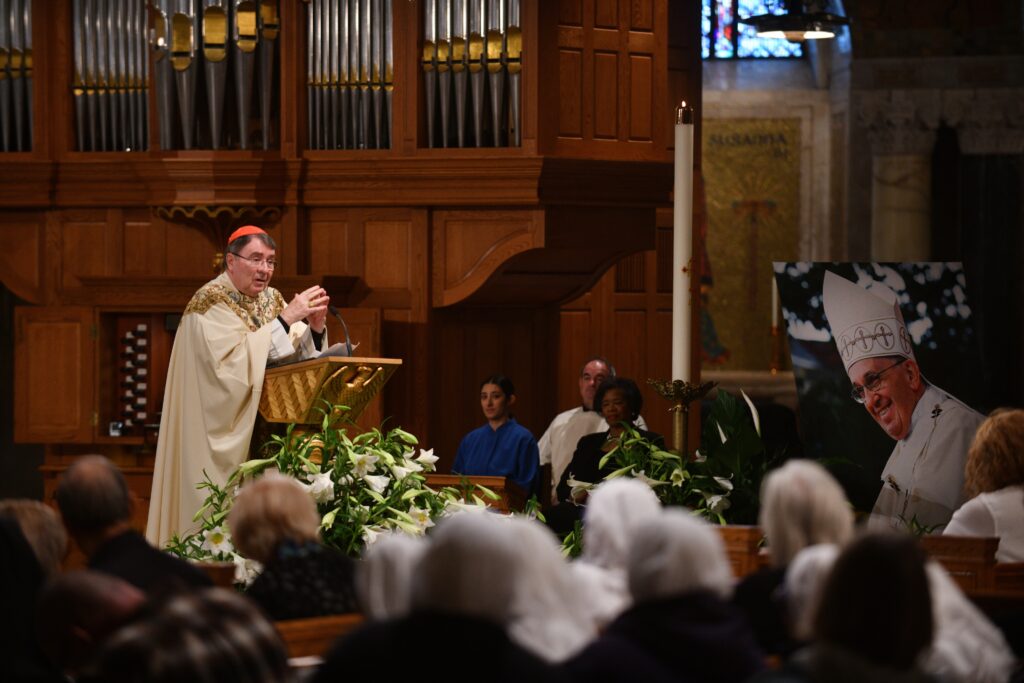
In late February, the French-born Pierre attended a Mass in Minnesota, after which he joined senior U.S. cardinals in denouncing the administration’s immigration crackdown in the state.
“I’m very proud, personally, to see our church, you know, be on the side of those who suffer,” Pierre said, according to the Associated Press, adding that Leo backed the U.S. bishops’ support of migrants.
During that event, Massimo Faggioli, a religion scholar who attended it, said one topic was how U.S. bishops were becoming more aware of the “real nature of Trumpism” and that they could not continue to side with the Republican Party simply because of the party’s opposition to abortion.
He said he worried that there was undue pressure being placed on the Vatican during the meeting with Pierre at the Pentagon.
“I don’t know what was said in the meeting, but the place where it happened — the Pentagon — is already a message in itself,” Faggioli said.
Leo at times has been blunt when criticizing administration policy, as when he described treatment of migrants in the United States last year as “inhuman.” More often, however, he has been circumspect, tending to refrain from mentioning Trump or the administration by name.
In January, just days after the U.S. intervention to capture Venezuelan President Nicolás Maduro, Leo spoke to diplomats in Vatican City about “the weakness of multilateralism.” Without mentioning the administration, he argued that a “diplomacy that promotes dialogue and seeks consensus among all parties is being replaced by a diplomacy based on force.”
He has grown more pointed over the course of the war in Iran, challenging the administration’s depictions of a warlike God who picks sides. On Palm Sunday, he said God “does not listen to the prayers of those who wage war,” and quoted Isaiah 1:15, saying, “Even though you make many prayers, I will not listen — your hands are full of blood.”
On Easter Sunday, he declared, “Let those who have weapons lay them down!” After Trump threatened to destroy “a whole civilization” in Iran, Leo bluntly called the remarks “truly unacceptable.”
The Vatican said in February that Leo would not visit the United States this year, a decision that came after officials in the Holy See had considered a trip that would include a possible address by Leo to the U.N. General Assembly in September.
That trip never came together, according to a Vatican official who spoke on the condition of anonymity to speak freely, because of the midterm elections and standing Vatican policy to avoid papal trips during major national campaigns.
That official disputed another claim in the Free Press story that the pope may never visit his homeland while Trump is in power.
Separately, Spadaro said: “The Pope is against war, not against Trump or any other political figure or head of state. There is a very clear message — the defense of peace, of international law — that has always characterized the Holy See.”
In a statement, White House spokeswoman Anna Kelly noted Trump’s increase in Catholic support in the 2024 election and said the administration has a “positive relationship with the Vatican, which was strengthened when Vice President Vance attended the Pope Leo XIV’s inaugural mass last year.”
In a February interview with The Washington Post, Vance acknowledged that he as a government official has “a different job” than the clergy.
“So that is going to inevitably lead to conflict between the government and the clergy,” Vance continued. “What I try to do is come at that conflict in a spirit of charity.”
Faiola reported from Rome. Stefano Pitrelli in Rome and Aaron Schaffer in Washington contributed to this report.
The post Vatican meeting at Pentagon was ‘unusual,’ a church official says appeared first on Washington Post.