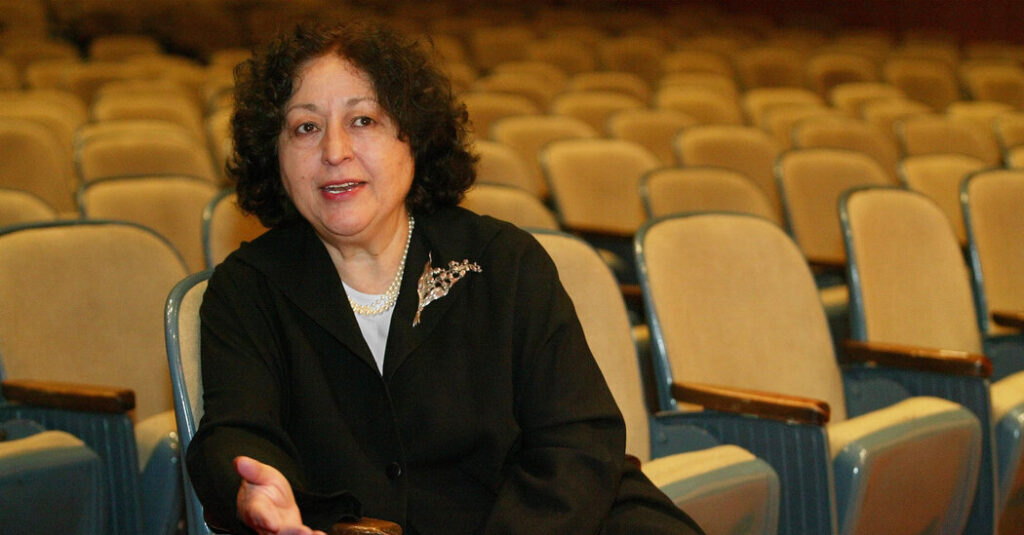
Hilde Limondjian, who spent more than four decades bringing music to the auditorium — and the galleries — of the Metropolitan Museum of Art in Manhattan, died on Jan. 24. She was 89.
Her death was confirmed by her sister, Jeanette Limondjian, who did not specify where she died. She lived in New York City.
Ms. Limondjian (pronounced lee-MONE-jun) was the director of the Met’s concerts and lectures series for 41 years, a period during which her fastidious taste melded with an instinct for using the museum’s vast resources to enhance her programming.
She was responsible for the New York debuts of renowned artists such as the pianists Peter Serkin, Garrick Ohlsson and Andras Schiff, the oboist Heinz Holliger and the singers Elly Ameling and Cecilia Bartoli. She boosted the fortunes of Orpheus, the acclaimed conductor-less chamber orchestra, and she cultivated new music by the likes of Steve Reich and Philip Glass.
Staging antiphonal music, Christmas concerts and a 12th-century Marian play in the Met’s medieval sculpture court, Ms. Limondjian was also an innovator in pairing music with era- or theme-appropriate art, a practice that is now standard at museums that also program the performing arts.
As a former art history major at Barnard College and a trained pianist who had studied with Edward Weiss, a pupil of the composer Ferruccio Busoni, she was well qualified to inhabit, and expand, the position.
When she started at the Met in 1969, she later told The New York Times, “I thought: ‘Well, the concerts take place in the context of the museum, but they’re all in the auditorium, and why? Why, when we have so many beautiful spaces in which we could match the music to the environment?’”
Year after year, she hosted mainstays of the New York music scene, including the Beaux Arts Trio and the Guarneri Quartet, establishing relationships with them so sustained as to be almost residencies. She organized performances of what is known as early music — written in the mid-18th century or earlier — before it was broadly fashionable.
Occasionally, Ms. Limondjian veered from her classical predilections, taking her younger assistants’ advice to bring in performers like Patti Smith, Nina Simone and B.B. King.
To attract new audiences, she also established hourlong piano recitals that began at 7 p.m.
“I thought it was more informal,” she told The New York Observer in 2010, after she retired. “And sure enough, in the middle of a sonata with three movements, after the first movement, everybody applauded. So that meant that they were new, because the old audience would just sit back. Which I think is silly — applaud, laugh, whatever you want to do.”
Museum officials, including Philippe de Montebello, the Met’s director from 1977 to 2008, commended Ms. Limondjian’s ability to attract top artists on a small budget, attributing it to her refined taste and serious commitment to the music. The artists she featured agreed.
“Her taste is impeccable, and she won’t let you just give a program,” the pianist Menahem Pressler, a founder of the Beaux Arts Trio, told The New York Times in 1994. “It has to mean something, has to have a line throughout.”
She also asked musicians to speak to audiences, which was at the time an unusual concept — “When I first went to concerts, I didn’t even know what musicians’ voices sounded like,” she told The Observer — and included lectures on the work that was being performed.
Fred Plotkin, an opera expert, recalled speaking about “Cavalleria Rusticana” and “Pagliacci” at Ms. Limondjian’s behest. “She was an impresaria, in that she created the vision and then filled it with the people who could be appropriate for that vision,” Mr. Plotkin said in an interview.
By the time Ms. Limondjian left the Met, in 2010, she had programmed more than 9,000 events, the museum said in the statement announcing her retirement.
“We have a citywide following. We attract the serious music lover,” she told the critic Tim Page of The Times in 1983. “When Peter Serkin plays Beethoven’s Diabelli Variations here, you can hear a pin drop.”
Hilde Annik Limondjian was born on Aug. 26, 1936, in Istanbul. After World War II, when she was 9, she and her mother, Violet (Hakian) Limondjian, a painter, joined her father, Hrant Limondjian, an importer of industrial machines and paper, in the United States, where her sister was born. They grew up in Forest Hills, Queens.
The family was related to the early 19th-century Ottoman-Armenian composer and music theorist Hampartsoum Limondjian, but was otherwise not musical.
Ms. Limondjian traced her love of music to a performance of Beethoven’s “Moonlight” Sonata that she heard on the radio when she was 11, according to a paid death notice published in The Times that she prepared herself, her longtime assistant, Debra Garrin, said.
At 13, she heard the great British pianist Myra Hess play at Carnegie Hall. Amid the wild applause at the end of the concert, the obituary said, “she felt a desire to be of support to Myra Hess and other musicians on the concert stage.”
After graduating from Barnard in 1958, Ms. Limondjian worked as a tour guide at the United Nations. In 1960, she went to work at the Met for William Kolodney, who had founded the museum’s concert series in 1954.
Nine years later, she succeeded him. “This has been my only work in my life,” she told The Times in 1994.
Ms. Limondjian is survived by her sister.
Self-effacing and discreet, Ms. Limondjian learned early on that her role was to support the performers. When the sitar virtuoso Ravi Shankar complained before going onstage that his shirt had not been ironed, she did it for him.
She also learned that it was better not to tell the musicians what to perform.
“I made that mistake my first year,” she told James Barron of The Times in 2003. “I stood back there and realized it wasn’t my dream performance. And since I only wanted dream performances, I realized never to put myself into the role of asking for a particular piece.”
Sheelagh McNeill contributed research.
Adam Nossiter has been bureau chief in Kabul, Paris, West Africa and New Orleans and is now a writer on the Obituaries desk.
The post Hilde Limondjian, Met Museum’s Longtime Concert Impresario, Dies at 89 appeared first on New York Times.