You’re reading Awakenings, a newsletter on religion. Click here to get the full edition in your inbox.
Julia Yost is a senior editor of First Things magazine.
This Easter, Catholic dioceses across America welcomed a surge of converts. According to data collected by the religion app Hallow, the average American diocese received 38 percent more converts this year than in 2025, with cohorts more than doubling in cities such as Los Angeles, Tallahassee and Pittsburgh.
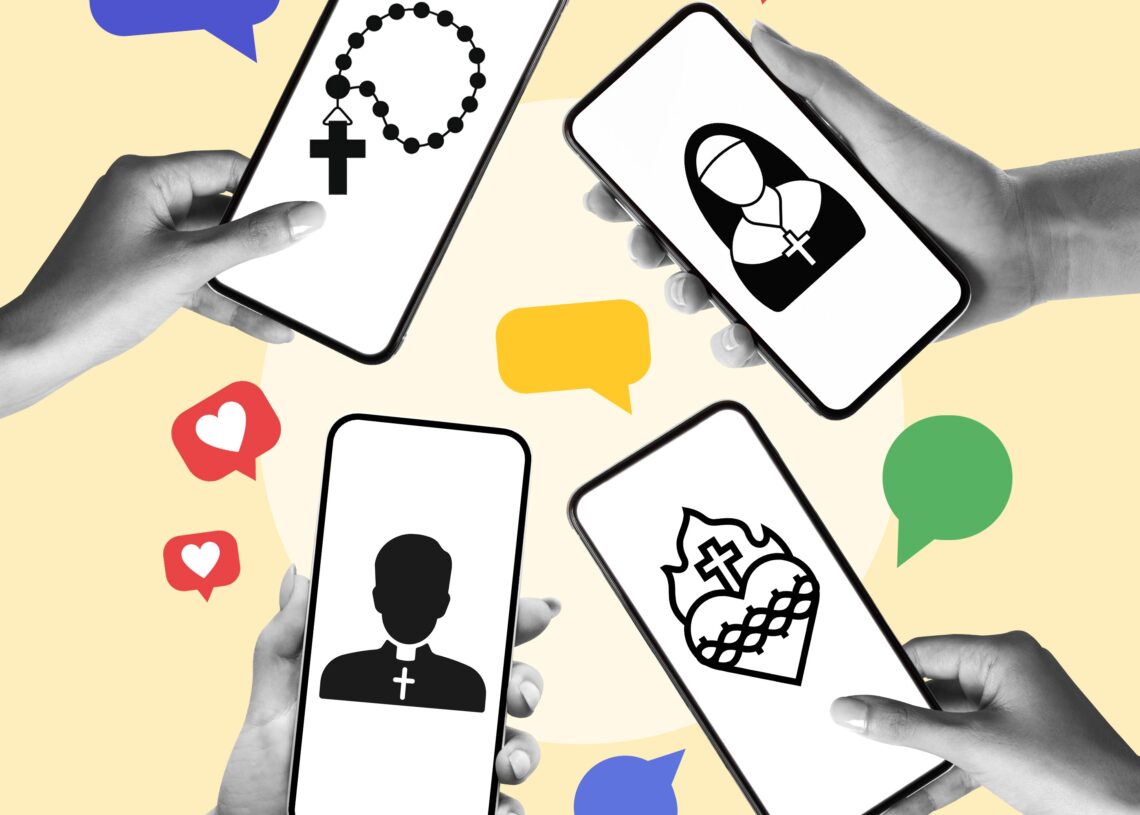
In many places, the converts are disproportionately young. These reports have encouraged talk of a religious revival in Generation Z and generated controversy on social media. Discussion has centered around the sudden prominence of a few “hot” churches, such as St. Joseph’s in New York’s West Village and St. Patrick’s Old Cathedral in Nolita. At these spots, young professionals mingle at post-Mass wine receptions. Meanwhile, Catholic social media influencers have helped make an ancient faith seem trendy.
Is Catholicism undergoing a revival? Not in broad numerical terms. A Pew survey suggests that for every young adult who joins the Catholic Church, a dozen leave it. This year’s conversion wave doesn’t come close to offsetting the decades-long decline in Church membership, or solving the problem of ever fewer infant baptisms. Indeed, the recent wave of converts is best understood as a response to religious decline. In a secularizing world, becoming Catholic has a rebellious cachet.
For most of American history, Christianity could be taken for granted as a cultural baseline. But amid growing secularization and religious pluralism, the name of the game is cultivating distinction — a “brand,” to use an odious and ubiquitous term. Public expressions of religious identity increasingly emphasize the outré, even incendiary gesture over the ecumenical. Catholic visuals are relished on social media for their exotic glamour (“drip,” in Zoomer parlance), and Catholic ascetical practices converge provocatively with looksmaxxing and thinfluencer disciplines (“Everything I consumed while fasting for Lent”).
The age of Instagram and TikTok favors Catholicism. An earlier era of the internet, that of the blogosphere, was congenial to Protestantism, with its biblical and exegetical basis. The result was the Young, Restless and Reformed movement — mostly male Protestants reading one another’s blogs and finding their way from seeker-sensitive evangelicalism to high-proof Calvinism. Today’s internet, by contrast, is image-forward and postliterate. This helps to explain why today’s online Christians tend to be Young, Restless and Roman.
Protestantism, which began as a revolution against idolatry — the whitewashing of church interiors, the stripping of altars — has image-aversion in its DNA. The visual language of American Protestantism is accordingly limited. White steeples, Puritan clothing, snake handling: not much for an influencer to work with. Catholicism has icons and incense; rosaries, chapel veils and ashes; priestly black, cardinal red and papal white. “Catholic drip” content, downstream of “Conclave” (the 2024 film about a papal election, praised for its costume and production design), enjoys intense engagement. An old stereotype has it that Protestantism is for people who read books, and Catholicism is for people who want spectacle. Say hello to Gen Z.
Is “hot” Catholicism a form of evangelism, or a perversion of the Gospel message? Jesus died for everyone, the cool and especially the uncool. But Catholic vanguardism is as old as modernity. Catholics have a history of being stigmatized in post-Reformation and post-Enlightenment societies, and of developing alternative forms of prestige. It is a useful history in a world that is increasingly hostile to Christianity.
In America, Catholics were targets of Know-Nothingism, the Ku Klux Klan and dual-loyalty allegations. In Britain, a confessionally Protestant polity that gradually became a bastion of rational liberalism, Catholicism was long the irrational other. With its celibate clergy and allegiance to the abstruse pronouncements of a foreign monarch, the Church represented all manner of social and sexual deviance. Catholics were spies, subversives and perverts — a term that originally denoted converts to stigmatized religions and acquired its current meaning in the 19th century, as imputations of homosexuality dogged converts to Rome.
Anglophone Catholicism thus became a resort for dissident elites. The 1845 conversion of Oxford theologian John Henry Newman set the pattern for generations of talented, disaffected university men. Few things so shocked the Victorians as when an Oxbridge gentleman “poped.” Naturally, most members of Oscar Wilde’s Decadent circle did it.
Today a conversion to Catholicism once again has a countercultural meaning. In its opposition to contraception, for example, the Catholic Church dissents more fiercely from bourgeois norms on sex than does any large Protestant body. So if infinite liberty leaves you with a hollow feeling, Catholicism has rules for life. Submission to the pope is rebellion against the man, at least in professional-class precincts. As a book editor recently told me, being Catholic seemed like “the most punk-rock thing I could do.”
People join the Catholic Church for all kinds of reasons — because they’re marrying someone already in it, or because their parents want them to. Is there such a thing as a bad reason to go to church? Presumably God wants to reach people who are driven by dissatisfaction with society, or even FOMO. In any case, the recent wave of Catholic converts are doing the work. They went through months of instruction to receive the sacraments, and those sacraments aren’t any less efficacious if you’re on TikTok.
The post Why Catholic converts are surging with an unexpected demographic appeared first on Washington Post.