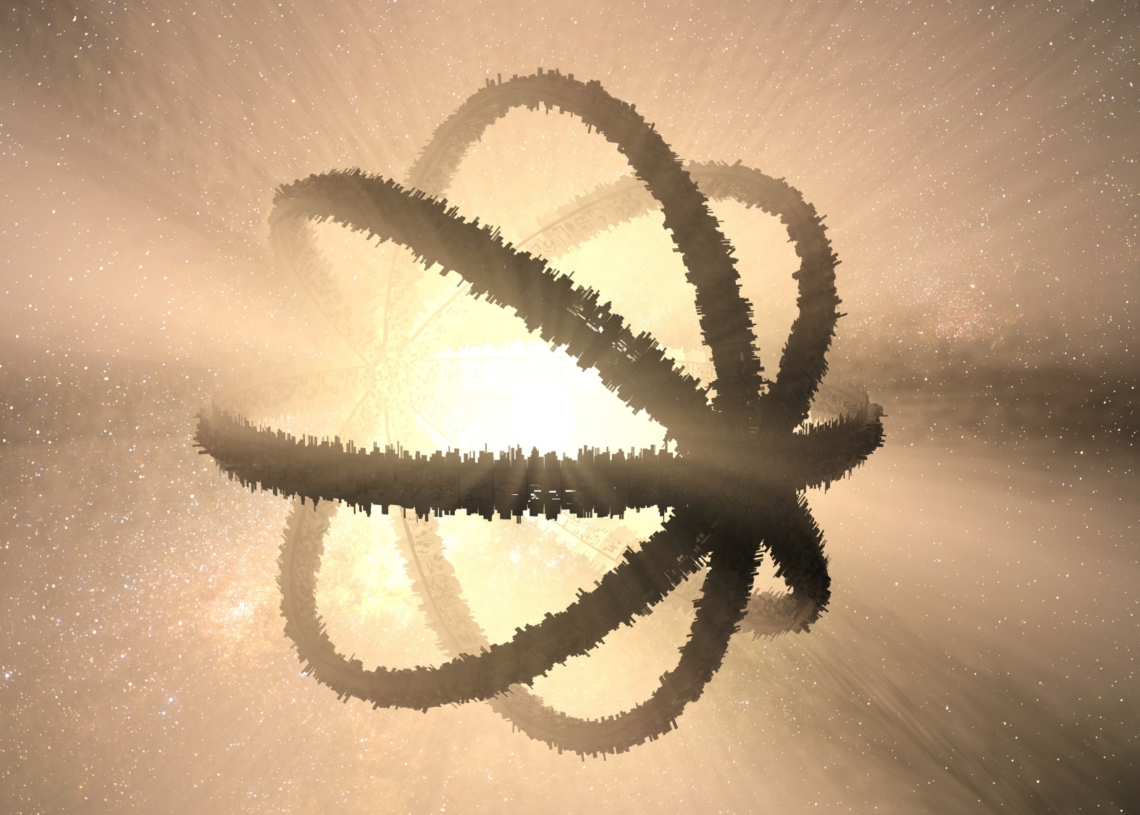
Alien megastructures are a fun idea, but they seem likely to collapse under the weight of their ambition. Vast machines that wrap around stars, encase entire planets, or even have the ability to push an entire solar system through space like a rocket ship so huge we can’t even fathom it. It all seems strictly confined to the realm of science fiction, but a study published in Monthly Notices of the Royal Astronomical Society this past January suggests that those ideas might not be as fantastical as they sound.
Research led by Colin McInnes at the University of Glasgow examined whether structures such as Dyson bubbles and stellar engines could remain stable over long periods. These are colossal, unimaginably huge construction projects that usually involve societies harnessing the full might and power of their host stars and their own highly advanced scientific and engineering know-how.
A Dyson bubble is a dense swarm of reflectors that surrounds a star, capturing an enormous amount of energy, way more energy than a single world could likely create on its own, and enough potential energy to fuel several planets’ worth of civilizations. A stellar engine could theoretically use radiation pressure to move an entire star system to steer several planets and a star or two away from some larger cosmic threat or toward a new region of space for whatever reason. Sounds like stuff that would be impossible to prevent from collapsing or drifting apart. McGinnis argues that it can work.
Theoretically, of course. At least for now.
Have We Already Missed Alien Megastructures in Space?
For instance, he and his team argue that stability would depend on the structure’s design. A stellar engine shaped like a ring, and the outer edge of that ring supported most of its mass, it can, theoretically, be stable enough not to rip itself apart. A Dyson bubble made of an incalculable number of small, lightweight reflectors could theoretically self-organize into a stable cloud that doesn’t have enough of its own gravitational pull to shred itself to bits.
McInnes suggests that all of this means that megastructures wouldn’t need constant maintenance to survive for thousands or even millions of years. If that’s true, it raises the eerily interesting idea that these gargantuan feats of engineering might theoretically already be out there, some of them maybe even outliving the civilizations that created them, like the titular halo from the Halo video game series.
I’ve used the word several times already, but it’s worth reiterating that this is all purely theoretical. That said, it is grounded in real physics, which is usually how science fiction eventually turns into science fact.
The post Is Space Full of Alien Megastructures We Just Haven’t Seen Yet? appeared first on VICE.