President Donald Trump said this week that the U.S. and Israeli attacks on Iran over the past six weeks were a “total and complete victory” for the United States, a declaration that came just a few hours after a tenuous, two-week ceasefire was reached.
Over the course of the war, the goals set by Trump and members of his administration appeared to shift. The president laid out some of the rationales in a video message at the start of the strikes, in which he said “Operation Epic Fury” aimed to ensure Iran never obtains a nuclear weapon, destroy the country’s navy and pave the way for Iranians to oust their government.
Though Trump said he achieved his goals, the war, for now, is only on pause. Experts weighed in on some of the objectives Trump outlined and what the president actually accomplished ahead of a U.S. meeting with Iranian officials Saturday to negotiate a longer peace deal.
1. Obliterate Iran’s missile industry
At the beginning of the war, Trump said in a video that the U.S. would destroy Iran’s missiles and raze the country’s missile infrastructure “to the ground.”
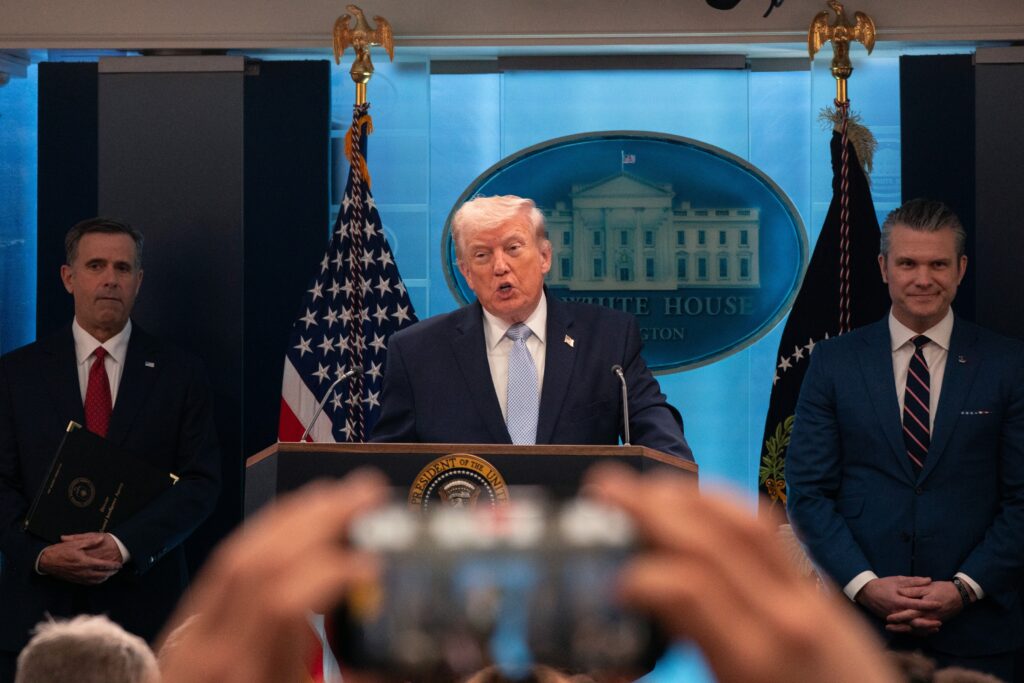
At a Pentagon news conference Wednesday, Defense Secretary Pete Hegseth claimed that the U.S. had “functionally destroyed” Iran’s missile program, as well as its launchers, production facilities and existing stockpiles.
“They can still shoot [missiles]. We know that. Their command and control is so decimated they can’t really talk and coordinate,” Hegseth said. “They still may shoot here and there, but that would be very, very unwise. But they can no longer build missiles, build rockets, build launchers or build [unmanned aerial vehicles].
“Their factories have been razed to the ground, set back in historic fashion,” Hegseth said.
Experts aren’t as convinced that Iran’s missile industry has been wiped out.
“For sure, the number of missiles coming out of Iran has dropped over the course of the war, but they’re still firing, and I’m assuming they can still manufacture [and] launch missiles,” Alex Vatanka, a senior fellow at the Middle East Institute, told The Washington Post.
An analysis publishedMonday by the Soufan Center, a nonprofit that provides research on foreign policy and global security issues, found that Iran is still firing “as many as 20 missiles a day at Israel,” and that “although numerically lower than early in the war, Iran’s missile and drone strikes are increasingly precise and lethal, and able to avoid interception.”
Tehran, the Soufan Center wrote, appears to be “using a variety of tactics to ensure its missile and drone arsenal remains available” beyond Trump’s initial two- to three-week estimatefor how long the war should last.
Nick Carl, a Middle East expert for the Critical Threats Project at the American Enterprise Institute, a conservative-leaning think tank, said Iran’s missile fire dropped by around 90 percent within the first couple of days of Trump’s attacks on Iran.
“The problem is that, even by reducing missile fire by like 90 percent, that’s still 10 percent that’s going out each day,” Carl said. “That poses various kinds of threats to us and partner interests. … It’s not at all clear to me that the U.S. military ever tried to bring Iranian missile fire all the way to zero, because that would have been an extraordinary undertaking that would have been extremely difficult to accomplish.”
Vatanka noted that Iran’s ballistic missile program is almost entirely homegrown. While Iran does need “ingredients coming in from places like China,” Iranians have been building their missile infrastructure since the 1980s, creating a powerful industry that he doesn’t believe has been obliterated, as the president wanted.
2. ‘Annihilate’ the Iranian navy
When he first launched the war in February, Trump said the U.S. was “going to annihilate” Iran’s navy.
At the Pentagon on Wednesday, both Hegseth and Joint Chiefs Chairman Gen. Dan Caine said that Iran’s navy had been obliterated.
“The Iranian Navy now lies mostly at the bottom of the Arabian Gulf, and we assess that we’ve sunk more than 90 percent of their regular fleet, including all of the major surface combatants,” Caine said. He estimated 150 Iranian ships, along with half of the Islamic Revolutionary Guard Corps navy’s small attack boats had been sunk.
“Joint fires projected from the land, sea and air executed more than 700 strikes against naval mine targets, and we assessed that we destroyed more than 95 percent of their naval mines,” Caine added. “And perhaps, most importantly, we’ve destroyed Iran’s defense industrial base, their ability to reconstitute those capabilities for years to come.”
Carl, of AEI, told The Post that the U.S. has successfully sunk “basically all of the major surface and subsurface combatants that the Iranians had fielded,” and that the U.S. has destroyed about half of Iran’s fast attack craft.
The U.S., he said, has caused “extraordinary degradation to Iranian naval forces, without a doubt.” The problem, he said, is whether that constitutes “our definition of annihilate.” Specifically, he said, what does an “annihilation” of Iran’s navy imply for the Strait of Hormuz, which remains blocked.
“Iranian naval forces have long played a critical role in endangering international shipping going through the Strait of Hormuz,” Carl said. “But it’s not the only tool on which the Iranians rely in order to disrupt maritime traffic.”
In fact, Carl noted, Iranian attacks in the strait on commercial tankers have been mainly through missiles and drones rather than mines or ships.
The U.S., Carl said, may have “made significant progress in destroying much of Iran’s naval capability and degrading the naval forces are at large.” The question of how to secure the Strait of Hormuz “is a bit broader, because the missile and drones play a significant factor here.”
Joseph Rodgers, a nuclear issues expert at the Center for Strategic and International Studies, noted that the U.S. and Iran may be waging different types of war.
While the U.S. has “pretty much destroyed the Iranian navy” and has left Iran with little air capability and missile defenses, Iranians are engaging in economic warfare with their shutdown of the strait, Rodgers said.
Though it may lack a sophisticated military, he said, “it doesn’t take much for Iran to be able to shoot down some oil tankers.”
3. Ensure Iran’s ‘terrorist proxies’ in the Middle East can no longer attack U.S. forces
Six weeks ago, Trump vowed that, as part of the strikes against Iran, the U.S. would “ensure that the region’s terrorist proxies can no longer destabilize the region or the world and attack our forces.” Though he did not name specific groups, he was likely referring to Hezbollah in Lebanon, the Houthis in Yemen, Shia militias in Iraq and to a lesser degree Hamas in Gaza, said Behnam Ben Taleblu, senior director of the Iran Program at the Foundation for Defense of Democracies.
Taleblu said “Operation Epic Fury” was focused on targeting Iranian military capabilities and capacity, and there was not a significant attempt to go after Iran’s proxies in the region.
“Indirectly, yes, [Trump] has been magnifying the military pressure the Israelis have been putting on Iran’s proxy network in the region by going after their patron in a meaningful way, militarily,” he said.
However, disagreements over Iran’s regional proxies threaten to undermine the fragile ceasefire. Israel on Wednesday ramped up bombing in Lebanon, ostensibly targeting Hezbollah but killing scores of civilians and injuring hundreds of others.
Both Israeli Prime Minister Benjamin Netanyahu and the White House said afterward that Lebanon was not included in the ceasefire, prompting Iran to threaten to withdraw from the agreement. Though Trump said he had asked Netanyahu to scale back attacks in Lebanon, Israeli forces launched a new wave of strikes targeting Hezbollah sites in Lebanon on Thursday.
4. Prevent Iran from obtaining a nuclear weapon
Trump claimed that Iran’s nuclear facilities were “totallyobliterated” last June, when the U.S. carried out strikes against three major Iranian nuclear sites in a mission dubbed “Operation Midnight Hammer.” The combat operations over the past six weeks were more focused on Iran’s military capability and less so at the country’s nuclear facilities. However, Trump said ensuring Iran does not obtain a nuclear weapon was one of his key goals for the conflict launched in February.
“If you marry the two [combat operations], the image you get is really an extended shelf life for the win that the president scored against the regime last June,” said Taleblu, who gave Trump credit for stopping Iran from uranium enrichment, a process required to produce a type of the element that can be used in nuclear weapons.
That said, enriched uranium remains in Iran. In a social media post Wednesday, Trump claimed the U.S. would be working with Iran to “dig up and remove all of the deeply buried” enriched uranium, but did not detail how or when that would happen. Iran also has not confirmed it is working with the U.S. to do so.
“I would be worried, ultimately, about what the regime would do with all this highly enriched uranium on its own territory,” Taleblu said. “Would they try to find a way to either bargain to save their life with it, or or potentially find a different way to tunnel and extract it and get it from underground. Who knows?”
Rodgers, from CSIS, told The Post that, from looking at satellite images of where this uranium is being stored, “it would be difficult to go in and grab it, because the entrances to these underground facilities are covered.”
“We’d have to basically bring in teams that would blow open the entrances to these facilities,” Rodgers said. “It would be a massive operation.”
Speaking at the Pentagon on Wednesday, Hegseth said the U.S. was aware of how much enriched uranium Iran had and suggested that the regime would either give it up or it would be seized. The Post reported Wednesday that the Pentagon has plans in place to seize Iran’s uranium, but that such a mission would be highly complex and dangerous.
5. Push for regime change
Trump made no secret of his desire for regime change in Iran and, at the end of his video in February, encouraged the Iranian people to seize their government after the initial airstrikes by the U.S. and Israel had stopped.
“It will be yours to take. This will be probably your only chance for generations,” Trump said then.
The surprise airstrikes on the first day of the war did kill Iran’s former supreme leader, Ayatollah Ali Khamenei, along with more than a dozen military and intelligence leaders. Trump is now claiming that Iran has “gone through what will be a very productive Regime Change!”
However, Khamenei was succeeded by his son, Mojtaba, a hard-line theocratic ruler whose selection was widely considered to send a message of defiance against Trump.
“Trump’s claim aside, there is little reason to believe that the ascension of Khamenei’s son to supreme leadership will lead to any dramatic change in the general policies and strategic orientation of the Islamic Republic,” said the AEI’s Carl.
Like his father, the younger Khamenei will also have the support of the Iranian Revolutionary Guards and its veterans, who have emerged over the past several decades as the most important class within the Islamic Republic, thanks to the decisions of the late supreme leader, according to Taleblu.
If anything, Taleblu added, the strikes have accelerated the path the regime was already on.
“At best what you can say is there has been a leadership change, not a regime change,” he said.
Taleblu said there was a low probability that the regime in Iran will surrender in the way the Trump administration wants it to.
“We really are going to be headed at this point for more tension in this relationship than a smooth road,” Taleblu said. “Again, I’ll stress, the regime is weaker than ever before, but it’s still lethal and still intent on revenge.”
The post Trump started the Iran war with 5 goals. How far has he gotten? appeared first on Washington Post.