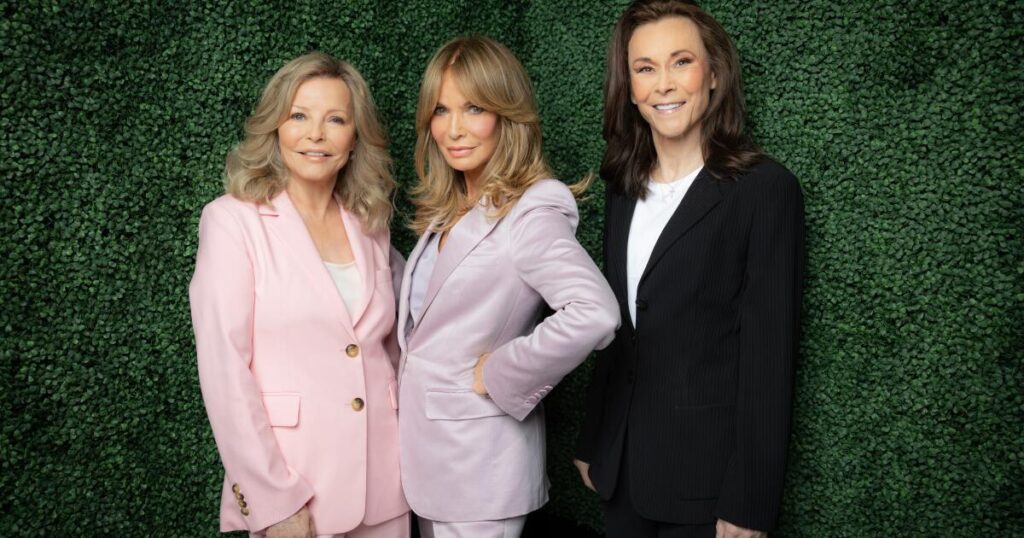
Once upon a time there were three women who starred in an ABC series about private investigators working for a mysterious boss they never saw. His name was Charlie.
“Charlie’s Angels” quickly became a sensation after its September 1976 premiere, turning Kate Jackson, Farrah Fawcett and Jaclyn Smith into major stars. Cheryl Ladd joined the show after Fawcett departed at the end of the first season.
Despite the network’s lack of enthusiasm and critics who dismissed it as “jiggle television,” “Charlie’s Angels” scored with viewers, as its depiction of intelligent and strong women overcoming the bad guys evolved into a pop culture phenomena. Lunch boxes and other merchandise with the stars’ images flew off of store shelves.
Jackson, Smith and Ladd are now taking a victory lap, reuniting for the show’s 50th anniversary. They received a rousing reception Monday from hundreds of adoring fans at the Dolby Theatre during the annual PaleyFest sponsored by the Paley Center for Media, and they will also be honored at the center’s black tie gala next month in New York. (PaleyFest runs through Sunday.)
“This is emotional,” said Smith before the Paley event. Jackson added, “We were just actresses doing a job. Who would have thought we would become such a huge part of popular culture?”
The drama, which concluded its five-season run in 1981, inspired two reboots: 2000’s “Charlie’s Angels” and its 2003 sequel “Charlie’s Angels: Full Throttle,” starring Cameron Diaz, Lucy Liu and Drew Barrymore, who produced the films. Another film, written and directed by Elizabeth Banks and starring Kristen Stewart, was released in 2019.
The Dolby audience repeatedly cheered as Jackson, Smith and Ladd shared backstage stories about the series, one of numerous TV hits developed and produced by Aaron Spelling and Leonard Goldberg.
They spoke fondly of Fawcett, who died of cancer in 2009. Much of the initial attention during the first season centered on the actress and her bountiful blond mane and sexy swimsuit poster. Feeling stifled by her “Angels” role, she later won raves for dramatic roles in films including “The Burning Bed” and “Extremities.”
They also gave tribute to co-stars David Doyle, who played the Angels’ handler John Bosley, and John Forsythe, who voiced the unseen Charlie. Doyle died of a heart attack in 1997 and Forsythe died of pneumonia in 2010.
Later in the panel, the Angels discussed their “sisterhood,” which was solidified with their individual bouts successfully fighting breast cancer.
Their obvious affection for each other has endured in spite of their different directions: Smith has a clothing, perfume and jewelry line that she promotes on HSN, as well as an upcoming memoir “I Once Knew a Guy Named Charlie.” Ladd is still open to acting if the right project comes along. Jackson left the business decades ago to be a full-time mother, but suggested during the panel she might be open to acting again as well.
In a pre-event interview, the actresses discussed the legacy of the series, how it impacted their personal lives and how they really felt about the “Charlie’s Angels” movies. The interview has been edited for length and clarity.
This must be an exciting time to be celebrating this anniversary of “Charlie’s Angels.”
Smith: Did I think it would have this reach or that we would be talking about it 50 years later? No way. I never thought it would become this big thing. It’s been a lot of years and we’re still good friends. We talk all the time.
I found a clipping of what our critic wrote in a preview of the fall season: “‘Charlie’s Angels’: Three women detectives so beautiful you’re surprised they can also talk. Watch them and ignore the trite plots. David Doyle gives good support. For girl watchers.”
Smith: The critics didn’t give us the value we deserved. They just saw the eye candy — that was all we were to them. But obviously we were more, or we wouldn’t be talking about it 50 years later.
Jackson: It was criticism instead of helpful critique which could have said, “Here are three actresses who are stars of the No. 1 TV show. It’s the pop culture phenomena of the 20th century. That’s not bad.” There were a lot of people who criticized the show without thinking about it. One said we were in bathing suits and wet T-shirts without bras. That never happened. None of us would have done that.
Smith: Absolutely not.
Jackson: And it wasn’t supposed to be a heavy show. I used to say “Charlie’s Angels” is so light, if you threw it in the air, it would take a week to hit the ground. Nothing wrong with that. It was entertaining and it will teach you something and you won’t even realize you’re learning.
Smith: And it was multigenerational. Families could watch it. It was a fantasy. Forget your worries, tune in.
What were your expectations in the beginning?
Jackson: I had been doing “The Rookies,” which was about three young male cops, so it was not a big step to flip that and be three young women.
Smith: I was innocent at that time. I just thought it was unique, that there was nothing like it on the air. That first season was an education, and it kept on being an education.
Jackson: I don’t think the network thought highly of the show. They thought it was a fluke and wouldn’t have any endurance. It will evaporate as soon as the closing of the first season.
Ladd: They were all wrong.
Smith: It refused to go away. And they ordered it again to still-higher ratings. Aaron Spelling had an instinct …
Jackson: He was a genius at casting.
Smith: Yes. And we’re all so different. Yes, we are Charlie’s Angels. But we’re different in looks and personality.
Ladd: It inspired so many women. It showed that women don’t have to be jealous of each other. That was so healthy for women, that we were there for each other no matter what. We cared about each other, we fought together.
Smith: We became a sisterhood.
Jackson: And it was that way even when the cameras stopped rolling.
Ladd: That’s right. A whole lot of female police officers have come to me every time I’m in a city and say, “Thank you for ‘Charlie’s Angels.’ I never would have become a police officer if it wasn’t for you.”
Smith: We gave women permission to be independent and not be defined by a man.
How soon into the first season did it register that this wasn’t just another TV show?
Jackson: It only took a couple of weeks. We couldn’t walk out the door without people following you, jumping in the car, trying to take pictures though the windows of the house, jumping over the walls of your house. It was startling.
Smith: We were rock stars. We couldn’t go anywhere.
Jackson: With movie stars, you’re bigger than life and people stand back a little bit. People on TV are invited into homes. So on the street, people feel free to come up, give you a hug and start talking to you. They feel as if they know you. You make friends when you don’t know you’re doing it. And they turn out to be friends.
Smith: Some of our fans are my friends. They’ve walked along with us and watched everything.
Cheryl, how were you processing that first season?
Ladd: I had worked for Aaron on a few things. So when Farrah decided she wanted to move on, he called me right away, sat me down and asked me to be on the show. I said, “Thank you, I appreciate it. But I don’t know if I would be able to fill those shoes.” He finally said, “I got it! You’re her little sister. So you’re already part of the family.” So I said, “I think that might work.”
Jackson: And it did work. We didn’t miss a beat. Not a step.
Kate and Jaclyn, were you worried it might not work?
Smith: I’m not going to deny it. We had a kinship, we had a friendship [with Fawcett]. So we wondered, “What the heck?” But once we met Cheryl, we fell in love. She was perfect. The first show of the season set in Hawaii was number one.
Jackson: And we’ve never been off the air. For 50 years, i’ts been on.
Ladd: Why aren’t we getting any more checks?
Smith: The merchandising alone was big. Lunch boxes, board games, dolls, lipstick, blankets, pillows, pinball machines.
Did you ever feel typecast?
Smith: Definitely. I got typecast a lot. I still feel typecast. Now I’m the older woman with a young guy. I would like a little departure from that.
Jackson: And Aaron had a habit of keeping us there all the time. So I couldn’t meet other producers and get into our heads that we could be movie stars.
Smith: One of my favorite roles was starring in the TV movie “Jacqueline Bouvier Kennedy” in 1981. When ABC recommended me, the director said, “I don’t want a ‘Charlie’s Angels’ for this role.” But I went in and tested for it and got it. I loved doing it because I admired her.
Ladd: My dream was to be on Broadway and sing and dance. And I got to do that. but I thought it’s never going to happen.
So I have to ask what you thought about the “Charlie’s Angels” movies?
Jackson: Most of the people who saw the movies didn’t know our show existed.
Smith: And the last one …
Jackson: Oh my God! We don’t count the last one. Elizabeth [Banks] made a mistake.
Smith: The girls didn’t support each other. Our show was about a sisterhood, loving one other, having each others’ back.
Jackson: There are certain rules you don’t break. Drew, Cameron and Lucy wanted to honor the show.
Smith: With Drew, the Angels were superheroes. I love Drew, and I did appear in the second movie. It was fun and kind of different. But it wasn’t our show. Ours was a fantasy, but it had a simplicity and innocence to it. Elizabeth went in another direction. I‘m sure we’ll be seeing them on Mars soon.
Do you watch the show?
Jackson: I haven’t in a while.
Smith: I do because my granddaughter asks to watch it. I don’t know if I would otherwise. But I might now. This has brought it all back. It brings back happy memories.
The post ‘Charlie’s Angels’ soars to a golden milestone appeared first on Los Angeles Times.