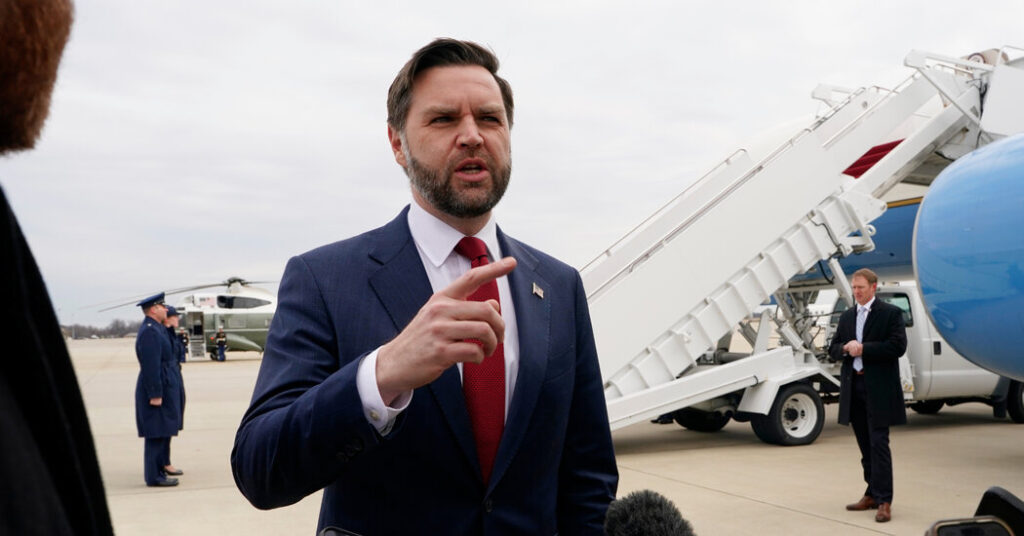
Weeks after Vice President JD Vance privately warned President Trump of the costs of a full-scale U.S. war with Iran, he is now leading the charge to negotiate an end to the biggest foreign policy crisis that the president has faced during his time in office.
Mr. Vance, along with Steve Witkoff, the president’s special envoy, and Jared Kushner, Mr. Trump’s son-in-law, are expected to travel to Pakistan on Friday to hold talks with the Iranians, as a cease-fire between the United States and Iran is under strain. It would be the highest-level meeting between U.S. and Iranian officials since 1979.
The stakes are enormous for Mr. Trump and for Mr. Vance, whose most high-profile assignments from Mr. Trump have involved domestic politics, most recently as the president’s “fraud czar.”
Before the war began, the vice president was planning to be heavily focused on traveling the country ahead of the midterm elections, counteracting widespread concerns over the cost of living and affordability by attacking Democrats as out of touch and politically extreme. The war has upended that messaging. An Iranian blockade around the Strait of Hormuz, a key oil route, has sent energy prices soaring.
“Knowing that this is a midterm election year, that is the biggest leverage point that the Iranians have, and they know that,” said Marc Short, who served as chief of staff to Vice President Mike Pence, Mr. Vance’s predecessor from Mr. Trump’s first term. “That creates a challenge for the president’s negotiating team.”
He added: “There’s a best-case scenario that you have successful talks, and you have a great news cycle about it. But doesn’t Iran know that they can break the terms, as they have in the past?”
Mr. Vance, 41, has stayed largely at the periphery of other high-stakes foreign policy missions, including the operation to seize Nicolás Maduro and depose him as Venezuela’s leader. He was traveling in Azerbaijan in February, when Benjamin Netanyahu, the prime minister of Israel, delivered a presentation requesting U.S. involvement in a war with Iran.
On Tuesday, as the president threatened to wipe out the Iranian civilization in Washington, Mr. Vance was in Hungary, stumping for Viktor Orban, the country’s nationalist prime minister.
He will now lead the effort to persuade Iranians to keep the strait open even as the Israelis continue a bombing campaign against Iran-backed Hezbollah in Lebanon, a conflict that the United States has said is not part of the current cease-fire agreement but is threatening to upend it.
His initial opposition to the war is appealing to Pakistani officials, who asked Mr. Witkoff for Mr. Vance to get involved, according to two people familiar with those discussions. The president then asked the vice president to lead the peace effort.
The coming days could be a delicate balancing act for Mr. Vance, who must work closely with Mr. Witkoff and Mr. Kushner, two people with deep ties to Mr. Trump who have been traveling the world on his behalf, as he tries to end the war.
Mr. Vance’s allies say his presence adds formality and heft to negotiations led by Mr. Witkoff and Mr. Kushner, whose fast-paced work is often conducted through constant phone calls back to Washington, and by writing, editing and circulating flurries of proposals. Mr. Vance is also joining a pair of negotiators who had failed to avert the war in the first place during an initial round of talks.
His involvement highlights the complex nature of the modern vice presidency: Unlike other cabinet members, Mr. Vance does not have a constitutionally defined role or an agency to run. For some people who’ve held the job, a lack of an established lane can be destabilizing and frustrating. As vice president, Mr. Vance has been content to be a “Swiss Army knife” with a willingness to go where he is needed rather than to ask for specific tasks, according to a person close to him who was not authorized to speak publicly.
But the vice president is the only person in the administration who can immediately be empowered to step into a high-profile diplomatic mission and speak as a direct emissary of the president.
“Because the vice president can pull all the strands together like no other cabinet member, it’s as close to a mirror to the president as you can get,” said Philip H. Gordon, who was the national security adviser to Vice President Kamala Harris. “The vice president doesn’t have to be central to anything, but when asked to undertake an important diplomatic mission, then the vice president is hugely empowered.”
In 2021, Ms. Harris was sent to France to smooth over relations with President Emmanuel Macron after the United States, Australia and Britain brusquely canceled out a lucrative and strategically important submarine contract that the French had with the Australians.
For his part, Mr. Trump has a history of sending his No. 2 to resolve thorny geopolitical disputes.
In 2019, Mr. Trump pulled an unsuspecting Mr. Pence into the Oval Office and told him to head to Ankara, the Turkish capital, and persuade the country’s president, Recep Tayyip Erdogan, to pull back his forces from northern Syria. Mr. Pence emerged after five hours of talks with a cease-fire agreement that the United States claimed as a victory. In truth, Mr. Erdogan refused to pull back from the enclave, gaining territory and displacing tens of thousands of Kurds in the region without paying a diplomatic price.
Mr. Vance is now tasked with helping resolve a conflict much larger in scale and complexity than the one Mr. Pence faced. Before returning to the United States on Wednesday, Mr. Vance told reporters that he had spent a lot of time working the phones trying to help secure a cease-fire, but said that the president would resume fighting if the truce did not hold.
“I sat on the phone a lot,” Mr. Vance said. He added: “I think the president has struck a good deal for the American people, but fundamentally, the Iranians have got to take the next step, or the president has a lot of options to go back to the war.”
For Mr. Vance, the elevated role could bolster but also complicate his political future.
“This reduces any opportunity he might have to distance himself from the policy if he’s going to be the lead negotiator,” Mr. Gordon said.
At various times in Mr. Trump’s second term, Mr. Vance has privately voiced disagreements with the president’s foreign policy. In a Signal chat message with other senior Trump officials early last year, Mr. Vance said that he thought the timing of a forthcoming Yemen operation was a “mistake” and appeared to question if Mr. Trump understood the potential consequences of the action, according to The Atlantic, which published parts of the exchange.
Mr. Vance has also close ties to some of the war’s most vocal dissenters, including Tucker Carlson, whom Mr. Trump attacked on Thursday along with a group of conservative critics, saying they had “Low IQs” and were “Hand Flailing Fools.”
As Mr. Vance nurtures his political ambitions, Mr. Trump has repeatedly floated Marco Rubio, his secretary of state and national security adviser, as another potential presidential candidate. Mr. Rubio, by contrast, has been much more aligned with and central to Mr. Trump’s foreign policy agenda.
In Islamabad, Mr. Vance will have his most high-profile test of negotiating on the world stage, and experts warn he faces a tall task.
“For all the presentation of the cease-fire as an agreement, it was a very narrow agreement on a cease-fire with everything else T.B.D.,” Mr. Gordon said.
He added: “It’s going to be an ugly, messy and incomplete process.”
Katie Rogers is a White House correspondent for The Times, reporting on President Trump.
The post Vance Faces a High-Profile Test of His Negotiating Skills With Iran Talks appeared first on New York Times.