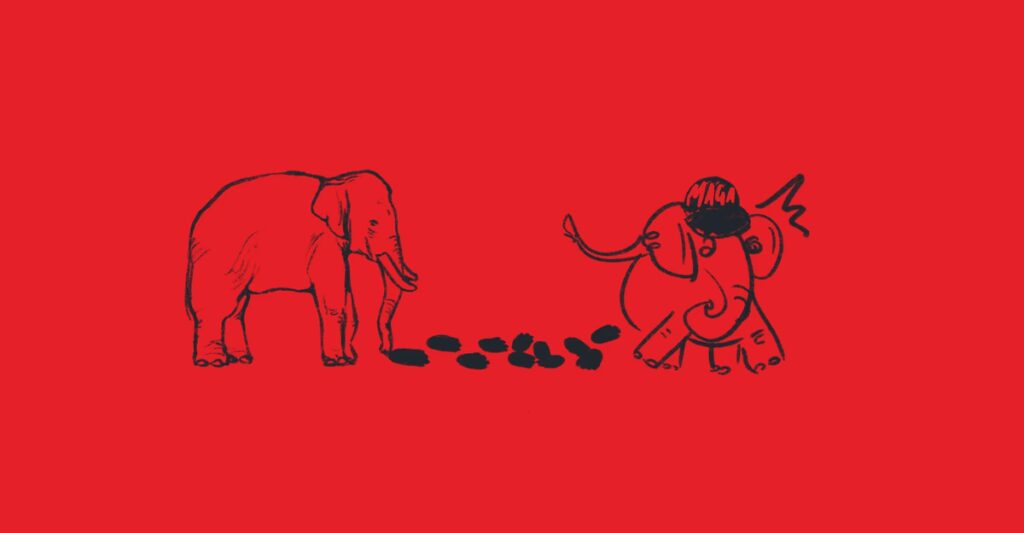
From the vantage point of a decade ago, Donald Trump’s current command over the Republican establishment today would be difficult to fathom. Even after he dispatched his rivals in the 2016 primary, the presidential nominee remained persona non grata. That year’s Republican National Convention filled its programming with second-raters (Scott Baio gave a prime-time speech), while Ted Cruz and other speakers refused to endorse Trump onstage; National Review famously published a special issue denouncing him. When outliers such as Jeff Sessions and Chris Christie straggled into his camp, their betrayal provoked mockery and outrage.
The party elites withheld their support for Trump due to concerns over his corruption, his affection for dictators and dictatorships, and his general unfitness for office. Those worries were borne out. And yet, nearly all of the party’s members have abandoned their qualms and fallen in line with a president who did every destructive thing they predicted. Why on earth would they do that?
John Tillman’s new book, The Political Vise, helps illuminate this still very unsettling question. Tillman is a mid-level, mainstream Republican operative who has worked mostly at the state level. The arguments he produces are shallow and largely familiar. But the very banality of the author and his reasoning are what make the book interesting as a source text: It reveals how traditional Reaganite Republican foot soldiers (and National Review, which gave the book a thumbs-up) made their peace with a figure they once found so repulsive.
“The Vise” is the organizing metaphor for Tillman’s argument, in which he posits that the American left has gained quasi-permanent control of American politics. Although his metaphor is original, the underlying case is not. Numerous conservatives have employed other conceits to illustrate the left’s supposed control of American life: “The Cathedral,” the “long march through the institutions,” the “Flight 93 election,” and so on.
All of those constructs serve the purpose of imagining the Democrats not as a rival coalition with opposing policies but as a unified, impersonal force that is always on the precipice of totalitarian control. This desperate situation leaves Republicans with no choice but to destroy that which threatens to destroy them. And if the instrument of destruction available to them is an imperfect vessel, so be it.
[Read: An anatomy of the MAGA mind]
Tillman has run a conservative pressure group in Illinois working for traditional party goals—lowering taxes, fighting unions, being tough on crime. He remains slightly uncomfortable about Trump, conceding that the president’s “pugnacious demeanor often made it easy for his enemies to rally against him” and that he “has not always behaved like a perfect gentleman” with women.
But Tillman also believes that the 2020 election was unfair. Conservative complaints about that election come in two broad categories. The strong version is Trump’s claim that the election was stolen through fraudulent ballots. The weaker version holds that the election was “rigged” by social media, liberalized mail-in balloting, and other stratagems, even if the vote count was technically correct. Tillman expresses openness to both theories. “We may never know the full extent of the manipulations that took place before, during, and after the 2020 election,” he writes. He justifies the January 6 attacks (“Without excusing violence, I note that when you squeeze ordinary Americans in a Vise, not all of them will comply with your demands”) and decries the sentencing of the rioters as excessive. “The Progressive Political Vise,” he asserts, using Trumpian-style capitalization rules, “worked to crush anyone who dared question the outcome of the 2020 presidential election.”
Tillman approvingly quotes Lenin’s call for his followers to seize the “commanding heights.” The difference, according to him, is that, unlike Lenin’s Communist revolution, the right-wing revolt will empower people who are good. “Those of us who love liberty can once again take control of the culture,” he writes, in a phrase brimming with Orwellian irony. (Any culture controlled by a political faction is, by definition, not at liberty.)
So how did a prosperous midwestern Republican proceed from wanting lower taxes to justifying a coup attempt? One answer is that the electoral failure of his traditional Republican positions has bred a suspicion of democracy. At one point, Tillman complains that “bureaucrats have worked hard to entrench Medicare,” and at another, he blames “the Vise” for stopping George W. Bush’s 2005 attempt to privatize Social Security.
The reality is that Medicare and Social Security enjoy fervent public support. The conservative movement has never accepted the legitimacy of those programs, but rather than recognize that public opinion has made them unassailable, it has turned against democracy itself. For better or worse, the failure to eliminate popular social benefits means that the political system is working as designed. Yet Tillman, like many other conservatives, attributes decades of frustration to shadowy forces.
A second explanation for this extremist drift is that the conservative movement has shut out information sources that challenge its own biases, sealing itself into a radicalization silo. Tillman dismisses mainstream media such as The New York Times and The Washington Post as partisan propaganda, boasting that “I laugh out loud” when anybody tells him that they trust those outlets’ reporting. Tillman relies on sources such as the late cartoonist Scott Adams, a prolific social-media poster known for endorsing conspiracy theories.
[Read: The intellectual edgelords of the GOP]
The effects of this unhealthy information diet upon Tillman’s critical-thinking skills leap off every page. He is, in particular, impervious to internal contradictions. “To keep the masses at heel,” he writes, liberals “warn constantly of an existential peril that is always just about to overtake our government.” Elsewhere, he warns of his opponents’ … existential peril: “We live in the period of greatest risk to our republic since the Civil War. The radicalized progressive left aims to apply the power of the Political Vise to subjugate those Americans who dissent from their worldview.”
Tillman urges politicians to “accept that your message didn’t carry the day and take responsibility for the loss,” but the only application he can find for this lesson in recent politics is the Democratic Party’s failure to accept the results of the 2016 election with sufficient grace. He casually cites Trump’s “record-high popularity” without bothering to explain what he means by that. (Trump’s approval rating at its best moments has never come close to the peak levels of Barack Obama, Ronald Reagan, and both George H. W. and George W. Bush.)
During one rant against cancel culture and its pernicious tendency to smear the innocent, Tillman brings up Joseph McCarthy as a prime example of a person whose reputation was unfairly destroyed. (That McCarthy’s most important contribution to reputation destruction might not be as a victim of it seems not to have occurred to him.)
The preface of the book is a George Orwell quote: “The Party seeks power entirely for its own sake. We are not interested in the good of others; we are interested solely in power, pure power.” It is supposed to be self-apparent that Tillman is describing the Democrats. Yet his book’s central point is that Republicans must recognize the Democrats’ ruthlessness and, as he writes, “cultivate that ruthlessness in ourselves.” Orwell’s perhaps most famous observation is that would-be despots employ their opponents’ abuses as propaganda to justify their own, turning themselves into the thing they decry. To this lesson, as to so many ironies screaming out from his prose, Tillman appears oblivious.
Although The Political Vise has little value as analysis, it offers a harrowing glimpse into how ordinary partisanship, when trapped for too long in an airless chamber of propaganda, metastasizes into outright authoritarianism. Tillman has taken the time to chronicle his own journey from a traditional Republican to a mouthpiece for an administration that aspires to lock up its foes, shut down independent media, and beat peaceful protesters.
The horror story of a man transforming into a monster is a familiar genre. So is the how-to guide. Rarely does a reader come across a work that manages to be both.
The post From Mainstream to MAGA in Two Easy Steps appeared first on The Atlantic.