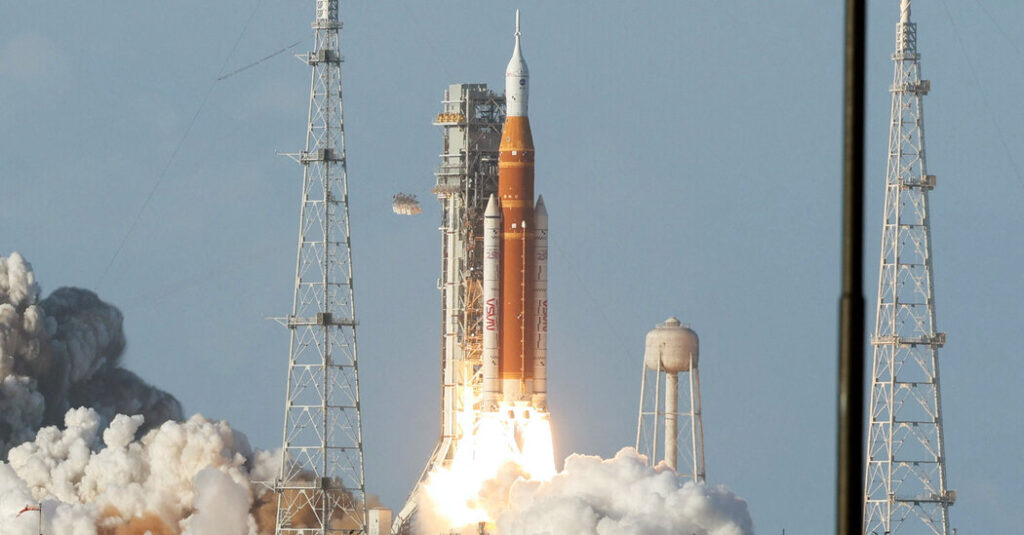
Like any great adventure, and especially one we can follow minute by minute, act by act, the flight of Artemis II, which is ending on Friday, has been gripping theater. That cramped cabin cluttered with hoses, equipment and bolts, the glimpses of a small, blue-and-white Earth in the distance, the astronaut Christina Koch’s floating hair, the sense that a new era of grand and perilous space exploration has begun — all make for a feeling of wonder and exultation at a time we badly need it.
But try as I might, I cannot resist the voice that keeps whispering, Yes, but we’ve been there before. I am of a generation (read: old) for which the first landing on the moon in July 1969 was a life-changing event with a far different import. Until Apollo 11, the notion of people stepping out onto a celestial body had existed only in Jules Verne novels or Marvel cartoons. “Fly Me to the Moon” was a Frank Sinatra love song, and home computers had not appeared. It’s hard — impossible, really — to reprise that extraordinary event 57 years and generations of technological advances later.
I can still feel the wonder staring up at the pockmarked moon on a hot, dry summer night in Oklahoma, trying to comprehend that there were actually two guys up there. The renowned news anchor Walter Cronkite recalled how he couldn’t find words to describe it: “I think all I said was, ‘Wow! Jeez!’ Not exactly immortal. Well, I was nothing if not human.” It’s still hard to find the words.
The context was so radically different. The elaborate computing required to reach the moon seemed almost mystically ingenious. I was being trained in Fort Sill at the time on an early military computer, a thing called a Field Artillery Digital Automatic Computer, or FADAC, that weighed about 200 pounds and required a dedicated generator to plot artillery targeting. Today, it could probably be replaced with an iPad, and even an ordinary car has at least 30 onboard computers. True, shooting people into space was not new — Yuri Gagarin’s first spaceflight came eight years before Apollo 11 — but nothing could really prepare the world for seeing men actually standing on the moon, with the little marble-like Earth in the background.
In his dramatic lead story for The Times about the first moon landing, under the huge banner headline “MEN WALK ON MOON,” the science writer John Noble Wilford described the sense of incredulity many felt: “People back on Earth found the black-and-white television pictures of the bug-shaped lunar module and the men tramping about it so sharp and clear as to seem unreal, more like a toy and toylike figures than human beings on the most daring and far-reaching expedition thus far undertaken.” (Conspiracy theories claiming that NASA faked some or all of the six crewed Apollo moon landings between 1969 and 1972 still circulate.)
It’s condescending, I know, and not fair, to put on been-there-done-that airs. The Artemis II mission is only the precursor of far greater feats, of a new era of space exploration, perhaps including a manned base on the moon and eventually a trip to Mars. Artemis has already broken one record of Apollo, reaching the greatest distance from Earth ever ventured by human beings: 252,756 miles, compared with 248,655 miles for Apollo 13 in 1970.
And after so long a hiatus in long-distance space travel, it’s wonderful that new generations can experience the humbling thrill of seeing Earth as “a grand oasis in the big vastness of space,” as the Apollo 8 astronaut and commander of Apollo 13 Jim Lovell put it, and the excitement of exploring distant worlds. None of the four Artemis astronauts — Reid Wiseman, 50, Victor Glover, 49, Ms. Koch, 47, and Jeremy Hansen, 50 — were alive when Neil Armstrong uttered that legendary phrase, “That’s one small step for man, one giant leap for mankind.” Nor, for that matter, when Eugene Cernan concluded the last mission of the Apollo program, No. 17, with a pledge for the future: “America’s challenge of today has forged man’s destiny of tomorrow. As we leave the moon and Taurus-Littrow, we leave as we came, and, God willing, we shall return, with peace and hope for all mankind.”
But there was a direct message from an Apollo veteran to the Artemis team. In words recorded before he died in August, Mr. Lovell said, “Welcome to my old neighborhood.” He added, “It’s a historic day, and I know how busy you’ll be. But don’t forget to enjoy the view.”
Eloquent proclamations and quips were de rigueur for astronauts of that pioneering era, and the current team has been trying hard to revive the tradition. Before the Orion spacecraft entered a communications blackout as it passed behind the moon, Mr. Glover, the pilot, said: “As we prepare to go out of radio communication, we’re still going to feel your love from Earth. And to all of you down there on Earth and around Earth, we love you, from the moon. We will see you on the other side.” Ms. Koch spoke of a new era in which people would not only step on the moon again, but live on it. “But ultimately, we will always choose Earth,” she added. “We will always choose each other.”
But then, as if to underscore that choosing space is no longer so exotic an option, the Artemis II astronauts had a collegial chat on their way home with colleagues orbiting Earth on the International Space Station. The I.S.S. has hosted people on board for more than 25 years, and the recent arrival of a Russian Soyuz spacecraft, largely unnoted, brought an American astronaut and two Russian cosmonauts, for a current total of 10 people onboard. A Chinese space station is also orbiting out there with at least three crew members. Will they be visiting each other on the moon before long? On Mars? Will we find that amazing?
The Times is committed to publishing a diversity of letters to the editor. We’d like to hear what you think about this or any of our articles. Here are some tips. And here’s our email: [email protected].
Follow the New York Times Opinion section on Facebook, Instagram, TikTok, Bluesky, WhatsApp and Threads.
The post Fly Me to the Moon appeared first on New York Times.