After venturing farther into space than anyone in history, four astronauts on NASA’s Artemis II are set to splash down in the Pacific Ocean off San Diego on Friday.
The Orion spacecraft will bring Reid Wiseman, Victor Glover and Christina Koch of NASA and Jeremy Hansen of the Canadian Space Agency back home after 10 days and a trip around the far side of the moon.
The splashdown ends the first crewed mission into deep space in more than 50 years. It is a significant step toward further space exploration and a new lunar landing.
Here’s what you need to know about Artemis II and its splashdown.
When is the splashdown, and how can I watch it?
The crew is scheduled to splash down in the Pacific Ocean at approximately 8:07 p.m. Eastern time.
NASA will stream video of the spacecraft’s return to Earth starting at 6:30 p.m. Friday. You can watch it on NASA’s YouTube and X accounts, as well as NASA’s website and smart TV apps. You can also watch it here on The New York Times’s website.
You can track the Orion capsule’s speed and distance from Earth on NASA’s AROW website. It shows a visualization of the capsule.
Will I be able to see the spacecraft return to Earth in California?
The spacecraft is not likely to be visible to those along the coast near San Diego as it falls through Earth’s atmosphere, said Rachel Kraft, a NASA spokeswoman. That’s because it will enter from the southwest over the Pacific Ocean and during daylight.
What happens during splashdown?
The teardrop-shaped crew module, which carries the four astronauts, is scheduled to separate from the service module, which powers and propels the spacecraft, at 7:33 p.m. This signals that the crew is preparing for re-entry into Earth’s atmosphere.
The separation will expose the crew module’s heat shield, which is designed to protect Orion from blistering temperatures as it races through Earth’s atmosphere.
The spacecraft’s speed will be nearly 24,000 miles per hour as it hits the atmosphere. It will then use parachutes to slow it to about 335 m.p.h., and then 20 m.p.h. or less. It will then splash down in the Pacific Ocean.
Following splashdown, recovery teams from NASA and the U.S. Navy will stabilize the Orion capsule and then help the crew board helicopters that will deliver them to the U.S.S. John P. Murtha. The crew will undergo medical evaluations on the ship before traveling back to shore. Eventually they will fly to NASA’s Johnson Space Center in Houston.
What happened during Artemis II?
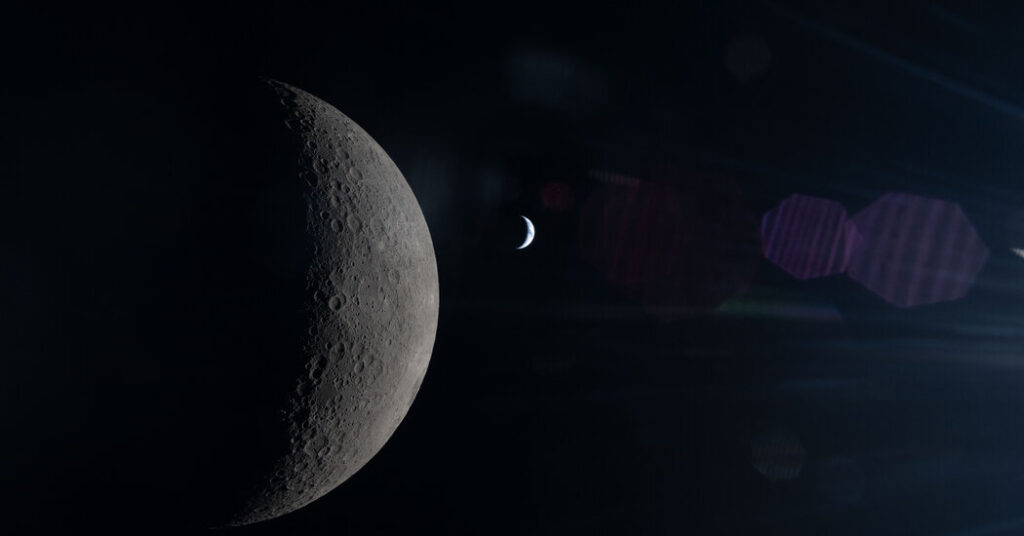
The Space Launch System, a massive orange-and-white rocket, launched the crew and their Orion capsule into space from Florida on April 1. On Monday, the crew went around the far side of the moon and observed parts of the lunar surface that had never been seen by human eyes.
The crew captured images of craters, smooth plains and other lunar features that will be studied for future moon missions. They named a crater after their spacecraft, which they call Integrity, and another after Mr. Wiseman’s late wife, Carroll Wiseman. After coming back around the moon, they witnessed a 53-minute solar eclipse.
The mission was also an opportunity for the crew to test new technology and equipment in space.
In the early hours of the mission, the crew tested Orion’s ability to execute docking maneuvers for future flights. The astronauts also tested new technology featured in their orange spacesuits designed to help them breathe for up to six days if the capsule depressurizes in emergency situations. They also had to troubleshoot glitches with the first toilet sent into deep space.
The round trip is expected to cover more than 695,000 miles from launch to splashdown.
Ashley Ahn covers breaking news for The Times from New York.
The post How and When to Watch NASA’s Artemis II Splash Down in Pacific Ocean appeared first on New York Times.