It might not come as a huge surprise that Western beauty standards are not much different today than they were 500 years ago: youth, rosy complexions, alabaster skin, flowing golden locks, soft curves adorned with jewels or enhanced by sumptuous finery, long slender limbs, comely smiles and modest gazes.
But what of beauty’s opposite, more malleable and imprecise, quality — ugliness?
A new exhibition titled “Bellezza e Bruttezza: Beauty and Ugliness in the Renaissance,” at the Bozar Center for Fine Arts in Brussels through June 14, argues that we cannot have one without the other, and that oppositional play between the two has shaped our aesthetic criteria for centuries.
Through 13 winding rooms with walls painted in rich, jewel-hued tones, over 90 works by masters of the Italian and Northern European Renaissance show what the curators describe as the “dynamic tension” between beauty and ugliness from the late 15th to the late 16th century — a time when the two qualities were increasingly juxtaposed.
It’s hard also not to use the word “beautiful” about many pieces in the show, which consists primarily of paintings, plus a handful of sculptures and objects, often depicting women.
In some instances, beauty symbolizes harmony. In a copy of a treatise by the Renaissance humanist Leon Battista Alberti, he theorizes that to make something beautiful — like a perfectly formed female nude — is to encourage order and virtuousness, giving the aesthetic a moral function. And in Albrecht Dürer’s “Four Books on Human Proportions” (1528), we see how the artist elaborately measured, named and numbered what he considered the ideal female body into dozens of horizontal slices.
Nearby, a large painting by Lorenzo di Credi (“Venus,” c. 1490) shows the goddess nude but for a diaphanous white veil wrapped around her body in elegant waves, just concealing her crotch and breasts — or one of them, at least.
Formally, she looks like she stepped out of Dürer’s tome; narratively, she is the Roman goddess of beauty (and love, desire, fertility, prosperity). Radiant, a literal ideal, she is nonetheless modest — an important quality, in a Renaissance context, for the truly beautiful to possess.
Beauty might also be a form of flattery in portraiture, as in Titian’s “Woman Holding an Apple” (1550-55), in which the painter invokes the goddess Venus to enhance the stature of his sitter, a real woman. She is fair-faced, red-lipped, with gold locks waving down over the shoulders of her velvety green dress and pale and delicate hands cradling an apple before her midsection — an allusion to the golden apple fatefully given to Venus by Paris, the Trojan prince.
A master of diplomatic enhancements, Titian also provided the Renaissance equivalent of a “glow up” to the visage of Charles V, the Hapsburg ruler who was both Holy Roman Emperor and king of Spain. The Venetian painter’s 1549 portrait shows a man with fine, dark features sitting with studious composure, a marked contrast with an anonymous portrait made two decades earlier in which the emperor is slumped and dead-eyed, with a large underbite and protruding chin.
In other rooms, the attractive contrasts with the hideous in the service of narrative or parable. A lovely young nymph surrounded by cherubim evades a demonic-looking satyr in Vincent Sellaer’s “Jupiter as a Satyr, Antiope and Their Children Amphion and Zethos” (c. 1530), and the goddess of fruit and vegetables regards the lustful Pan with disgust in the strikingly detailed “Pomona” by Frans Floris de Vriendt (1565).
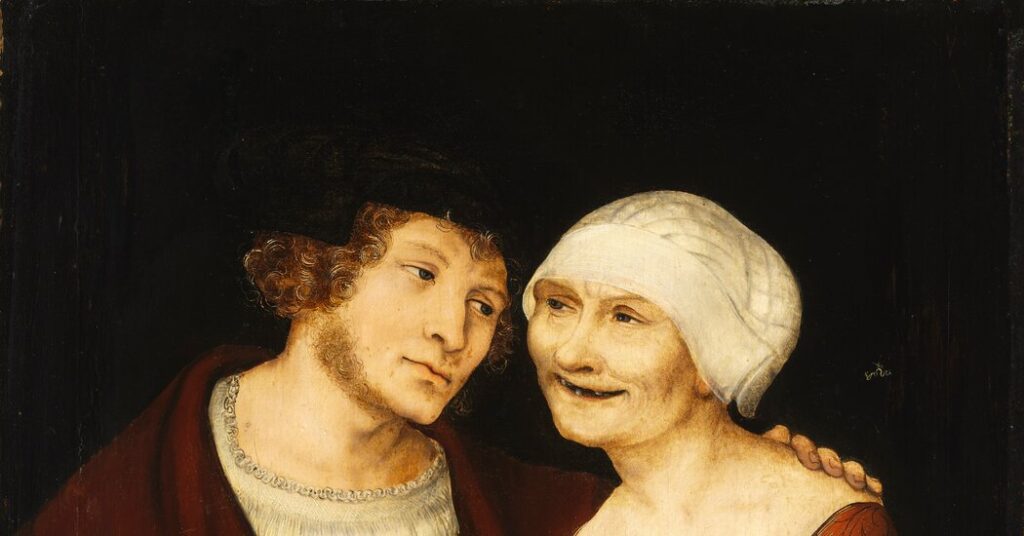
Or, more comical and extreme in human terms, a handsome young man or woman is coupled with an elderly and desiccated romantic partner clutching bags of money that their younger paramour sneakily reaches into: “Ill-matched Couple (Young Man and Old Woman)” (c. 1520-22) one painting by Lucas Cranach the Elder is titled, and, even more mocking, “The Older One Gets the More Foolish One Becomes” is the name of a mid-16th-century work by the Flemish painter known as Master of the Prodigal Son.
The lesson? Lustful old women are ugly and morally corrupt, easily fooled and parted with their money; wealthy old men should be wary of young women who use their beauty to blind and manipulate. (Another common theme: Beauty is not quite to be trusted.)
The displays focusing on “ugliness” are less straightforward and sometimes tread in ethically dubious waters — perhaps because of the language we now use to describe a wide variety of human bodies and faces, as well as emotional and mental states, as positive rather than negative, and the wise edict that beauty is in the eye of the beholder. (In spite, of course, of the trend for people to surgically alter themselves to look rather identical.)
We see portraits of toothless “elderly” women — including one tired-looking sitter with jowls, described as “Portrait of a Lady Aged 54” — with dun and saggy, wrinkled skin, hooded eyes and a pocked visage. There are leering peasants and drunken revelers; tax collectors whose faces appear twisted with avarice; a mentally ill person having “the stone of madness” removed from his forehead; a woman with hypertrichosis (a genetic condition that causes fur to grow all over the body); and a famous Florentine dwarf named Morgante, whose major sin seems to have been a large potbelly.
Are these ugly scenes? Certainly, in the sense that they reveal certain eternal prejudices about character and looks, like in Peter Bruegel the Elder’s 1559 “Proverbs,” a raucous painting filled with figures illustrating human folly or wickedness.
Yet, in this exhibition, even the “ugliest” images are painted with the utmost care and detail. They are thrilling to behold and, you could say, beautiful.
Bellezza e Bruttezza: Beauty and Ugliness in the Renaissance
Through June 14 at the Bozar Center for Fine Arts in Brussels; bozar.be.
The post Why Beauty and Ugliness Go Hand in Hand appeared first on New York Times.