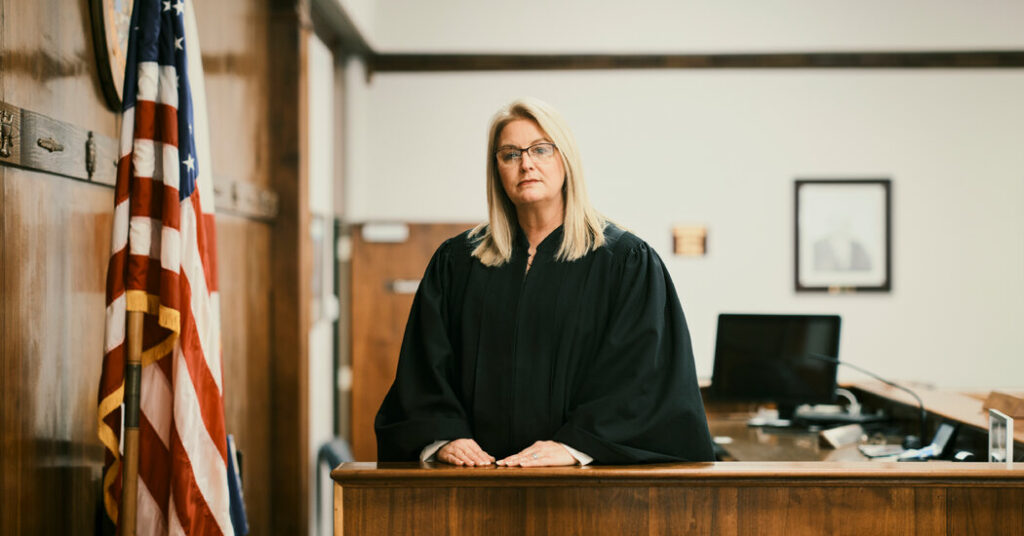
In an animated video, a man in an American-flag-print face mask who called himself “the Patriot” tracked his target, Judge Jennifer Johnson, with a hatchet in his hand.
The man followed a cartoon version of the judge, who sits on a county court in rural Florida, down a sidewalk as he muttered insults about her appearance and shared personal details about her marriage and children. Then he announced that it was “takedown time.”
“Judge Johnson, let’s bury the hatchet,” the man said, striking his virtual target in the back until she fell to the ground. Then he swapped the hatchet for a gun and shot her in the head. As blood pooled around her corpse, the man celebrated her “execution.”
Judge Johnson knew exactly who had made the video, which was uploaded to YouTube and TikTok in September 2023. The man had been threatening her since soon after she heard his child dependency case in 2016, at one point calling her “target number one.” But local authorities had told her that his incessant social media posts and phone calls were too legally “gray” to act on, she said.
So she bought a gun, as the sheriff had already advised her to do, and enrolled in courses to learn how to shoot it. When the video was posted, she installed a home security system, altered her daily travel routes and stopped sitting with her back to the door in restaurants or in the same pew at church.
“I was treated like threats were part of the job,” Judge Johnson said. “But it should not be a part of the job description to deal with threats of violence against your person. I didn’t sign up for that.”
For judges across the country, threats and harassment have become an inescapable occupational hazard. The Department of Homeland Security issued a nationwide alert late last year to law enforcement agencies: Harassment of judges has surged, and the trend is likely to continue.
The New York Times has identified thousands of threats targeting state judges in the past three years alone, among more than 14,000 broader security incidents involving state courts and their employees across the country. These figures offer a look at a problem that has historically gone uncounted because of a lack of record-keeping; they almost certainly understate the true scale, given that many states fail to formally track the issue.
Some of the violence is high-profile: In January, Judge Steven Meyer and his wife survived a shooting at their home in Lafayette, Ind., an attack that the police said was orchestrated by a defendant in an upcoming domestic battery case. In 2023, a Maryland state judge was shot and killed in his driveway, and in 2022, a retired Wisconsin state judge was killed in another targeted home attack.
But many more incidents never reach the public. Records show that state judges have been subjected to stalking, death threats, physical assaults and assassination plots. They have reported being struck in the head, shot and pelted with feces.
Threats are also on the rise against federal judges, of which there are around 2,700. Such threats have more than doubled in four years, from 224 cases in 2021 to 564 in 2025, according to the U.S. Marshals Service.
But there is no centralized security force that tracks threats against the estimated 30,000 state judges who are on the front lines of some of the most contentious cases in the country. Nor is there the same mandate to protect them.
Federal judges benefit from high-level threat monitoring and subsidized professional home security systems. But state judges typically rely on local law enforcement agencies for help and pay out of their own pockets for those services.
In interviews, some state judges said they had spent thousands of dollars to protect their homes after receiving death threats. Many said they felt that local authorities were not equipped to properly investigate such threats, and that they themselves were not given enough security training. Several state judges said that local authorities had admitted to not having the resources to protect them at all times and advised them to arm themselves. A 2024 judicial survey of hundreds of state judges found that nearly a third of respondents reported carrying a gun for protection since taking the bench.
Ever since she took the bench as a lower-court judge in 1998, Chief Justice Loretta Rush of the Indiana Supreme Court has been the subject of harassment, including threats of vehicle sabotage, a bomb scare and graphic threats to burn her alive.
Justice Rush said that judges had always been targeted but that she had never seen a climate like the present. The danger isn’t just personal, she said, but a structural threat to the American legal system.
“The idea of shooting a judge because of the role they have fundamentally affects what it means to live in a free society,” Justice Rush said.
Judicial Independence at Risk
There is no conclusive research on why threats against judges are on the rise, although they are part of a larger national trend of rising political violence. Some federal judges have pointed to President Trump’s rhetoric — he has slammed judges as “disloyal” and recently called on lawmakers to pass a crime bill that “cracks down on rogue judges.” But other judges said they did not blame Mr. Trump and instead pointed to a broader, corrosive distrust of public institutions and increased partisan tribalism. Judges in rural areas where everyone knows everyone say they feel particularly vulnerable.
Even when harassment does not escalate to physical harm, the psychological toll can be profound. It may be difficult for judges to be impartial if their decision-making is clouded by concern for their or their family’s safety.
“These threats affect the independence of our judiciary and people’s willingness to serve,” said Julie Kocurek, a state court judge in Texas. In 2015, she survived an assassination attempt in her own driveway by a man who had a case pending in her court. Local authorities had been made aware of a death threat the man had made shortly before, but dismissed it as “not credible,” a police officer later testified at trial. The shooting resulted in extensive wounds to her face and body and the loss of a finger.
The Times requested data on threats directed at judges from all 50 states from 2020 to 2025. Many do not track that information systematically. However, an analysis of 15 states that provided specific data on judicial threats revealed a surge, with threats climbing in all but two of them.
In Texas, general court-security-related incidents, which include seized weapons, disorderly conduct and physical assaults, jumped from 447 in 2023 to 2,129 in 2025. In New York, judicial security investigations more than doubled from 204 cases in 2020 to a peak of 514 in 2024, and remained at high levels with 487 new cases opened in 2025. In New Jersey, threats against judges have climbed from 444 in 2023 to 550 in 2025. In Pennsylvania, threats against judicial officials have grown from 104 in 2022 to more than 200 annually ever since.
And even before the shooting in Indiana, a 2023 court survey of 214 judges in that state found that 159 had been the subject of threats, with jurists reporting litigants who brandished firearms during remote proceedings or vowed to set them on fire.
Ron Zayas, the chief executive of Ironwall, a company that contracts with courts to provide data protection and security services, said the number of what he considered credible threats of violence against the state judges his company supports rose by more than 40 percent in recent years. Death threats among them have increased by 65 percent since 2024, with women and judges of color bearing a disproportionate burden.
In interviews, surveys and legislative testimony, judges recounted confrontations at churches, election sites and hair salons. Despite some legislative efforts to shield judges’ privacy, in many states their homes remain vulnerable targets. Incident reports from just the last six months in New Mexico, for example, revealed a plot to assassinate a jurist at his home, coordinated over jail phones, and a separate case in which a woman tracked down a judge’s personal address to confront her over a custody issue.
Judges consistently report feeling inadequately protected. In a 2024 randomized national survey published in Court Review, the quarterly journal of the American Judges Association, more than half of 398 state judges who responded reported receiving threats of harm. One judge reported receiving a letter threatening the rape and murder of her family, but said the police didn’t follow up on it; another reported sleeping with a shotgun for about two weeks before authorities arrested a neighbor who had threatened to infiltrate his home.
Half of the judges surveyed reported receiving less than a day of official security training, far less than what the U.S. Marshals offer federal judges.
In 2024, after the murder of a retired judge by a former defendant, Wisconsin jurists testified in support of a package of security bills. The Wisconsin court system documented 232 threats against judges in the year preceding the hearing, 114 of which were direct threats of physical harm or death.
One judge described an attempt by a divorce litigant to hire a hit man from jail, while another recounted how litigants had photographed her home and scared her children. Another judge testified that a man who had also tracked down her home address online entered the courthouse and left her a pound of leaking raw meat accompanied by a note: “Here is some burger to fry and burn like you burned me.”
In interviews, judges across the country described having to take measures to protect themselves because local law enforcement agencies did not have sufficient resources.
Vivian Medinilla, who recently retired as a state judge in Delaware, said she and her staff began receiving telephone calls with death threats against her and her children in 2021, but state court security would not act on them, telling her that they did not rise to the level of a crime. After she thought she heard someone in the back of her home, she purchased and installed her own home security system. She said she wished the authorities had conducted even a cursory investigation.
“Follow up and come back and tell me that you at least looked into it,” she said. The state agency that oversees Delaware court security declined to comment on her account.
Judge Carroll Kelly, who presides over domestic violence cases in Miami, received threats from an Army veteran last year after she issued a risk protection order that temporarily took away his firearms.
County law enforcement officials posted a patrol car outside her house after she learned of the threat. The next morning, they notified her that they believed the man had driven past her house in the middle of the night. A multiagency team gave her a blunt assessment: “If he wants to get you, he is so highly trained, he’s going to get you,” she recalled.
Terrified, Judge Kelly packed a bag and decamped to a hotel for five days. Soon law enforcement officials delivered more bad news: They were sorry they couldn’t guard her home indefinitely and said she should think about getting a gun. She ultimately paid out of pocket to install an expensive home security system.
“We have no resources for judges when this happens,” she said. “We’re really out there alone.”
A Terrifying Video
When Judge Johnson joined the Dixie County court in Florida in 2015, the small-town dynamics there made her a direct target for those unhappy with her decisions.
Family law is the most dangerous judicial assignment, experts say, because the intimate nature of domestic disputes can pose a greater risk of targeted violence, especially when adjudicated in small-town courthouses without tight security. Judge Johnson said she had received other threats, but Christopher Cambron, the man who would later call himself “the Patriot,” stood out from the rest.
Mr. Cambron had started threatening her after she heard his 2016 child dependency case, a civil court proceeding that determines whether a child requires the protection of the state. She had issued a security order against him after he threatened state child protection team workers, inspiring his fury. The harassment persisted for years.
He called Judge Johnson’s office and left rambling, vitriolic messages about her appearance and her divorce, she said. She became even more alarmed, she said, when he attacked her on social media, called her an “inbred pig” and said judges like her needed to die. None of his threats were specific enough to warrant a law enforcement response, Judge Johnson said the sheriff’s office told her.
But in the September 2023 video, Mr. Cambron declared that the time to execute Judge Johnson was “today.” He somehow knew how Judge Johnson wore her hair when she wasn’t in court — up in a ponytail, instead of down and blow-dried.
Still, the authorities did not take action. Because Mr. Cambron had moved to Louisiana by then, local authorities told her they didn’t have jurisdiction, so Judge Johnson spent months pressuring a state-level law enforcement agency to help. Judge Johnson said she pleaded with them to conduct a simple “knock and talk” check at his home to assess how serious a threat he posed.
The Dixie County Sheriff’s Office and the Florida Department of Law Enforcement did not respond to requests for comment.
There is a high bar for what constitutes a true threat under the First Amendment. But the police don’t always have the staff, resources and training to fully determine whether a threat is credible. Even the most well-meaning local police departments are organized around making arrests after a crime occurs instead of intervening earlier to neutralize threats beforehand, said John Muffler, a retired U.S. Marshal who is now a private security consultant.
“I hate to say it, because I respect the law tremendously, but I don’t think that they took it seriously,” Judge Johnson said.
But Judge Johnson continued to push. In February 2024, five months after the video was posted, a Louisiana police officer knocked on Mr. Cambron’s door.
He readily admitted to the officer that he had created the video, according to police records of his interview. His goal, he said, was to inspire “fear.”
But the police officer’s visit changed the investigation’s momentum. “He came back and was like, ‘No, no, this is legitimate,’” Judge Johnson recalled. “And the fire got lit.”
Mr. Cambron was arrested and extradited back to Florida, where he was charged with “written or electronic threat to kill.” A jury convicted him and he was sentenced to 15 years in state prison.
During the trial, the defense argued that Mr. Cambron was “trying to redress his grievances” through the video, as was his constitutional right.
“The First Amendment is very valuable, and most of all for people saying unpopular things, especially things that criticize people in power,” said his lawyer, Yancey Burnett, in a recent interview. “And if we can’t do that, then the First Amendment doesn’t mean that much.”
In court, the prosecution countered that the Constitution did not give people the right to terrorize others. “You do not have the freedom to claim that you’re going to execute someone,” the prosecutor told the jury.
A Push for New Laws
Some states find the political will to enact tougher judicial security measures only after a tragedy occurs.
Following the murders of judges in both states, Maryland and Wisconsin enacted laws in 2024 to, in part, scrub jurists’ home addresses from the internet and establish more centralized systems to track threats before they turn deadly. Texas offers some of the country’s strongest protections for state judges because of the near-fatal failure in Judge Kocurek’s case.
The 2020 murder of U.S. District Judge Esther Salas’s son, Daniel Anderl, by a gunman at their home in New Jersey became the catalyst for a namesake federal law that helps judges remove their personal data from the internet. But there is still no comprehensive national legislation. This year, a bipartisan group of lawmakers hopes to pass a bill that would establish a national resource center providing state courts with more technical assistance and threat-tracking infrastructure.
But the most difficult shift, judges said, may be cultural: moving away from the idea that threats are a standard occupational hazard.
After Mr. Cambron’s conviction, Judge Johnson began speaking out for the first time, sharing her story at judicial conferences. She said she was stunned by the flood of colleagues who came forward with their own accounts.
“I’m not going to tell you where that line is between viable threat and First Amendment, because judges fight for the First Amendment and the Constitution,” said Judge Johnson. “But I wish the public understood that these aren’t just threats to judges. They are threats to authority, democracy and our nation.”
Georgia Gee contributed research. Steven Rich contributed data reporting. Nicholas Bogel-Burroughs contributed reporting.
Katie J.M. Baker is a national investigative correspondent for The Times.
The post State Judges Turn to Guns in New Era of Judicial Threats appeared first on New York Times.