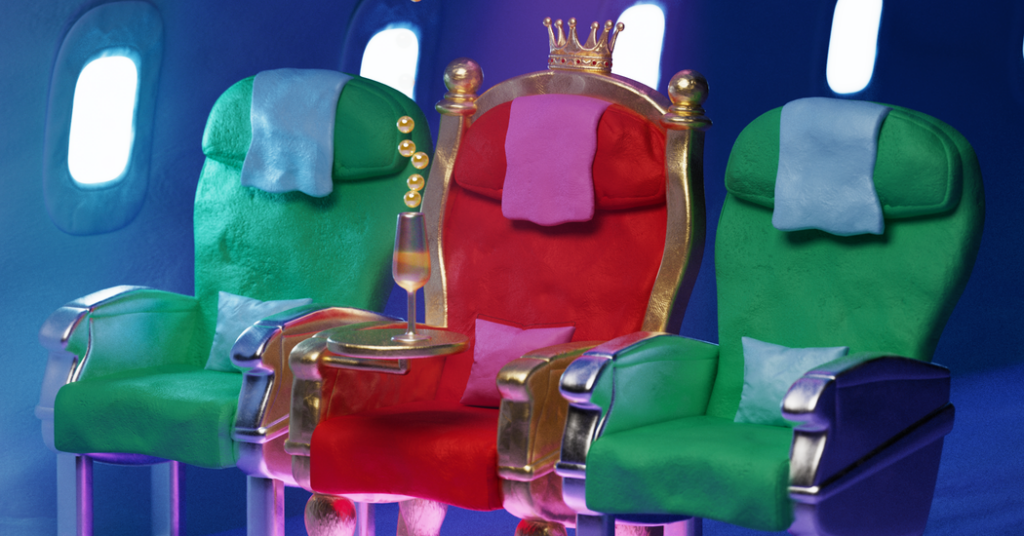
Twenty years ago, Delta Air Lines was giving away its best seats.
Back then, only about 15 percent of first-class passengers paid for their seats, while most of the rest were loyal customers the airline had upgraded for free. Delta has since flipped the script: Today, it sells over 70 percent of those prime seats, a shift that has helped it become the most profitable airline in the United States.
“When you think about where the industry was 20 years ago, or where Delta was, we basically just sold main cabin seats,” said Joe Esposito, Delta’s chief commercial officer. He added: “What we all thought back then was, ‘Can you make a premium product that people are willing to pay for?’”
The answer has been a resounding yes. Airlines have become much better at selling those nice seats to travelers, and customers have grown much more willing to pay for them.
The biggest U.S. carriers — American Airlines, Delta and United Airlines — have invested billions of dollars to redesign planes with more cushy seats and services. Even budget carriers like Spirit Airlines and Frontier Airlines are getting in on the action. Southwest Airlines, which for decades let passengers sit where they wanted, has no business class but recently started assigning seats in part to sell some with extra legroom. The company expects the change to increase its operating profit by more than $1 billion this year and even more next year.
In the past decade, the number of premium seats on U.S. airlines has grown 69 percent, according to Cirium, an aviation data and research firm. The number of main economy seats, which still dominate most planes, increased 43 percent.
The push to sell more premium seats could be risky. Competition among airlines can lead to an oversupply of seats and flights, which can hurt profits, especially during economic downturns.
But American, Delta and United are not concerned. Those airlines say they have geographic advantages and deeply loyal customers. Demand for premium seats remains high, and besides, executives said, airlines make decisions for the long term.
“We’re not going to plan around a recessionary environment,” Andrew Nocella, United’s chief commercial officer, said in an interview. “That happens every once in a while, but it’s not the norm.”
The definition of a premium seat is expanding, too. In the past, the term was used for first- or business-class seats that offered more space and nicer food and drinks. Today, the best premium seats can be downright lavish, with fully flat beds, huge screens and privacy doors. They typically come with access to airport lounges and more loyalty points than economy tickets do.
But airlines have also added more options on the lower end, like premium economy cabins on international flights. Those offer better food and more comfortable seats that are wider, have more legroom and recline farther than those in regular economy.
Consider a direct, round-trip flight between New York and Paris a month from now. On Delta, the cheapest economy ticket runs about $1,000. Premium economy costs about $3,000, and Delta One, the airline’s business-class seat, costs about $5,000.
To fliers of a certain age, some parts of the modern premium experience were standard on major carriers not that long ago. As recently as the 1990s, most American travelers enjoyed free checked bags and complimentary food, including hot meals on some domestic flights.
The people who now buy premium seats often say they do so because airports and airplanes have become especially chaotic and cramped.
The popularity of premium seats is also a function of rising economic inequality. More than 90 percent of Delta’s revenue comes from consumers who have an annual household income of more than $100,000, well above the national median.
Affluent Americans have amassed trillions in wealth since 2019 and want to spend it on travel, Delta’s chief executive, Ed Bastian, said at an investor conference in December. “There’s no sign that they’ve had their fill of that,” he said. “In fact, it’s at every demographic, every age level.”
Hooked on Legroom
In the past, premium seats were typically occupied by business travelers. But since the Covid-19 pandemic, when passengers sought out more space, leisure travelers have been buying such seats in greater numbers.
Younger people also place a high value on experiences, airline executives say, while older people with large investment portfolios have amassed significant wealth in recent years. Many people have become more comfortable with paying more for a better trip.
“Coming out of the pandemic, people really decided, ‘I need to start spending my time and my dollars on experience,’” said Nat Pieper, American’s chief commercial officer. “The air part of the journey became as critical, frankly, for some folks, as the destination.”
Delta and United, the other leader in industry profits, have been expanding their premium options for years. Last month, United revealed details of a major fleet overhaul, with plans to add 250 new jets full of high-end seats and improved technology over the next two years. Offerings include luggage closets for first-class fliers on shorter flights and lie-flat seats in private suites on longer ones.
“Postpandemic there has been just a surge in the demand for our premium products,” Mr. Nocella told reporters last month. “It’s across the board. It’s happening in all of our hubs, and it’s happening in business destinations as well as leisure destinations.”
American has lagged Delta and United in its premium offerings and profitability, but it is also investing heavily. The airline is taking deliveries of new planes with more high-end cabins and adding premium seats to the planes it already has. By the end of the decade, it expects to have 50 percent more lie-flat seats.
“It’s not just new aircraft deliveries,” Robert Isom, American’s chief executive, said at an investor conference in March. “It’s also that we’re reconfiguring just about every aircraft that isn’t new.”
Changing plane layouts is expensive and can take years across a large fleet. And the decision must be made carefully because airlines typically keep seat configurations for roughly a decade.
‘People Don’t Like to Downgrade’
The demand for premium seats was always there, airline executives said. But to capitalize on it, they had to adjust how tickets were sold.
Historically, tickets were often sold by travel agencies or websites like Expedia, where customers typically shopped on price alone. That made it difficult for airlines to persuade customers to spend more. So carriers spent years increasing direct sales.
By controlling the booking process on their own websites, airlines could offer fares that included perks like free checked bags or priority boarding. Such bundles have been a huge success, said Jay Sorensen, who runs IdeaWorksCompany, a consulting firm that works for airlines and other aviation businesses.
“Direct online selling enabled airlines to be far more creative than they could be in the past in how they present their products,” Mr. Sorensen said.
Since 2019, a growing number of travelers on the biggest airlines have been willing to pay more for business and premium economy seats.
Count John Rossi, 68, among them. In 2022, Mr. Rossi took his son on a trip to Germany, Belgium and France as a college graduation gift. After years of flying in economy or premium economy, he splurged on a business-class seat on United. The experience was eye-opening.
When he flies internationally now, he often books business- or first-class seats so he is more rested and ready to explore when he arrives.
“I felt like I earned my stripes,” he said. “I flew coach so many times.”
Globally, each business- and first-class seat earns about 3.4 times as much as an economy seat, according to Julia Seiermann, the head of industry analysis at the International Air Transport Association, a trade group representing the global airlines.
Mr. Pieper of American said: “Basically, 30 percent of our inventory on airplanes I would classify as premium. And it’s generating 50 percent of our revenue.”
Airline executives said they weren’t too worried about a collapse in demand for premium seats in a severe recession. They reasoned that economic contractions are typically short-lived, and wealthy customers who buy premium seats may be more resilient in a recession.
Besides, demand for those seats appears to be incredibly durable, with room to grow. Delta has said the vast majority of customers who try a premium cabin seat book another. And airlines say demand has so far remained strong so far despite the disruption and higher prices caused by the war with Iran.
“People don’t like to downgrade,” Mr. Esposito of Delta said. “Once they’ve been in a nice cabin, their natural inclination is to stay there or go even higher.”
Niraj Chokshi is a Times reporter who writes about aviation, rail and other transportation industries.
The post First-Class Seats Drive Airline Profits. It Wasn’t Always This Way. appeared first on New York Times.