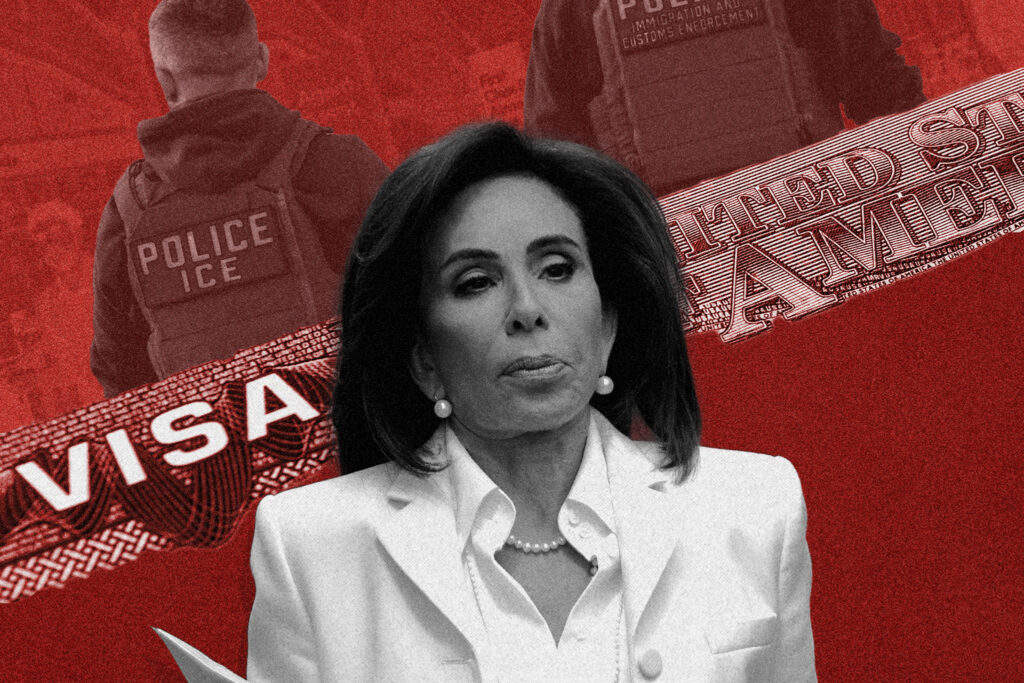
The U.S. attorney’s office in D.C. recently worked through a large backlog of applications for visas available to immigrant crime victims after spending most of 2025 refusing to process them.
The suspension compounded already existing distrust in public safety authorities among immigrants, which remains a lingering problem even as U.S. Immigration and Customs Enforcement arrests in the city have declined from their peak.
Immigrants without legal status who are victims of serious crimes are allowed to seek a “U visa” in exchange for their cooperation with police or prosecutors in the investigation or trial, offering a path to permanent legal residency in the interest of public safety.
As the Trump administration ramped up immigration enforcement in D.C. and across the nation last year, the U.S. attorney’s office in D.C. stopped routinely processing those visa applications without explanation — a decision U.S. Attorney Jeanine Pirro reversed after learning about it, according to her office.
Immigration attorneys, immigrants and aid organizations said in interviews that the pause implemented in early 2025 under then-interim U.S. attorney Ed Martin undermined the purpose of the U visa program as immigrant crime victims were already struggling to trust local police, who have visibly patrolled with federal officers since August.
“Ultimately what that leads to is that it’s going to be a decrease in victim cooperation with law enforcement, which is the very purpose of the U visa program — which makes every one of us in D.C. more at risk of becoming victims of violent crime,” said Deepa Bijpuria, supervising attorney in Legal Aid DC’s immigration division.
U visas, along with a similar visa for undocumented human trafficking victims, were created in 2000 to “strengthen the ability of law enforcement agencies to investigate and prosecute cases of domestic violence, sexual assault, trafficking” and other serious crimes, as U.S. Citizenship and Immigration Services describes it.
As part of the visa application, either local prosecutors or police — and, in some cases, judges — can certify that an immigrant was helpful in an investigation. D.C. is unique in that its local prosecutor is the U.S. attorney’s office. While that office put a blanket halt on U visas from early 2025 through August, policies within the D.C. police department added further roadblocks, ultimately preventing an unknown number of immigrant victims from seeking a U visa from either agency.
One obstacle was a long-standing refusal by D.C. police to certify U visas in cases in which an arrest has been made, a policy that appears to be in defiance of federal guidance. Those applicants are instead referred to the U.S. attorney — which became unworkable for those applicants when the U.S. attorney’s office stopped certifying. Under a newer policy, officers also began requesting a photo ID from U visa applicants, in many cases a passport, which attorneys say deterred at least some immigrants from moving forward.
The result was a breakdown in this piece of the legal system for an untold number of immigrant crime victims last year, advocates say.
“There’s an entire class of victims of horrific crimes and violence that could not move forward with requesting a certification,” said Michaela Lovejoy, who serves on the U visa committee at the American Immigration Lawyers Association’s D.C. chapter.
Pirro started as U.S. attorney in D.C. in May, months after the office had stopped certifying applications. She told The Washington Post through a spokesman that, when she discovered in August what was happening, she ordered the employee in charge of the division overseeing U visas to immediately begin processing the applications. He did not obey the order, and she demoted the employee, replacing him in September with a longtime victims’ services prosecutor who prioritized restarting certifications, spokesman Tim Lauer said. Pirro later accepted the demoted employee’s resignation.
The office, which had a further pause on U visas due to the government shutdown lasting over a month in the fall, said it was able to complete a backlog of 137 certification requests early this year and, since January, had processed an additional 23 requests. Bijpuria and others welcomed the recent developments and said they finally saw movement on long languishing applications.
Lauer said Pirro, a former district attorney in New York, “champions the U visas and believes they’re essential. She says it is about victim protection and creating an orderly society where victims are protected [regardless] of their legal status.”
The D.C. police department said, in cases of reported crimes involving undocumented immigrants in which no arrest was made, that officers still processed roughly 200 U visa certifications in 2025, similar to 2024.
A department spokesman encouraged “anyone in need of help, or anyone who witnesses a crime, to contact us immediately,” adding in a statement that “public safety is a partnership, and that partnership has helped drive significant reductions in crime over the last two years.”
The spokesman did not answer questions about how the department is working to address a major obstacle in that partnership — distrust within immigrant communities — or about department protocols regarding coordination with federal officers.
In a D.C. Council hearing last month, interim D.C. police chief Jeffery Carroll acknowledged that federal officers can and do enforce immigration law in some cases while on joint patrols with D.C. police. Several cases in which interactions with D.C. police ultimately led to immigration detention are under investigation, including one in which a man was detained by ICE after arriving at a D.C. police station to retrieve the car he had reported as stolen.
Carroll told council members in the hearing that, while that case is still under investigation, the alleged facts did not sound good. He acknowledged significant work ahead to rebuild trust.
“There are officers that have been out here every single day trying to deal with the situation, and to deal with it as tactfully as possible, that are now going to be left after this very challenging situation to then rebuild that trust,” he said. “So we’re trying to do what we can now to continue to build trust. And I understand the challenge.”
For immigrants, the decision to cooperate with police comes at two junctures: whether to call 911 at all, and whether to continue participating in an investigation — both of which became far more complex last year. The fear can have deadly consequences: Nationally, in at least two cases — one in Californiaand one in Virginia— women who were eventually killed by their partners did not report domestic abuse to police because they feared deportation, their friends or family said.
For one D.C. resident, an undocumented immigrant from El Salvador and survivor of domestic violence who spoke on the condition of anonymity for fear of retribution, the decision of whether to call the police felt like “un arma de doble filo,” she said — a double-edged sword.
Her abuser, who is the father of their 5-year-old son, had long threatened to take the boy away from her and never return. On a Friday this past summer, she thought her fear was realized: Without her knowledge and against court visitation rules, he had taken him to New York.
“For me, it was like two options,” she said in Spanish. “Either I call the police and make a report, or I stay quiet and act like nothing happened, so that the child comes back home and the police don’t call immigration.”
She decided to stay quiet.
A weight of fear
The decision makes sense only in a Washington where immigration enforcement has become so visible, and so entwined in people’s minds with local policing. After a week of paralyzing anxiety, her son returned home.
The 35-year-old came to the United States in 2005, fleeing El Salvador with her younger brother as gangs tightened control over their neighborhood.
After arriving and finding cleaning work, she entered a relationship with a man who became abusive. By the time she tried to leave, she was pregnant.
When their son was just 2 months old, she said, she almost died after he choked her to the point of convulsing.
“I don’t know how I came back,” she said. She ran out of the apartment, disoriented and terrified, leaving everything behind — even, for a moment, her baby — before returning because she had nowhere else to go.
In 2023, she said, she found the strength to leave for good. But today, her life has begun to contract again under a weight of fear tied to immigration enforcement.
She avoids certain streets, drives farther for groceries and no longer takes her two children to parks, museums or the zoo. Passing law enforcement officers can trigger panic. “My God, make me invisible before the eyes of these people,” she says as they approach.
The feeling is common across D.C.’s immigrant communities, even more so for survivors of violent crimes.
A second undocumented D.C. woman, who also spoke on the condition of anonymity out of fear of retribution, said she rarely leaves home. In August, she quit her restaurant job in D.C. after officers entered workplaces and customers stopped coming. Immigration agents have waited outside her building late into the night, she said. Neighbors have been detained.
She no longer uses public transportation after an encounter with federal agents left her “dying of fear,” she said. She avoids speaking Spanish in public. When her children walk to school, “you entrust yourself to God,” she said — “that they will get there safely, and come back safely.”
Her fear is twofold, she said: The man who assaulted her at her former Virginia workplace in 2024 also lives in D.C.
She reported the assault the day it happened. A forensic exam found traces of his DNA, she said. Her attacker was arrested and charged but ultimately released after prosecutors told her that they did not have enough evidence to secure a conviction.
“I trusted the police,” she said. Now, her sense of safety is fractured. Her abuser recently started contacting her again. If something were to happen, she said, she would no longer risk turning to the police.
“With this change, you don’t know who can trust,” she said, referring to local police coordination with federal law enforcement.
‘A twisted system’
While the Fairfax County prosecutor did not pursue a conviction in the case, the office did certify a U visa, allowing her to move forward with the application.
In D.C., however, the same process was far more challenging for victims in similar circumstances last year.
Immigration attorneys said they began experiencing problems with U visa processing at the U.S. attorney’s office in D.C. during the Biden administration in late 2024. Communication, typically swift and efficient, became inconsistent, and U visa requests began to lag, attorneys said.
Then, Donald Trump took office as president. Problems worsened and requests were going unacknowledged, attorneys said. Finally they received some clarity. In March 2025, multiple attorneys say, they received written communication from the office that all U visa certifications were put on pause. No reason was given.
Some attorneys began appealing to the D.C. police.
Many had long been rankled by the department’s policy declining to certify U visa requests if an arrest was made in the victim’s case. “It’s just kind of a twisted system where you can get a certification simply because you never had justice in your case,” Lovejoy said.
USCIS allows departments to develop their own protocols for certifying U visas. Still, the D.C. police policy appears in conflict with the federal agency’s guidance. Police are encouraged by USCIS to certify U visas for crime victims at any stage of the investigation, regardless of whether an arrest has been made or the case is still open.
But the department did not budge on the policy even when immigration attorneys informed officers that they could not go to the U.S. attorney’s office. Lovejoy said an officer informed her the policy exists because, after an arrest, police have no way of knowing whether a victim will continue to be helpful to prosecutors, even though that is not the standard laid out in federal regulations. Police are not asked to predict whether a person will continue to cooperate, only if they have cooperated.
A D.C. police spokesman defended the policy in a statement but did not address the disconnect with federal guidance.
“Once an arrest is made, it’s prosecutors, not detectives, who have firsthand information on victim or witness cooperation,” the statement said.
Some attorneys and victims were also taken aback by requests for a photo ID to certify, especially as deportations increased. This policy, as well, is not a federal requirement.
Genevieve Augustin, an attorney at Carecen, which aids immigrants in visa cases in D.C., said many undocumented immigrants lack a photo ID other than a passport, which they may be hesitant to relinquish because it could prove useful in a deportation proceeding. “The thing is, because that’s never been sought before, that was a very big concern,” she said.
A D.C. police spokesman said in a statement: “Identification is requested to ensure that names on certification paperwork are aligned with identification in police reports, helping speed up the certification process.”
Challenges evident nationwide
A 2025 analysis by the Cato Institute, a libertarian think tank, found that, from 2017 to 2023, immigrants cooperated with law enforcement in 5.1 million cases — contributing to nearly half a million criminal arrests, including about 300,000 violent offenders. In that period, about 50,000 to 70,000 people per year applied for U visas.
That pace held up overall in the 2025 fiscal year, which includes the last few months of the Biden administration, with more than 60,000 petitions filed during the 12-month period that ended in September, according to data published in March by USCIS. But there was a steep drop-off in U visa petitions in the last quarter as Trump’s deportation agenda dramatically escalated. From July to September, the agency received just 7,450 U visa petitions, compared with about 20,000 during each of the first three quarters.
Asked for an assessment of the decline, USCIS spokesman Matthew J. Tragesser said the agency was focused on “rooting out fraud in these programs to help women and other survivors of abuse,” charging that the Biden administration allowed rampant “exploitation” by applicants with unfounded claims that could clog up the system.
Attorneys handling these cases argued that it was distrust and fear that fueled a hesitancy to apply. While previous administrations granted applicants deferred action — or a temporary shield from deportation — the Trump administration ended that policy, leaving applicants unprotected from deportation, they said.
Across the country, multiple U visa applicants — many of whose petitions passed an initial review — have been detained and in some cases deported, said Gina Amato Lough, directing attorney of Public Counsel’s Immigrants’ Rights Project. The practice prompted an ongoing lawsuit.
“It’s important to remember that the U visa exists to keep communities safe,” Amato Lough said. “Yes, it does help undocumented people, but the actual objective is to help law enforcement do their job.”
Attorneys and immigrant crime victim advocates in the D.C. area did not report known cases of detained U visa applicants. Still, many had clients afraid to pursue one.
Augustin, at Carecen, said she encountered about two cases a month in which an immigrant crime victim decided against seeking a U visa due to distrust.
Many others, Augustin said, decided they were too afraid to contact police at all.
Lovejoy said that in one case, she had a client whose daughter returned home after being abducted and assaulted. The father sought legal advice about whether it was safe to go to the police. It was early September, as Trump’s grip on the D.C. police remained firm. Lovejoy began making inquiries — and was told by a D.C. officer that her client should consider holding off reporting the crime until things died down.
The father and daughter never reported the crime.
The post As ICE ramped up in D.C., immigrant crime victims faced visa roadblocks appeared first on Washington Post.