After years of uneven attempts to play global peacemaker, China’s role in this week’s U.S.-Iran ceasefire suggests that its long bid for influence finally may be starting to land. But with the truce still fragile, Beijing is in largely uncharted territory and remains cautious about taking on a messy war of America’s making.
China, one of Iran’s key partners and its largest oil buyer, was in contact with Iranian officials on the day of the Tuesday truce and urged the regime to accept the terms of the Pakistan-brokered ceasefire, according to two Chinese officials familiar with the matter.
President Donald Trump appeared to confirm that Beijing had played a role, telling news agency Agence France-Presse after the announcement Tuesday, “I hear yes,” when asked whether China had helped bring Iran to the negotiating table.
However, the extent of China’s willingness to act as a meaningful mediator remains unclear.
Iran’s envoy to Beijing said Wednesday that he hoped China would serve as a guarantor of the deal, but Beijing privately balked at the request, one Chinese official said — wary of its limited track record in mediation and keen to avoid becoming entangled in the conflict. The officials spoke on the condition of anonymity because of the sensitivity of the matter.
A guarantor of a peace deal often does more than lend influence to an outcome; it commits to upholding the pact, monitoring compliance and, if necessary, pressuring or penalizing parties that violate its terms, a level of commitment China has so far avoided.
“The Chinese have refrained from accepting that invitation from the beginning. … Even as of yesterday, the Chinese are saying, ‘No, we’re playing our role according to our own comfort level and our own definition,’” said Yun Sun, director of the China program at the Washington-based Stimson Center think tank.
A spokeswoman for China’s Foreign Ministry said Wednesday that Beijing has “worked actively” to bring an end to the conflict, noting that Foreign Minister Wang Yi had made 26 phone calls to foreign counterparts. “As a responsible major country, China will continue playing a constructive role and making positive contributions to restoring peace and tranquility in the Gulf and Middle East region,” spokeswoman Mao Ning said at a news conference.
Even with its substantial oil reserves, China has strong economic incentives to keep the Strait of Hormuz open and preserve Iran as a counterweight to U.S. influence in the Middle East. Early signs that Tehran would allow Chinese vessels through the strait have not meaningfully materialized. Beijing joined Russia this week to veto a U.N. resolution urging coordinated efforts to protect shipping in the waterway, saying the measure was biased against Iran.
The conflict has also disrupted China’s diplomatic agenda. Trump in March delayed a planned meeting with Chinese leader Xi Jinping by nearly two months, citing the war.
As China has risen to major-power status, it has sought to cast itself as a diplomatic heavyweight, deepening its role in institutions such as the United Nations and offering facilitation in conflicts from Southeast Asia to the Middle East, as well as the Russia-Ukraine war.
Those efforts have produced mixed results, in part because they clash with Beijing’s long-standing diplomatic policy of noninterference. That tension has been especially evident in recent months, as China has tried to project influence while maintaining distance from Washington’s entanglements in conflicts with major Chinese allies such as Russia, Iran and Venezuela.
“They have come to the realization that they need to do something, and they have been experimenting in the past number of years as to what is Chinese mediation with Chinese characteristics,” said Sun. “Convening people to talk, conveying messages — that’s not mediation, that’s facilitation. Mediation requires very specific involvement in the formulation of the solution and also implementation of the solutions.”
China in 2023 helped broker a rapprochement between longtime foes Iran and Saudi Arabia in Beijing, a rare diplomatic success resulting in the two countries restoring full-fledged diplomatic ties.
But other efforts have yielded more modest results. As the war in Ukraine unfolded, Beijing’s 12-point peace plan was met largely with indifference, while a three-point proposal for a two-state solution between Israel and the Palestinians gained little traction. Other initiatives — including pushing for talks between Myanmar’s junta and ethnic groups, and hosting discussions this month between Afghanistan and Pakistan in Xinjiang — have opened channels for dialogue but produced few immediate, measurable outcomes.
Chinese officials and analysts said Beijing’s role in brokering this week’s ceasefire was bolstered by a unique web of relationships, including its close ties with Pakistan, which maintains generally positive relations with Washington, and China’s economic and political sway over Tehran.
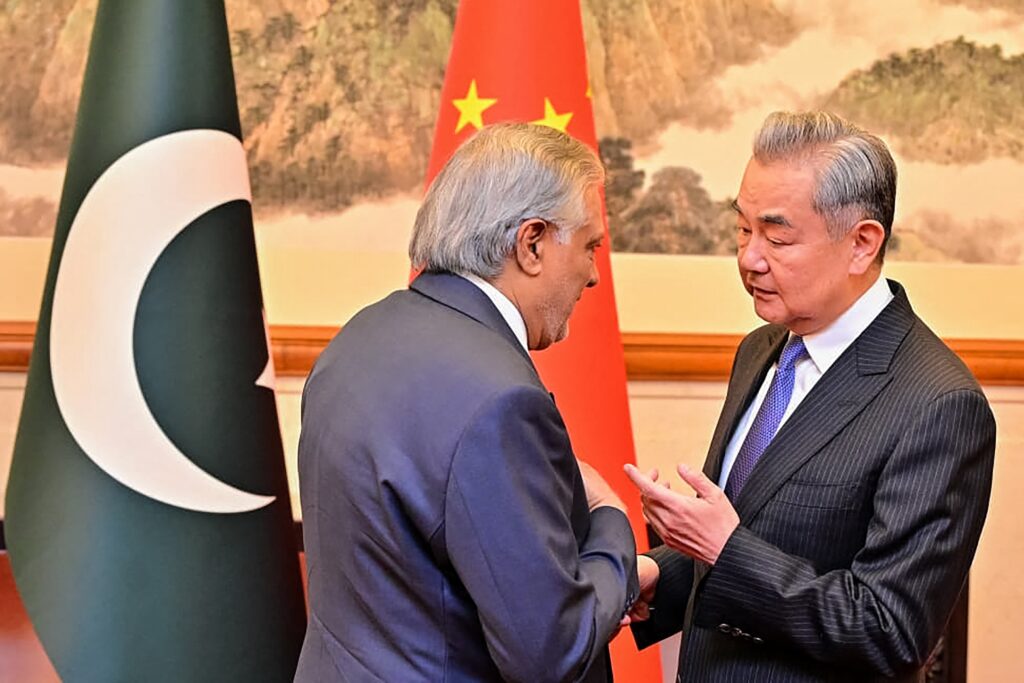
Beijing coordinated with Pakistan to put forward a plan following a meeting between the two countries’ foreign ministers in the Chinese capital late last month. The five-point proposal was less a detailed road map than a set of broad goals — including an immediate ceasefire and the creation of an undefined framework for peace — echoing similar broad blueprints China has proposed in the past. Separately, the United States has put forward a 15-point ceasefire framework, while Iran has advanced its own 10-point proposal, with both sides weighing the competing plans.
Even so, Chinese state media this week lauded the diplomatic success while issuing veiled warnings that the ceasefire’s durability depends on the actions of the U.S. and Israel.
“Peace is hard-won, and consensus is precious. The commencement of these talks represents a victory of rationality over recklessness … the United States and Israel must honor their commitments and refrain from further military escalation against Iran,” said a Wednesday commentary in a top Chinese state newspaper, People’s Daily.
The post China helped broker Iran truce, but it’s wary of deeper involvement appeared first on Washington Post.