BEIRUT — Caught up in the war in Lebanon, Lamis resisted leaving her apartment even after Israel ordered evacuations. She feared for her life but as a trans woman and Syrian immigrant, she had nowhere to go.
“All the shelters in Beirut demand a Lebanese ID, and make it clear the priority is for Lebanese families,” Lamis, 26, said. Being trans made things even more difficult. “I couldn’t even show my Syrian ID, which states that I was born a male, which puts me under the worst bullying and molestation,” she said. So she slept on a sidewalk for four nights until a local nonprofit finally took her in.
Israel’s war against Hezbollah has displaced 1 million people inside Lebanon. The warnings that the Israel Defense Forces issue before launching strikes have emptied out large swaths of southern Lebanon and the southern suburbs of Beirut. Israeli officials say their military plans to occupy an area stretching 18 miles into Lebanese territory. “The 600,000 residents of southern Lebanon who evacuated north will not be allowed to return south of the Litani — until the security of northern residents is guaranteed,” Defense Minister Israel Katz said.
Despite a tenuous ceasefire with Iran, there are no signs that the war in Lebanon will be winding down soon after Israel initiated a heavy aerial barrage that killed more than 200 people on Wednesday. Israeli Prime Minister Benjamin Netanyahu said the halt in hostilities does not include Lebanon, contradicting Pakistan, which helped to broker the pause.
In Lebanon, not all displacement is equal. Some evacuees can head for second homes, move in with family or stay in hotels. Those who can’t crowd into cramped shelters, stadiums or parking lots, in some cases sleeping in tents or cars.
The most vulnerable — foreigners, LGBTQ+ people, people with disabilities — face still more difficulty. Many were already refugees from war in Syria, Yemen or Sudan, or from discrimination in their homelands. Their lives were hard before the war. Now they’re struggling just to survive.
Hanan Sherri fled the violence in her native Sudan for Syria, and then the civil war in Syria for Lebanon. Now she’s nine months pregnant and on the move again. She’s sheltering at St. Joseph Catholic Church in East Beirut, set to deliver any day now, with no idea what her future holds.
“The problem with us Sudanese is that we don’t come here to work, we came here because of war,” she said. “Right now, I’m pregnant with no protection. We had been looking for a shelter but were told the priority is for Lebanese.”
The church, run by Jesuits, was converted into a shelter after fighting reignited between Hezbollah and Israel in early March. On the morning after the first exchange of rockets, church leaders found around 30 people waiting outside, according to Michael Petro, an American training to be a priest who works with the Jesuit Refugee Service in Lebanon, which is managing the shelter.
Many were parishioners; others were Muslims. Both groups were celebrating Mass on Palm Sunday when Washington Post reporters visited last month.
“As of now, we’re hosting 198 people,” Petro said, including two who were born after the start of the war. Petro’s organization arranged for the mothers to give birth at a local hospital.
“Many migrants have been here for decades,” Petro said. “Some live and work in homes, yes, but much of the population are often families who don’t fit that classic picture.”
Lebanon has long been a haven for those escaping war from surrounding countries. During Syria’s civil war, it hosted up to 1.5 million refugees.
Haneen Abduallah and her family are part of that wave. She can’t go home to Yemen, still riven by civil war, and her husband can’t return to Sudan, where he could be conscripted.
She was at the church when a neighbor sent a voice message saying her home had been flattened.
On the night the fighting erupted, Abduallah said, she “took to the street with all residents of the area filling up the roads and heading to the unknown” — a four-mile trek through anxious crowds. “I don’t know how we walked all the way here.”
When they reached the church, she said, they were offered an Iftar — the evening meal with which Muslims break their daily fast during Ramadan.
The government has set up a shelter for non-Lebanese migrants, but it’s far from where they tend to live and work. An additional challenge, according to Doumit Azzi of the LGBTQ nonprofit Helem: The government’s shelter strategy focuses on Lebanese families, not individuals.
That leaves Lamis and people like her out of the system. She is estranged from her family, which she says tried to kill her after she was outed as trans. She escaped Syria but still fears her relatives: “My two brothers are in Lebanon and are looking for me because they want to kill me.”
She’s waiting and hoping for approval to go to a “country that would treat me as a human being.”
The displacement has unsettled Lebanon’s sectarian fault lines. Beirut, which was split between Muslim and Christian areas during Lebanon’s 15-year civil war, feels like a divided city again. West Beirut, the largely Muslim area, now hosts a disproportionate amount of the displaced; a plan to build a shelter in Christian East Beirut drew opposition from politicians there who didn’t want Shiite Muslims living near them.
Israeli strikes on predominantly Christian areas have caused panic. An attack Sunday on the mountain town of Ain Saade that was aimed, the IDF said, at a Hezbollah operative, killed an anti-Hezbollah politician instead.
The IDF said “details of the incident are under review,” but accused Hezbollah of hiding in the civilian population and using ordinary people as human shields. After the strike, people emerged from their homes and shelters to demand the displaced leave.
Other towns have urged landlords against renting out their properties without first securing the approval of local officials.
Early in the war, Elie Choufani, the mayor of the border town of Rmiesh, received a cryptic threat from a person who said they were from the IDF.
“We had displaced people from neighboring villages,” he said. “They warned us of the danger of the displaced in case any one of them are from ‘the group’” — Hezbollah.
“They warned us don’t make any moves, because if you do we will make you evacuate and strike.” The town asked those who had been displaced from nearby towns to leave.
An IDF spokesperson told The Washington Post the army is “trying to find solutions so that the war affects the Christian communities in southern Lebanon as little as possible.” The official spoke on the condition of anonymity to discuss sensitive operations.
The Christian town of Maghdoucheh, near Israel’s evacuation zone above the Zaharani river, has quietly taken in around 2,000 Shiite Muslims, doubling its population. Mayor Raef Younan said all were being vetted — “Our main focus is the security of our hometown” — and the municipal guard was watching day and night for any unusual activity that might draw attacks.
Southern Lebanon is suffering. At a school-turned-shelter in Sidon, Nadia Hamad and her family were sharing a seventh-grade classroom with another family. Mattresses lay on the floor; personal items cluttered the blackboard chalk rail.
The building has a capacity of 500. It’s now hosting 1,100. There’s not enough privacy, Hamad said; women can’t remove their hijabs in sight of men from other families.
In peacetime, Hamad’s family works in farming. They had started repairing their home, damaged in the previous war between Israel and Hezbollah, only to be displaced again, for the second time in less than two years.
“We’re definitely worried that we won’t be able to go back,” Hamad said. Her husband has heart problems; her sister has cancer. The shelter provides one meal a day; for anything more, people are on their own.
“We can’t support our daughters,” Hamad said. “I’m crying in the bathroom, unable to provide for our children’s needs, medicine, and food.”
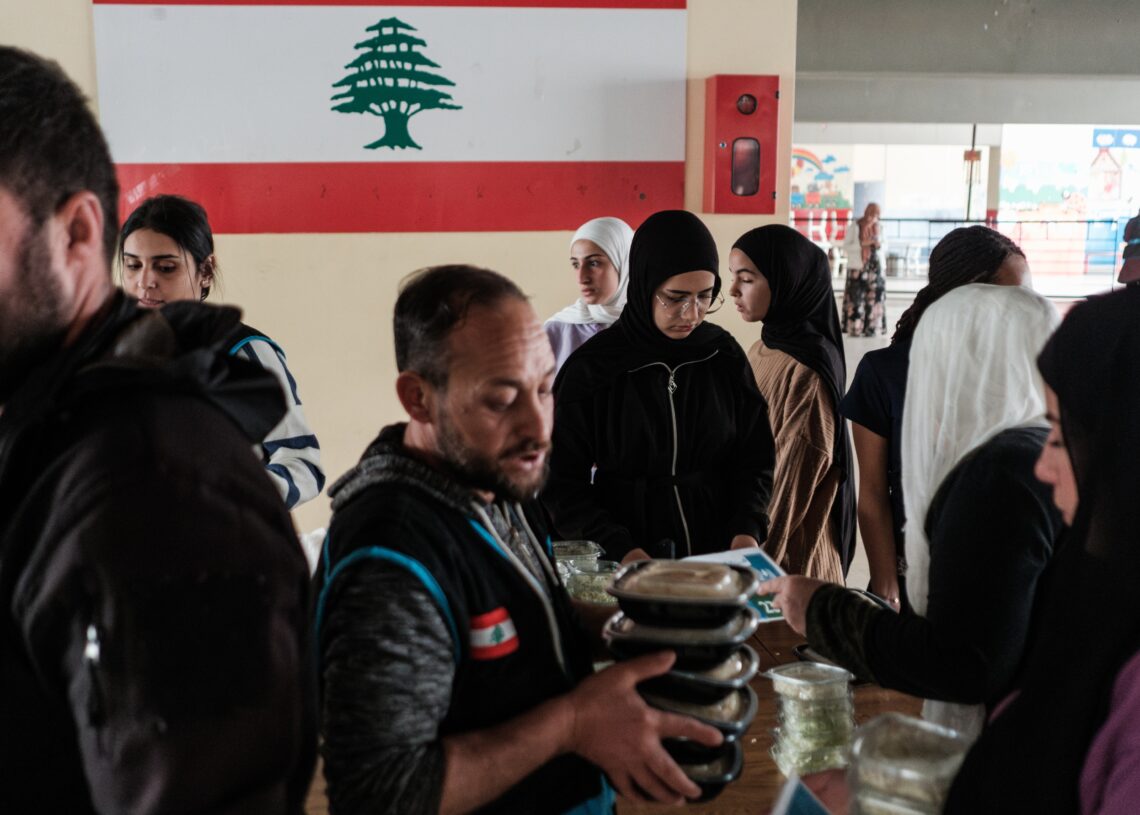
Many of those meals are prepared by nonprofits. One of them is a community kitchen staffed by people with disabilities that provides 400 meals a day to the Sidon area alone. Ibrahim Saadeddine, a Palestinian with symbrachydactyly, a congenital condition in which fingers are underdeveloped, was helping prepare fajitas with rice. “I don’t like to sit around,” he said as he prepared to help pack meals. “I prefer to be productive.”
Mustafa Hijazi, Sidon’s mayor, said the town’s shelters filled up faster than during the last war, in 2023 and 2024. “There’s overcapacity by 50 percent and there’s pressure on infrastructure inside the shelters on basic services, be it water, sanitation, hygiene, the networks, the supply of electricity, medication, the psychosocial support.”
“These are schools, not hotels,” he said. “my fire trucks are supplying them with water. I mean, the streets are full.”
Sylvana Lakkis, director of the Lebanese Association for People with Physical Disabilities, said the elderly and people with disabilities are most at risk in an evacuation.
Many with disabilities are unable to flee or escape danger, said Sylvana. Shelters often lack accessibility or electricity, which many be needed to power special equipment.
At the Sidon shelter, 67-year-old Ahmad Deeb lay on the floor in a room designated for the elderly. A stroke five years ago left his left side paralyzed. He was unable to leave Tyre without help from family; he was carried upstairs and into the shelter. “Hopefully we’ll be back home soon,” he said. “I long to be home.”
Hijazi, the mayor, says he has contingency plans in case conditions worsen and more people are displaced. But a protracted conflict, he said, would be disastrous.
“How are we going to feed people for a year or two years?” he asked. “That’s the question. It’s a catastrophe.”
Lior Soroka in Tel Aviv contributed to this report.
The post In Lebanon’s shelters, not everyone is welcome appeared first on Washington Post.