“When we’re serious, we don’t every day say the opposite of what we said the day before,” President Emmanuel Macron of France said last week adding, cuttingly: “And, maybe, one shouldn’t speak every day.”
It sounded like a grown-up speaking down to an obstreperous child, and that was probably what the French president intended. The target of his admonition was, of course, Donald Trump. Mr. Macron was speaking shortly after the American president had issued another boorish rant that included rude comments about the French president and his wife.
Mr. Macron is one of the few European leaders who have dealt with Mr. Trump almost from the first day of his first term. His transition from initial deference and feigned friendship to very public rebuke reflects the degree to which respect for the American president has fallen among European leaders and their publics. Mr. Trump’s war on Iran, about which NATO allies were not consulted and in which they subsequently declined to participate, has made clear that Europeans no longer defer to Mr. Trump as the de facto “leader of the free world.”
Mr. Trump’s comments about Mr. Macron and his wife were made at an Easter lunch with Christian leaders and close allies. They were not intended for public consumption, but they somehow made it onto YouTube long enough to be downloaded and widely shared. Typical of Trump tirades, they are richly laced with grievance, malice and crudeness: In addition to mocking the Macrons, he bashes NATO and the Supreme Court. The video is especially discomfiting when Mr. Trump’s spiritual adviser Paula White compares the president to Jesus Christ. (“You were betrayed and arrested. And falsely accused,” she said.)
But that luncheon talk was only a squall in a period in which Mr. Trump, fired up by an Iran war that was not going as he liked, let loose fiery threats to annihilate the country. “Tuesday will be Power Plant Day, and Bridge Day, all wrapped up in one, in Iran. There will be nothing like it!!! Open the Fuckin’ Strait, you bunch of crazy bastards, or you’ll be living in Hell — JUST WATCH!” was what Mr. Trump decided to post on the morning of Easter Sunday, with “Praise be to Allah” gratuitously tacked on. On Tuesday, he declared that “a whole civilization will die tonight, never to be brought back again,” effectively threatening a grave violation of the Geneva Conventions. Eighty-eight minutes before the apocalyptic 8 p.m. deadline, Mr. Trump backed down.
There was a time when Mr. Trump’s stream of insults, falsehoods, expletives, threats and malice would have raised questions among foreign leaders as to whether Mr. Trump was being deliberately obnoxious to achieve a goal — say, to get European allies to pay more for NATO, or as a variant on the “madman theory” strategy devised by President Richard Nixon to convince rivals that the president was dangerously unpredictable. They tried to appease Mr. Trump with praise and pomp, hoping to steer him in a more productive direction.
But more than a year into Mr. Trump’s return to the White House, the Europeans, and much of the world, have concluded that no amount of bowing or scraping will win more than fleeting approval from him. The barrage of tariffs that opened the second Trump administration, aimed indiscriminately at friend and foe; the brazen demands that Denmark cede Greenland to the United States, and now the absence of any consultation with European allies before joining Israel in an attack on Iran that has affected the entire world, have erased any illusion among most Europeans that Mr. Trump is anything but an unpredictable, vindictive and uncontrollable danger.
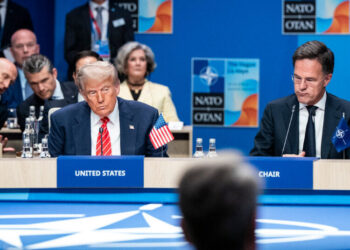
Mr. Trump’s current beef with NATO is that none of its members responded to his call for military help in opening the Strait of Hormuz, raising questions about whether he will try to pull the United States out of the alliance, or whether the alliance even has any meaning now. So far, however, that has not persuaded any European leaders to capitulate, despite Mr. Trump’s constant trolling. Britain’s prime minister, Keir Starmer, has said he would stick to his position on the war “whatever the noise.” Last month, the German defense minister, Boris Pistorius, struck a similar note, saying, “This is not our war.” Mr. Trump responded by calling NATO allies “cowards.”
Even Prime Minister Giorgia Meloni of Italy, one of Mr. Trump’s closest European allies, distanced herself from his seemingly unprecedented threats to Iran this week. “It is crucial to clearly distinguish between the responsibilities of a regime and the fate of millions of ordinary citizens,” she said. That effectively left Hungary’s prime minister, Viktor Orbán, as Mr. Trump’s most loyal ally in Europe, which explains why Vice President JD Vance was dispatched to prop up Mr. Orbán in advance of an election on Sunday that he may well lose. Mr. Orbán’s stance on the Iran war, however, is unclear, especially after The Washington Post reported on Wednesday that Hungary offered to help Iran in 2024 after Israel caused thousands of pagers belonging to Hezbollah, Iran’s Lebanese proxy, to explode.
Mark Rutte, NATO’s secretary general, who is considered something of a Trump whisperer, may be one of the very few — if not the last — European leader still clinging to the policy of flattery. He has actively tried to maintain friendly ties to Mr. Trump, suggesting gamely that Mr. Trump’s anger at the alliance was understandable and would pass. But in a social-media post after talks with Mr. Rutte, the president reiterated his ire and threw in Greenland for good measure: “NATO WASN’T THERE WHEN WE NEEDED THEM, AND THEY WON’T BE THERE IF WE NEED THEM AGAIN. REMEMBER GREENLAND, THAT BIG, POORLY RUN, PIECE OF ICE!!!”
At least there was no new talk of leaving NATO, for now. The shouty missive elicited no major pushback from foreign leaders. This was Mr. Trump being Mr. Trump: tedious, repetitive, vulgar. He is still dangerous, and he could still unleash terror on the people of Iran should the cease-fire collapse. But his uppercase blasts, chest-thumping rants and coarse insults are more likely now to draw a Gallic shrug.
Serge Schmemann joined The Times in 1980 and worked as the bureau chief in Moscow, Bonn and Jerusalem and at the United Nations. He was editorial page editor of The International Herald Tribune in Paris from 2003 to 2013.
The Times is committed to publishing a diversity of letters to the editor. We’d like to hear what you think about this or any of our articles. Here are some tips. And here’s our email: [email protected].
Follow the New York Times Opinion section on Facebook, Instagram, TikTok, Bluesky, WhatsApp and Threads.
The post Europe Is Done Bowing and Scraping to Trump appeared first on New York Times.