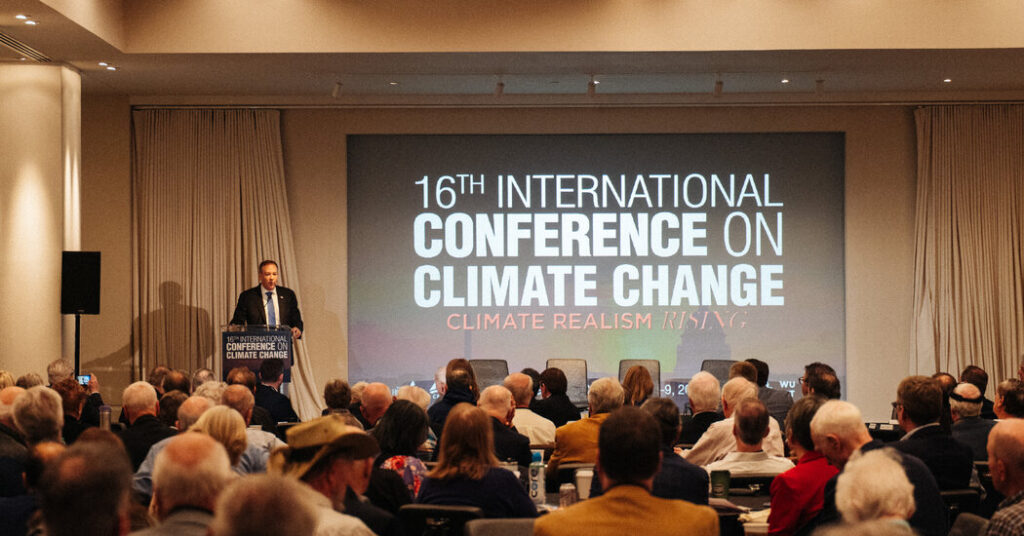
Yesterday I found myself in a strange setting: the ballroom in the basement of a hotel in downtown Washington. I was there to cover a conference hosted by groups that reject the overwhelming scientific consensus on climate change.
It might have seemed like a fringe event, except for the high-profile opening speaker: Lee Zeldin, the administrator of the Environmental Protection Agency and one of President Trump’s possible choices for the next attorney general.
The mood in the room was celebratory. The roughly 220 attendees at the gathering at the Hotel Washington, which is a short walk from the White House, treated Zeldin like a rock star, giving him a standing ovation before he had even spoken.
“We aren’t just following blind obedience to whatever the dire, doom-and-gloom prediction of the day is,” Zeldin said, drawing more applause.
In some ways, Zeldin was echoing his boss: Trump has called climate change a “hoax” and “the greatest con job ever perpetrated on the world.” And his administration has systematically sought to slash federal funding for climate research while dismantling dozens of climate and environmental regulations.
‘A moment of triumph’
As I reported in an article published today, the event made clear that climate change deniers are seeing a new level of prominence in Trump’s Washington after years of feeling sidelined by the political and scientific establishments.
It was organized by the Heartland Institute, a research organization that has fought mainstream climate science for decades. James M. Taylor, the president of the institute, told me that the Trump administration had done more for his group than any other administration in history.
“This is absolutely a moment of triumph,” he said, adding, “It’s nice to be winning.”
After talking to Taylor, I was offered some free swag, including blue-and-green stress balls that resembled miniature Earths. The white lettering on the stress balls read: “Don’t stress. There is no climate crisis.”
To be sure, the vast majority of scientists agree that Earth is warming, and that those changes are driven by the burning of oil, gas and coal. Climate change is already fueling deadly heat waves, coastal floods and water shortages, and scientists expect those impacts to grow more severe as greenhouse gas emissions continue to rise.
Conference attendees expressed varying levels of skepticism of this scientific consensus. Some flatly denied that the planet was warming, while others recognized the trend but argued that it was not an emergency and that the potential solutions were too costly.
Two terms, two approaches
I’ve been covering climate politics for nearly a decade, and at the event I was struck by the differences between Trump’s first and second terms.
Toward the start of the first term in 2017, Scott Pruitt, the E.P.A. administrator at the time, proposed a “red-team, blue-team” exercise to challenge mainstream climate science. A red team of climate skeptics would critique major scientific reports on global warming, and a blue team of climate scientists would then rebut these claims.
But the exercise never happened. John F. Kelly, then the White House chief of staff, blocked the effort, which he saw as poorly planned and politically risky.
The second Trump administration has shown no such restraint.
Since Trump returned to office in January 2025, his administration has waged a wholesale attack on climate efforts across the federal government. It has revoked billions of dollars in climate grants, fired thousands of employees at environmental agencies and rolled back dozens of longstanding limits on harmful pollution.
In February, the E.P.A. took the extraordinary step of renouncing the government’s legal authority to combat climate change. And in August, the Energy Department issued a contentious report that said the mainstream scientific view on warming was too dire. (Experts said the report was riddled with errors, and a federal judge recently ruled that the Energy Department violated the law when it handpicked the researchers who wrote the document.)
Judith Curry, one of those researchers, addressed attendees virtually yesterday. She said a revised version of the document would be published by the end of the year, adding, “Stay tuned.”
Conservation
Emperor penguins are now considered endangered
Emperor penguins, the world’s largest and perhaps most recognizable penguin species, have joined the list of wildlife endangered by global warming, the International Union for Conservation of Nature announced on Thursday.
In an update of its Red List, a comprehensive and authoritative listing of global species based on their extinction risk, the group also said that Antarctic fur seals had moved into the endangered category and that southern elephant seals had moved to vulnerable.
In the case of penguins and fur seals, the changes were largely driven by shifts in sea ice levels and food availability linked to global warming, researchers said.
For species in the Antarctic region, “this is the first clear evidence of climate change’s influence pop up in a big way,” said Kit Kovacs, a marine mammal researcher at the Norwegian Polar Institute who leads the I.U.C.N. seal project. — Rachel Nuwer
Chart of the day
The American West’s extraordinarily low snowpack
After the warmest winter on record for many states and a blistering March heat wave that left almost no snow in parts of the American West, the region is facing a summer of serious wildfire risks and a drought that could force broad water restrictions.
New measurements this month show most of the Mountain West won’t be able to rely on melting snow, the region’s largest water source, because there’s hardly any snowpack there.
Scientists in many parts of the West found a snow drought this month unlike any they had seen. — Scott Dance, Sachi Kitajima Mulkey and Mira Rojanasakul
Quote of the day
“I oppose everything they stand for. It’s never mattered before.”
That’s Bill Callan, a 55-year-old resident of Tempe, Ariz., expressing his opposition to Turning Point USA, the conservative group founded by Charlie Kirk. Turning Point backed a slate of candidates for the board of Arizona’s largest public utility, pushing Callan to cast his first ever vote in a utility election this week.
Reis Thebault reports that Turning Point’s funding and organizing drew national attention to the normally sleepy utility elections — and attracted ire of liberal organizations. The winning candidates, who campaigned as the Clean Energy Team, drew support from the Sierra Club and the actress Jane Fonda.
The utility, known as the Salt River Project, delivers power and water to millions of customers across metropolitan Phoenix, and its board determines how much households will pay for those services in one of America’s hottest and driest cities.
More climate news from around the web:
-
Last month was the hottest March on record in the continental United States, Associated Press reports. It was the most abnormally hot month on record, regardless of the month of the year.
-
Soaring energy stock prices during the Iran war have meant a windfall for the chief executives of oil and gas companies, The Wall Street Journal reports.
-
China is wasting renewable energy, meaning it is generating the power but not delivering it to customers, at an alarming rate, Bloomberg reports. “The amount of solar power generated without being delivered to customers rose to 9.2 percent in January and February, from 6.1 percent in the same period last year,” according to the report.
Read past editions of the newsletter here.
If you’re enjoying what you’re reading, please consider recommending it to others. They can sign up here.
Follow The New York Times on Instagram, Threads, Facebook and TikTok at @nytimes.
Reach us at [email protected]. We read every message, and reply to many!
Maxine Joselow covers climate change and the environment for The Times from Washington.
The post Climate Denial Comes to Washington appeared first on New York Times.