Do you feel the world is spinning out of control? Would you like some distance from the chaos, if only to see it a little more clearly as you catch your breath?
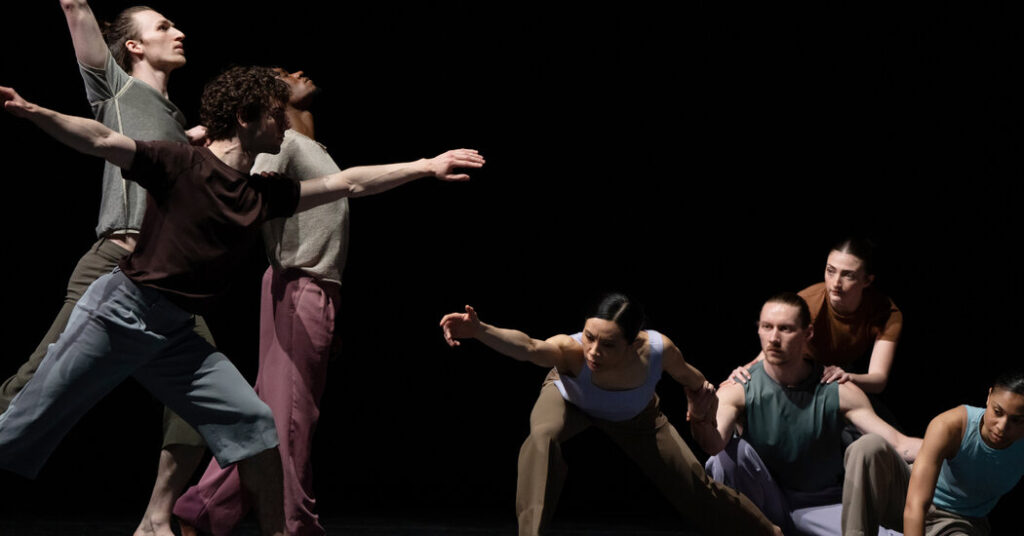
That is what Jawole Willa Jo Zollar’s new work provides. “On Contemplation of Wailing” is a whirlwind of a dance. It expresses confusion and the centripetal force of isolation, but at an artful remove.
In the dance, which had its world premiere in the Gibney Company’s program at the Joyce Theater on Wednesday night, eight performers start separated, each in a spotlight, opening arms in supplication or spinning in a defensive crouch. They come together, but only as objects in a tornado do. Pausing in stretched-out tableaus, they snap back into motion. One of them, Tiare Keeno, shakes violently and is calmed by another’s touch, though soon she’s shaking again and slapping her chest as she bends back nearly to the floor.
That sounds dramatic, and it is, but it isn’t presented histrionically. The distancing in the title — both the essayistic preposition and the philosophical noun putting off the wailing — finds form in the dance. The work is helped in this regard by Jordyn Davis’s original score, a subtle composition of acoustic bass, shuttling percussion and sounds that are not wailing but suggest it.
Near the end, Keeno, running in circles around the others, is caught by them in a cat’s cradle of bodies that’s both comforting and confining. They freeze, and she extricates herself for a moment, looking at the maelstrom from the outside. Then she squeezes back in, and the group opens like a flower to the light. The message of strength in the collective is familiar, but the moment of separation, that perspective, is what “On Contemplation of Wailing” most valuably offers viewers.
It’s remarkable how little the work resembles most of what Zollar created for her own company, Urban Bush Women, for 40 years. (She stepped away in 2024.) Gibney Company has given her an opportunity to show another side of herself, and she, in turn, has made a piece that suits the troupe.
That last achievement stands in relief against “Vukani” (“Wake Up”), which the South African choreographer Mthuthuzeli November made for the company in 2024. It appears to depict a rite of initiation for a young woman, and the choreography is intriguing in its recognition of mingled pain and care, and engaging in its mix of Xhosa and contemporary elements. But it feels too culturally specific for this company of skilled, pliable dancers — a company without a strong identity of its own. I didn’t believe it.
Medhi Walerski’s “Silent Tides,” a duet he made for Nederlands Dans Theater in 2020, is the sort of thing these dancers can do well but shouldn’t do at all. Like much of that company’s repertory, it’s sleek, slinky and fake.
Lucinda Childs’s “Canto Ostinato” is a better match than November’s and better art than Walerski’s. A short dance from 2015 now getting its company premiere, it has the choreographer’s signature features: lucid, diagrammatic patterns built from a limited vocabulary (walks, pivots) in a restrained balletic style. Halfway through, it repeats.
The score, by Simeon ten Holt, operates similarly, with repetition and minor variation. In Dominique Drillot’s design, vertical lines pan across the rear wall like a squeegee across glass.
Because of the restraint, small expansions (a turn, an extended leg) bloom with outsize force. Rather than growing dull with reiteration, the patterns become more incisive. Even more important, the clarity of the choreography reveals the dancers and their training cleanly, without pretense or affectation.
This sign of choreographer-company compatibility is good news, since Childs, now in her mid-80s, has just started a five-year run as Gibney’s resident choreographer. An evening-length piece is in the works. Even in the preshow reminder to turn off your cellphone, the addition of Childs’s voice is an improvement.
Gibney Company
Through Sunday at the Joyce Theater, Manhattan; joyce.org.
The post Review: At Gibney Dance, Reaping the Maelstrom appeared first on New York Times.