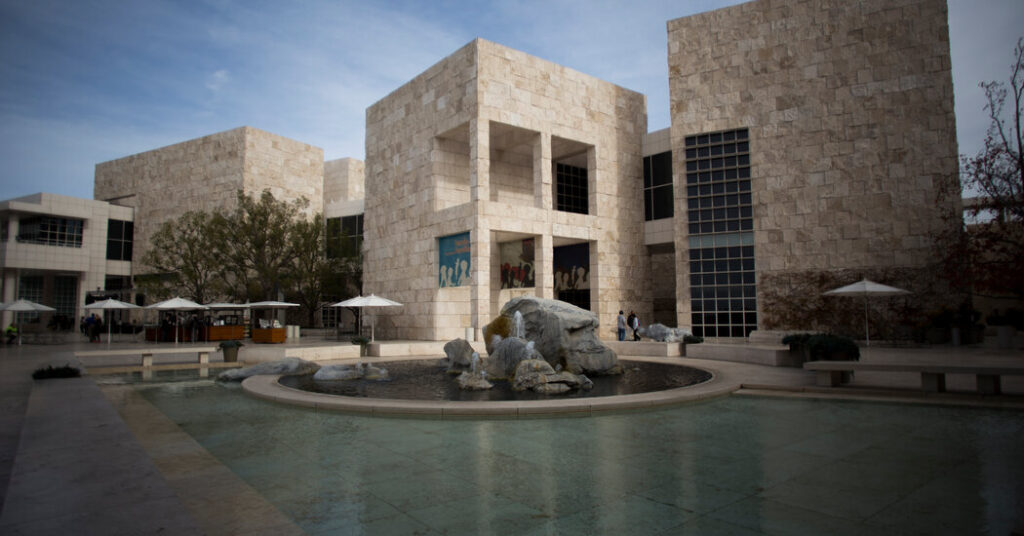
The Getty Center, a cultural anchor of Los Angeles that offers both artistic masterworks and panoramic views of the city, will close for roughly a year as the campus undergoes what officials are calling the most significant modernization in its almost 30-year history.
To replace its famous tram and complete a series of renovations, the museum will close to the public beginning March 15, 2027.
The reopening of the museum, which draws about 1.3 million visitors each year, is planned for spring 2028, shortly before the Summer Olympics come to Los Angeles.
The Getty Villa, a sister museum about 10 miles away, will remain open throughout the Getty Center’s closure and add a gallery with a selection of paintings from the Getty Center’s collection, which includes works by van Gogh, Rembrandt, Rubens, Monet and Degas. The institution will also open a new permanent programming space on Sepulveda Boulevard.
Many people think of the Getty Center as more or less brand-new, said Katherine E. Fleming, the president and chief executive of the J. Paul Getty Trust. But the museum that opened on the city’s Westside in 1997, she said, is “starting to get a little long in the tooth.”
“Are we sad? Yeah, we’re sad, but also kind of excited,” she added. “If you renovate your house, it’s a real pain in the neck and a bummer to have to move out for a while. But that’s the only way you can get it done.”
Fleming said the need to close really traces to the tram, the primary way visitors get to the top of the hill where the main museum campus awaits. With its scenic, elevated views of the city, the journey is among the most pleasant parts of a day spent at the Getty Center.
She said that after more than three decades in use, the tram was nearing the end of its life.
“It breaks down with much greater frequency than it should,” she said. “You have a car. You can tell when something starts to feel like it’s leading to something worse.”
Once officials realized the tram would need to be swapped out, they began to look at the rest of their to-do list: modernize some art galleries, reimagine the welcome center and take care of less-glamorous tasks like replacing air handling units.
Rather than running shuttles up and down the hill, closing on certain days and forcing visitors to endure construction, the museum decided to condense the process. “It made a lot more sense for us to do the work in a more intensive and speedy way,” Fleming said, “and have a little bit of a splash when we reopen.”
The new tram will be able to move about 400 more people per hour than the old one and will play music, Fleming said. The arrival and departure areas will also be redesigned.
The museum will also revamp its wayfinding, and perhaps even rename the pavilions so they are more readily identifiable, Fleming said. The rotunda where people enter will become a welcome hall with more “places for people to hang out” and a revamped bookstore, cafe and museum store, she said.
Roughly 27,000 square feet of gallery space inside the South Pavilion will be reworked, from the gallery design to the way the museum displays its decorative arts. Fleming said that some of those galleries have an “old-school vibe” and that period pieces are “going to be displayed in a much, much more visible and modernized way.”
There will be more retail kiosks across the museum, Fleming added, along with newly commissioned works in outdoor spaces.
And with Angelenos in mind, she also promised to improve the parking.
Matt Stevens is a Times reporter who writes about arts and culture from Los Angeles.
The post Getty Center in Los Angeles Is Closing for Year of Renovations appeared first on New York Times.