Tiny teams, a flatter workforce, and squiggly lines.
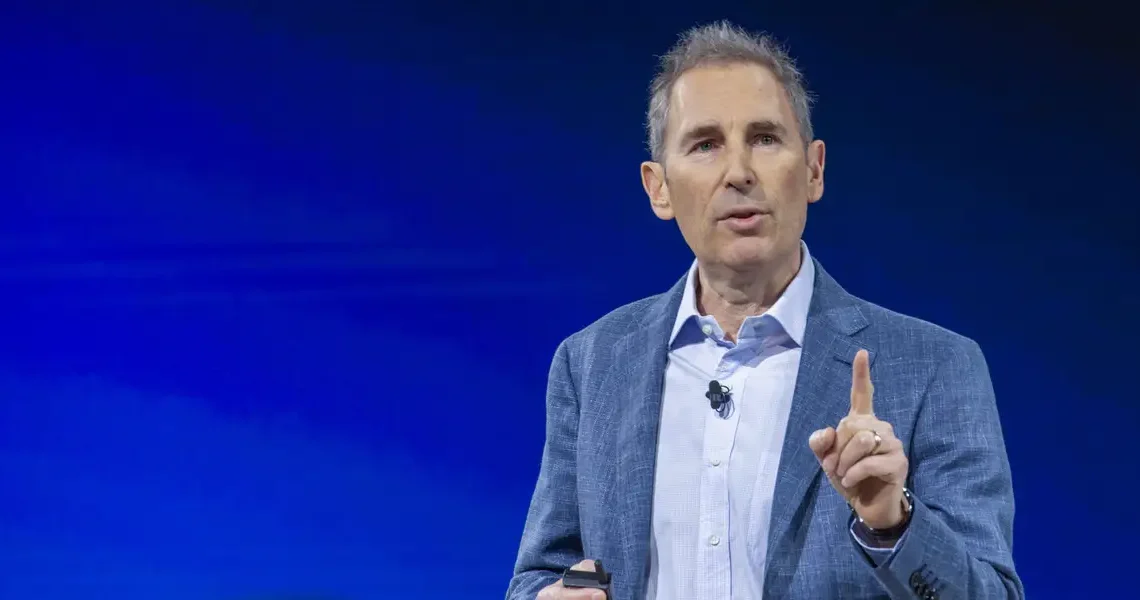
Andy Jassy’s latest letter to Amazon’s shareholders offers fresh insights into how he’s thinking about the company’s workforce of 1.5 million people globally, including roughly 350,000 corporate hires.
The Amazon CEO’s missive arrives at a critical point for the company. While its stock is up 26% over the past 12 months, it’s virtually flat year to date, and trades 10% below the all-time high it reached in November.
The power of tiny teams
Jassy touted the power of tiny teams, specifically when it comes to Amazon Bedrock.
Amazon Bedrock gives users access to multiple third-party LLMs, such as Anthropic’s Claude and Meta’s Llama. Bedrock was built and scaled quickly before the team realized it needed a different inference engine, Jassy wrote.
“This wasn’t a tweak; it required a completely different architecture,” Jassy wrote.
When it came to executing the work, a small team of people using AI was able to execute a workload that traditionally required many more people.
Jassy wrote:
As Business Insider has previously covered at length, small teams of people working alongside AI agents can accomplish the workloads of much bigger teams.
The tone Jassy struck in the letter is in line with his previous comments about the future of the workforce. In February, for example, he said that he thinks humans won’t be “necessary” for many of the jobs they’ve been filling for the past 20 or 30 years.
Flatter structures and a faster pace
Amazon has done two major rounds of layoffs since Jassy’s 2024 letter to shareholders. The company cut 14,000 jobs in October and another 16,000 jobs in January.
In his letter this week, Jassy said he’s “pleased” with the flatter organization’s work, writing:
Jassy said during Amazon’s third-quarter earnings call in October that years of rapid growth meant the company had wound up with a “lot more people” and a “lot more layers,” which threatened to “weaken the ownership” of key employees and slow everything down.
He said his leadership team was “committed to operating like the world’s largest startup. And that means removing layers. It means increasing the amount of ownership that people have, and it means inventing and moving quickly.”
On the call, Jassy added that technological change had made it “important to be lean, it’s important to be flat, and it’s important to move fast, and that’s what we’re going to do.”
The Amazon CEO reiterated the vital importance of speed in his letter, writing: “You need to move fast, have teammates that act like true owners, and be scrappy.”
Squiggly lines and comfort with ambiguity
Jassy’s letter also gives a look into the qualities he prizes in his workforce.
They include comfort with ambiguity, a willingness to “invent and experiment like crazy,” and a tendency to move fast and be scrappy.
Jassy drew a parallel between Amazon’s winding path and his own career. He wrote that after college, he tried to get into sportscasting but had to settle for sports production. He coached high school soccer and worked at a golf store for extra cash. He later worked as a product manager, ran his own businesses, worked in sales and investment banking, then went to graduate school before joining Amazon three days after his final exam in May 1997.
“Not exactly a straight line,” he wrote, before chronicling the twists and turns of Amazon Web Services’ evolution.
“Most long-term endeavors do not follow a linear straight line, up and to the right,” Jassy wrote. “Progress jumps around; it’ll zig up, then sometimes stall, or zag down, or force you back to the starting line. Sometimes, it feels like you’re running in circles. But, the path is rarely straight.”
The upshot is that being able to deal with change and uncertainty is critical, Jassy said.
“You have to have people and a culture that are comfortable operating with ambiguity as you sort through the new normal,” he wrote.
“Inflections aren’t usually smooth or calm. They favor the bold and adaptable,” he added.
Read the original article on Business Insider
The post What Andy Jassy’s shareholder letter tells us about his vision for Amazon’s workforce appeared first on Business Insider.