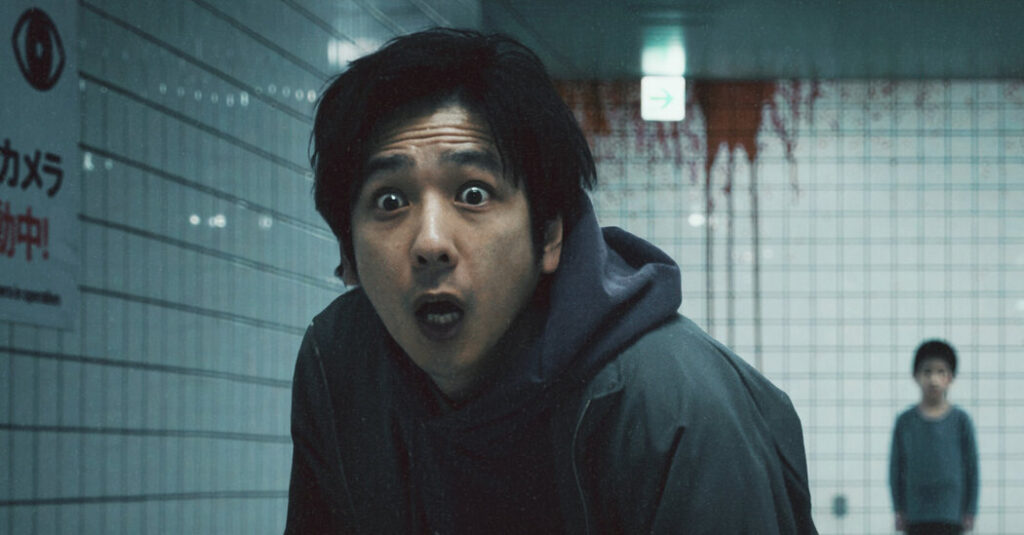
The circle of life takes a head-spinning detour in “Exit 8,” a diverting existential puzzler about wrong choices and right moves. Modestly scaled and cleverly streamlined, the movie takes place almost entirely in a few halls of a Tokyo train station, an outwardly bland, familiar setting. It’s one of those liminal spaces that you scarcely notice as you’re moving from here to there, lost in your own thoughts. Yet while these halls are notably bright and admirably clean, with gleaming white-tiled walls and plenty of light, they don’t offer any obvious way out.
For some unlucky travelers, the white-tiled halls turn out to be a trap, at once a closed loop, a maze and a very harsh life lesson. It’s based on a video game, “The Exit 8,” and has a labyrinthine design, complete with characters, rules, challenges and levels. Yet while the game’s objective seems as self-evident as an exit door, it’s unclear who’s playing against whom, why and to what end. The rules are listed on an information sign, and are plainly stated. The first one (“Do not overlook any anomalies”) seems straightforward while the second has a shiver of enigmatic menace: “If you find an anomaly, turn back immediately.”
“Exit 8” is a pip and as fun to watch as it is to mull over. Smoothly directed by Genki Kawamura, who shares script credit with Kentaro Hirase, it will be familiar to anyone who’s a fan of puzzles, has watched Christopher Nolan’s movies, read the myth of the Minotaur, knows something about cognitive behavioral therapy or has just watched a lot of genre movies. It plays with form rather than upending it, using conventions and archetypes (and your expectations) to tell a story about a hapless, unnamed Everyman (Kazunari Ninomiya) who’s trapped in a sticky, potentially terminal situation of his own making.
This guy’s very bad day begins on a crowded subway car during rush hour. Casually dressed, almost slovenly, he has his earbuds in and a phone in hand, and is pointedly facing some closed doors. He clearly doesn’t want to engage with anyone, including the male passenger who’s loudly and repeatedly berating a woman with a crying baby. When our guy raises his eyes, what he sees his own reflection. He’s on his way to his temp job, but he has a lot on his mind, so when he steps into the station, he seems unaware of his surroundings. He just walks into a bright white-tiled hall and then a second one with a yellow overhead sign for Exit 8.
By the time our mouse has turned a few more corners, he has a nickname — the words Lost Man materialize over him — and the confusion etched in his face has turned into panic. After a few puffs on an asthma inhaler, he begins familiarizing himself with his surroundings and circling a square made of four halls joined by a thick, yellow line on the floor. Made of what looks like inlaid brick, it runs parallel with the walls, like one of those wayfinding paths that airports use to guide travelers. In “The Wizard of Oz,” just before Dorothy heads off on the Yellow Brick Road, the Good Witch says that “it’s always best to start at the beginning,” which isn’t all that useful advice when the path seems to be a Möbius strip.
A similar conundrum faces Bill Murray’s character in “Groundhog Day,” Harold Ramis’s brilliant 1993 comedy about a jaundiced weatherman who becomes trapped in a time loop until he figures out how to change his life. “Exit 8” slips in some ideas about responsibility — the sound of crying babies is a refrain and a hint — but it’s a simpler, less emotionally and philosophically resonant movie, more ticklishly amusing than deep. Even so, because “Exit 8” is so streamlined and uncluttered, it gives you room to ponder life’s labyrinths, clock the cinematic allusions (Stanley Kubrick’s “The Shining”) and admire Kawamura’s technique, his brisk pacing and his comic timing. The atmosphere-goosing score, which includes a motif that evokes the chimes of closing train doors, is especially good.
“Exit 8” remains tightly focused even as the Lost Man’s journey grows more complex and enjoyably gnarly. Other characters enter, including a woman (Nana Komatsu), a high-school girl (Kotone Hanase), a wee boy (Naru Asanuma) and someone called the Walking Man. Played by Yamato Kochi with exacting physicality and some unnerving smiles, the Walking Man has a briefcase in one hand, ramrod straight posture and an eerily rhythmic gait. A sad little ponytail hangs off his balding head, a discordant appendage that suggestively summons up youthful hopes, dashed dreams and maybe an old drum kit stashed in the garage. In time, the Lost Man will look at this other guy and announce that he sees a monster, but part of what makes “Exit 8” effective rather than just clever is that you never do. You only see the man.
Exit 8 Rated PG-13 for blood, rats and peril. In Japanese, with subtitles. Running time: 1 hour 35 minutes. In theaters.
Manohla Dargis is the chief film critic for The Times.
The post ‘Exit 8’ Review: Round and Round and Round He Goes … appeared first on New York Times.