The fragile U.S.-Iran cease-fire is being tested by reports of Tehran’s continued chokehold on the Strait of Hormuz despite President Donald Trump’s demand for a “complete and immediate” reopening of the crucial waterway.
But as U.S. and Iranian officials negotiate the conditions for a potential permanent end to the war, with core points such as the freedom of navigation through the Strait—and how that would work long-term—yet to be resolved, concern is mounting over another critical maritime chokepoint.
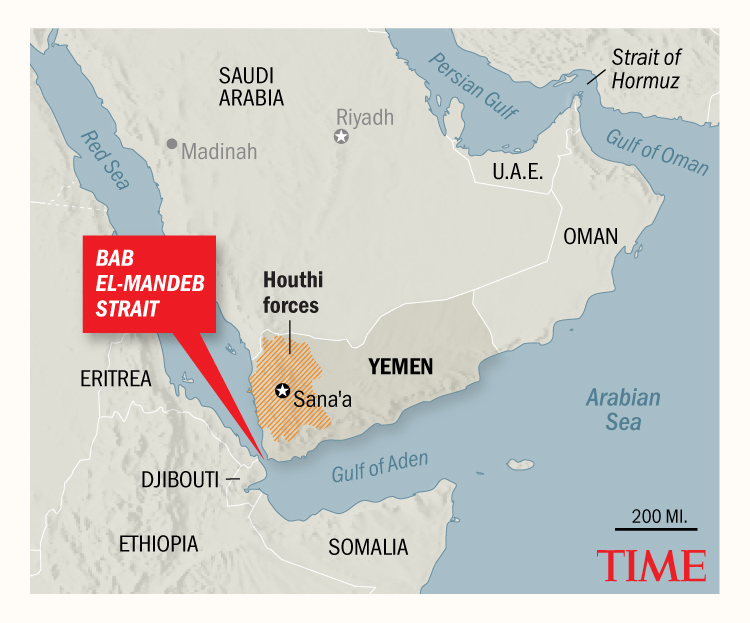
The Bab El-Mandeb, a waterway situated between Yemen and Djibouti and Eritrea in the Horn of Africa, has come under threat from Iranian officials.
Ali Akbar Velayati, an adviser to Iran’s Supreme Leader, warned over the weekend that the U.S. “views Bab el-Mandeb as it does Hormuz.”
If the White House “dares to repeat its foolish mistakes, it will soon realize that the flow of global energy and trade can be disrupted with a single move,” he said.
Mohammad Bagher Ghalibaf, Iran’s parliament speaker, has also indicated Iranian interest in the Bab el-Mandeb, which is Arabic for “Gate of Tears,” due to its tricky navigation conditions.
“What share of global oil, LNG, wheat, rice, and fertilizer shipments transits the Bab-el-Mandeb Strait?” he queried on April 3. “Which countries and companies account for the highest transit volumes through the Strait?”
Some key shipping companies re-routed vessels away from the Bab el-Mandeb Strait and the Suez Canal early on in the Iran war. Danish container shipping company Maersk said it had decided to “pause future Trans-Suez sailings through the Bab el-Mandeb Strait for the time being,” citing security concerns.
The fact the Bab el-Mandeb Strait is overlooked on one side by Yemen’s Iran-backed Houthi militants further complicates matters.
Abed al-Thawr, a Yemeni military official, indicated in late March that the closure of the Bab El-Mandeb would be among the primary options that could be taken by the Houthis as a response to further escalation in the Iran war.
“We will use the trump card of closing the Bab al-Mandab Strait to American and Israeli ships and the naval and air blockade of Israel and America,” he said, according to Iranian state media.
The Houthis have often disrupted shipping through the Bab el-Mandeb Strait between the Red Sea and Indian Ocean.
The group started causing severe disruption to navigation through the Red Sea in 2023, shortly after the start of the Israel-Hamas war, firing anti-ship ballistic missiles at vessels.
Now, with tension over naval navigation in the Middle East reaching a critical point, here’s what to know about the Bab el-Mandeb Strait and how a blockage of any kind could significantly impact global trade.
What is the Bab el-Mandeb Strait?
The Bab el-Mandeb Strait connects the Red Sea to the Gulf of Aden and the Arabian Sea and narrows to about 18 miles at its tightest point.
It serves as a key transit route for oil shipments moving from the Persian Gulf through the Suez Canal to Europe and beyond to various worldwide shipping markets.
“The Bab el-Mandeb, just like Hormuz, is critical for the global economy,” Noam Raydan, a senior fellow at The Washington Institute for Near East Policy, tells TIME. “It is a chokepoint through which you have various ships, container ships, oil tankers or carriers that move between different regions or continents.”
In November 2023, during the early stages of the Israel-Hamas war, Yemen’s Houthi militia began targeting commercial vessels in the Red Sea, disrupting flows through the Bab el-Mandeb.
The attacks upended shipping routes and negatively impacted global trade.
According to the U.S. Energy Information Administration (EIA), crude oil exports and petroleum liquids transiting via the Bab El-Maneb Strait increased from 5.7 million in 2020 to 9.3 million barrels per day in 2023. This figure decreased to 4.1 million barrels per day in 2024 following the Houthi attacks on the Strait and remained steady at 4.2 million barrels for the first quarter of 2025.
Emily Holland, director of the Eurasia program at the Foreign Policy Research Institute, who sat in the NATO shipping center as deputy political adviser for critical industry infrastructure during the Houthis’ campaign, described the impact of the group as “very disruptive.”
“It’s not as if the Houthis were firing missiles and drones at every ship, it’s more of a market signal that they can do it, and so then ships are reluctant to pass through the Strait because they cannot get insurance to do that,” she says.
The Houthis framed their campaign as an act of solidarity with the Palestinian cause.
The U.S. Maritime Administration described the attacks by the Houthis as being on vessels with an Israeli, U.S., or U.K. association and any vessel within a group or company where the company had been identified as making port calls in Israel when transiting via the Bab el-Mandeb Strait.
Following the cease-fire between Israel and Hamas in October 2025, it was reported the Houthis would pause their attacks on commercial vessels in the Red Sea.
But even since, oil transit through Bab el-Mandeb has remained largely unchanged due to the threat the Houthis pose to companies and oil tankers in the region and security concerns.
How has Iran threatened to restrict the Bab el-Mandeb Strait—and how could that impact global trade?
Iranian officials have indicated that should the war restart and escalate, the Bab el-Mandeb could be leveraged as a geopolitical bargaining chip in a similar fashion to the Strait of Hormuz.
A senior Iranian source was quoted as telling Reuters on April 7 that “if the situation gets out of control, Iran’s allies will also close the Bab El-Mandeb Strait.”
Iran’s direct ability to act in the region is limited, notes Eugene Gholz, an associate professor of political science at the University of Notre Dame.
“The reason Iran can threaten to disrupt ships in the Strait of Hormuz is that Iran has military forces directly located on the coast of the Strait. Iran has no military forces near the Bab el-Mandeb,” Gholz tells TIME, adding that Iran would instead have to assert its influence via regional proxies.
The Houthi movement announced its entry into the Iran war by firing a barrage of ballistic missiles at southern Israel on March 28.
“Iran provides them (Houthis) with weapons and money and all sorts of ideological support,” says Holland. “If we’re looking at sort of an existential disruption to the Iranian regime, as President Trump is alluding to, then it’s certainly possible that the Iranians could influence the Houthis to increase the tempo of their attacks.”
Despite reduced traffic, Bab el-Mandeb remains strategically significant and a key shipping route.
The Strait has increasingly served as an alternative avenue for oil shipments rerouted from the Persian Gulf, including Saudi crude oil transported via the East-West pipeline to the ports of the Red Sea and it is also key for Russian oil exports to Asian markets like India.
“Bab El-Mandeb right now serves as a key passageway for the flow of Saudi crude oil that had to be rerouted from the Persian Gulf to the Red Sea because of the crisis in the Strait of Hormuz,” says Raydan. “If anything major happens in a battlement that’s similar to the Strait of Hormuz, it will have massive ramifications on regional countries like Saudi Arabia that are right now relying on the Strait to ship crude oil specifically to Asian clients.”
“It’s going to also put further pressure on the global economy,” she adds. “It will be restricting the movement of several commodities via key chokepoints in the region.”
Has Iran blocked the Bab el-Mandeb Strait before?
Iran has not directly blocked the Bab el-Mandeb Strait, which has largely fallen under the influence of Houthi forces since 2023.
Iran signaled interest in the area through limited naval activity in April 2015, when Iranian naval officials said two destroyers had reached the entrance of Bab el-Mandeb, describing their mission as protecting commercial shipping.
Analysis from the International Institute for Strategic Studies (IISS) has described the Iran-Houthi relationship as a partnership rather than a direct command structure.
The IISS found that, despite the presence of Iranian political and military advisers in the Yemeni capital of Sanaa, the relationship between Iran and the Houthis remains one in which both sides assert their independence while often aligning on foreign and military objectives.
“The Houthis are part of Iran’s (what we call the) Axis of Resistance, which is a group that’s ideologically aligned with Tehran,” says Holland. “But they do have their own objectives, so it remains to be seen if the Houthis will agree to do what Iran wants.”
Still, Holland adds that if “Iran were to put significant pressure on them [the Houthis], there is the chance that they could do what they did in 2024, which is effectively close the [Bab el-Mandeb] Strait.”
How has the blocking of the Strait of Hormuz disrupted oil prices worldwide?
The blocking of the Strait of Hormuz, and its grave impact worldwide, serves as a stark warning.
The restriction of navigation via the crucial passage prompted Brent crude prices to surge, reaching around $115 per barrel on Tuesday before falling toward $92 following the cease-fire announcement.
“What we’ve seen in Ukraine, and now here with the closure of the Strait of Hormuz, is that governments are targeting energy as a legitimate target of war, and this is going to shape the market,” says Holland.
If Bab el-Mandeb were to face similar disruption, the effects could compound existing strains.
Despite the temporary cease-fire, supply pressures remain.
“We are really in an enormous energy crisis. I think people have picked up on it, but… haven’t understood the severity and the long-term effects,” argues Holland.
“You can open up the Strait, you can have oil pulling again, but you still have these sort of long-term effects, particularly poorer countries being priced out,” she continues. “Of course, the U.S is less exposed. Nevertheless, because oil is a global market, American consumers feel this as well.”
The post What to Know About the Bab El-Mandeb Strait as Iran Threatens to Restrict Other Key Trade Passage appeared first on TIME.