Seven months after a wildfire destroyed thousands of homes in Altadena and surrounding neighborhoods, about 70% of homeowners who suffered severe fire damage had neither put their property up for sale nor made a move toward rebuilding.
But a few weeks after the first anniversary of the fire, the number of people in that limbo had dropped to fewer than half, as more have taken some action toward recovery, according to data released Thursdayby UCLA’s Latino Policy & Politics Institute.
Though it’s the latest sign of progress in the Eaton fire’s aftermath, researchers say that recovery remains far from settled for most fire survivors, even if they’ve started on a path to rebuilding.
The data show that there has been a new wave of people starting and advancing through the permitting process, but a widening lag after that point because of, among other reasons, financing.
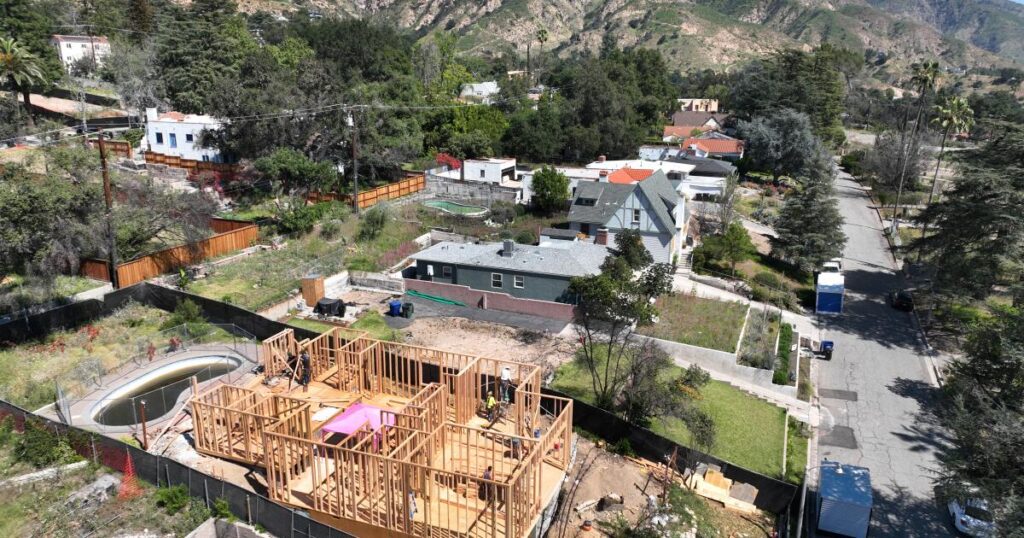
About 44% of homeowners have fully approved permits to rebuild, but only 30% have started construction, according to the data.
“This is the first step in a very long and extensive process,” said Gabriella Carmona, a senior research analyst at the institute and a lead author on the report. “Recovery is still very deeply uncertain for most households.”
Just under 50% of homeowners, the analysis found, still have taken no steps toward recovery.
The report analyzed data from single-family homes that were at least 50% destroyed in the fire, including building permit applications, property sale records and fire damage assessments, as well as race and ethnicity markers for potential disparities. The report did not analyze data for renters, businesses or the Palisades fire zone.
“Rebuilding activity increased across all groups, but the largest gains occurred among Black and Latino homeowners,” the report found, comparing similar data from August with February. The most recent data found that about 56% of Black homeowners had taken some step toward recovery, up from 27% in August. Among Latino households, that metric climbed to 63% as of February, compared with 35% in August.
The new data come as the Eaton fire recovery enters its 15th month. The Times last week released an analysis that found that just over half of all residences destroyed in the Eaton fire — roughly 6,000 — have filed applications to rebuild. The review also found that it is increasingly taking longer for applicants to obtain a permit, up to about 155 days.
Compared with the pace in Santa Rosa after the 2017 Tubbs fire, The Times’ analysis found rebuilding in both Altadena and Pacific Palisades was markedly slower.
Los Angeles County Supervisor Kathryn Barger, who represents Altadena, called the increase in applicants “meaningful forward momentum,” but she acknowledged that means residents from about 3,000 homes still haven’t started to move forward.
“The fact that only half of wildfire survivors have submitted applications makes clear that significant barriers remain, especially financial ones,” Barger said in a statement. “Many impacted residents have taken no action to rebuild because they lack the capital to move forward — an issue exacerbated by delayed insurance payouts.”
Barger continued to call for more federal support to help finance the recovery, something that Carmona said would help homeowners who remain stalled. But Carmona also said new policies are needed to support different financial avenues for families and community members to finance rebuilding, access meaningful loans and receive full insurance payouts.
It’s still unclear when and how much Southern California Edison may pay out to fire victims — the utility has not admitted it caused the fire but says its equipment was probably associated with the ignition, and faces hundreds of lawsuits — and what nontraditional or philanthropic options might be available to families.
“Many families [are] stuck between wanting to rebuild” and not being sure “what loan makes sense or what will be available to them,” Carmona said.
Marisol Espino, who lost her home in the Eaton fire and has since become a disaster case manager with the Legacy Land Project, said these financial questions had become a game of mental gymnastics for herself and many of her former neighbors.
“A major misconception is that people can just ‘rebuild,’” Espino said. Instead, people are finding out they’re underinsured, that their insurance money is tied to their mortgage, that they don’t quality for a loan or that the loan they received has major restrictions.
“What’s happening is that people are draining their savings, they’re pulling from their 401(k)s, they’re sacrificing their retirement and their children’s future to try to get back home,” Espino said.
She understands the desire to return home, she said, but worries about the long-term stability of this next wave of homeowners trying to rebuild.
A recent survey from the Department of Angels, a nonprofit focused on fire recovery and facilitating community organizing, found that about 40% of fire survivors had taken on debt since the fire, and the majority said their mental health had worsened.
“It is a bifurcated recovery, and the No. 1 factor is money,” said Joy Chen, the executive director of the nonprofit Every Fire Survivor’s Network. She said the group had found that the people who had been able to quickly rebuild either had prefire wealth or received full insurance payouts.
Though there are financial hurdles for many, the UCLA report pointed out some positive trends when it comes to home sales: Not only are investors making up a smaller share of homebuyers in recent months, but fewer homes are also being put up for sale. Altadena locals have been extremely concerned about investors and corporations buying up homes in their relatively affordable and diverse community, especially in historically Black neighborhoods where many homes have been passed down for multiple generations.
In August, about two-thirds of the sales of fire-damaged homes were made by investors — defined as limited liability companies, corporations or family trusts associated with real estate investment activity — but by the one-year mark, that share fell to about 59%, according to the report.
New listings in the fire zone also have slowed down, with only about 1% of severely fire-damaged homes up for sale in February, down from about 2% five months prior.
“In general, sales have been lower” than expected, Carmona said. “We had the biggest spike in the first couple months. … There really hasn’t been a massive uptick in sales since.”
And although much remains uncertain about Altadena’s recovery, the markers of progress do provide some hope, said William Syms, the executive director of the Legacy Land Project, which was founded in the wake of the Eaton fire to provide direct assistance to residents in need. His nonprofit is one of dozens that make up the Eaton Fire Collaborative, helping to provide residents with an array of resources they need to move forward, including case management and financial support.
“The outreach that’s happening, the conversation and events and the collective power of community is working,” Sym said. “I think more people realize that it’s possible to rebuild — and while it’s expensive and costly, together we’re going to make sure that anybody who wants to get home can.”
That includes Espino, who said Habitat for Humanity recently had found a way to help finance the rebuild for her multigenerational family.
“We’re moved on to the next phase,” Espino said. “We’re trying to get all of us together, back home.”
The post Rebuilding permits in Altadena have picked up, but construction lags and financial woes loom appeared first on Los Angeles Times.