The device used many of the same electronic components as the most lethal weapons of modern warfare. It was operated remotely. It could recognize images. It fired a laser.
Well, a laser pointer. The device, Petcube, was created by a Ukrainian entrepreneur, Yaroslav Azhnyuk, and his team. It is a smartphone-controlled gadget for remotely watching and entertaining dogs and cats when they are home alone. When Mr. Azhnyuk first tested it on a colleague’s lonely, incessantly barking dog, the animal jumped around wildly chasing the laser, he said.
Petcube is now sold in dozens of countries. But the company’s founders have moved on to a new idea, one that reflects an across-the-board transformation of Ukraine’s civilian technology industry into a hub of military contracting.
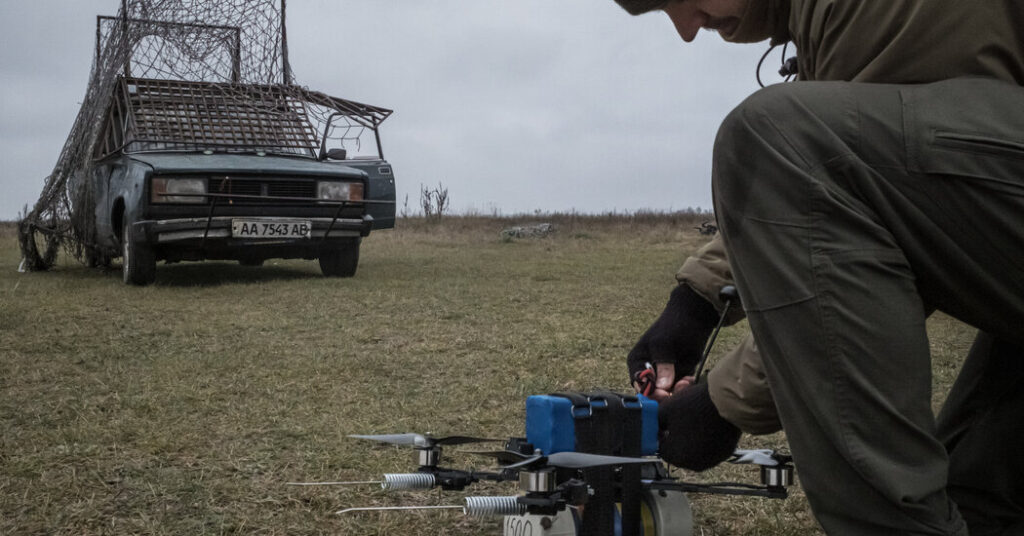
After initially joking about creating a military Petcube, with more powerful lasers to zap Russian troops, Mr. Azhnyuk and his team turned to first-person-view, or F.P.V., drones. Such small, buzzing quadcopters, carrying explosives, have become ubiquitous on the battlefield in Ukraine.
The team, now working as two new companies called Odd Systems and The Fourth Law, integrated an artificial-intelligence-powered image-recognition system into the drone. Instead of identifying, say, a dog or a cat, it can be asked to spot military vehicles, artillery pieces or enemy soldiers.
The image-recognition system is meshed with an autopilot program that is used to attack. Pilots who fly Odd Systems drones use a targeting approach called YOLO, or “you only look once.” After operators see a target, they engage an automated system, and the drone flies the final 400 or so yards autonomously, making it impervious to Russian jamming.
Odd Systems also produces a drone interceptor made to counter Iranian-designed Shahed drones. Russia has been firing these cheap, triangular exploding drones at Ukraine for years, and Iran has used them in recent weeks to attack U.S. bases, American embassies and other targets in the Middle East. The company’s interceptor, Zerov, is a fast, rocket-shaped craft with four propellers that is programmed to identify Shaheds, fly toward them and explode.
Iran’s attacks have prompted a surge of interest in Ukrainian anti-Shahed technologies. Odd Systems declined to disclose whether it is exporting its products to the Middle East or plans to do so.
In Ukraine, the company’s F.P.V. drones with an image-recognition system are in regular use on the front. It is testing versions that fly autonomously along a programmed route and strike targets identified from a database.
“We made cameras that threw treats for pets. and now we make cameras that throw explosives at occupiers,” Mr. Azhnyuk, 37, said in an interview at a restaurant in Kyiv, where the company is based.
The Red Cross and other groups monitoring the laws of warfare have opposed the use of A.I. to conduct strikes without full human control. But Mr. Azhnyuk said such developments were necessary in Ukraine to counter a ruthless adversary, and would be needed in other conflicts as drones dominated battlefields.
Odd Systems and a sister corporation operated by the same team, Fourth Law, are emblematic of the boom in weapons start-ups in Ukraine. Investors are finding opportunities, partly with an eye on a postwar period in which the companies could export their products as well as supply the Ukrainian Army.
Ideas for weapons that seem exotic or fanciful are making their way onto the battlefield at a fast clip. Helium balloons that drop drones, guns that fire nets rather than bullets, remotely piloted exploding speedboats, wheeled robots that retrieve wounded soldiers and underwater drones are all finding a place in the Ukrainian military.
The underwater drones look like smooth black telephone poles with propellers. Late last year, one design struck and damaged a Russian submarine in port, the Ukrainian military said, showing the vulnerability of a vaunted Cold War-era naval vessel.
A major priority for both Ukraine and Russia is F.P.V. drones. On both sides, such drones now inflict most casualties. Russia has focused on producing a few effective systems at a vast scale. Ukraine has struggled with production but has a huge array of new designs.
More than 2,000 military technology start-ups are active in Ukraine, according to Brave1, a fund set up by the Ministry of Digital Transformation for defense investment. Some arose out of the military, beginning as basement workshops for drone units.
Last year, foreign direct investment in Ukrainian defense companies rose to about $100 million, from $40 million the year before, according to Artem Moroz, head of investor relations at Brave1. About 80 companies raised funds on capital markets, he said.
The largest deal last year came in September. Swarmer, a developer of A.I. targeting software for swarms of drones, raised $15 million. Investors included several American venture funds, including D3, which is backed by Eric Schmidt, the former chief executive of Google.
This month, U-Force, a consortium of Ukrainian drone manufacturers including the maker of Magura drone speedboats, raised $50 million in seed capital. That investment valued the company at more than $1 billion.
Public money is also a source of financing in Ukraine’s defense industry. Half a dozen European countries, led by Denmark, are investing in Ukrainian companies. These investments sometimes help contractors at home, too. Estonia funds Ukrainian companies if at least 30 percent of the components in their products are Estonian-made.
In another business model, foreign contractors partner with Ukrainian companies on a mostly non-monetary basis, trading technology for access to the battlefield and the possibility that Ukrainian soldiers will test their products on the battlefield. Shield AI, a San Diego-based contractor, cooperates with Iron Belly, a company based in Lviv, in western Ukraine, that makes fixed-wing exploding drones.
Funding rounds are not always made public. “In the U.S. and Europe, whenever somebody raises money, they want a lot of publicity,” Mr. Moroz of Brave1 said. “In Ukraine, companies want to stay in the shadows” because their factories are prime targets for Russian missiles.
Before the war, Ukraine’s tech industry had achieved outsize international success. Among its stars were Grammarly, a writing tool, and Ring, a video doorbell and home security company that Amazon bought in 2018 for about $1 billion. Information technology was Ukraine’s third-largest export until the 2022 invasion, behind steel and agricultural products.
Before the war, Mr. Azhnyuk, the Petcube founder, was dividing his time between Kyiv and San Francisco, honing his product for pets. He hails from a long line of Ukrainian academics, who he said initially looked down on the project as frivolous.
On the day that Russia began its all-out attack, Mr. Azhnyuk decided to step down as chief executive and focus on helping Ukraine’s defense. By 2023, he had set up Odd Systems and Fourth Law to tackle what he saw as a key technological challenge of the war.
About 90 percent of drones crash rather than hit a target. Video signals are jammed, or the craft fly out of radio range and plunge from the sky. Mr. Azhnyuk’s auto-targeting system is intended to address that problem.
Taking humans partially out of the equation is “not as scary as it seems,” he said. The drones are geofenced, meaning they will strike only within a designated zone. That is intended to prevent the drone from attacking a civilian or circling back on the soldier who launched it.
Mr. Azhnyuk said he had attracted early rounds of seed capital but could not disclose the sources for security reasons.
Last month, Axon Enterprises, the Arizona-based maker of Tasers, announced an investment in Mr. Azhnyuk’s Fourth Law. The amount was not disclosed.
Mr. Azhnyuk was unapologetic about creating a computer program designed to automatically make life-or-death decisions.
“We could literally regulate ourselves to death” by holding back on A.I. in weaponry, he said, given that Russia and China had no such qualms.
He said he was obliged to carry on the design work because “I took an oath to defend my country when I was in the Boy Scouts.”
Oleksandr Chubko contributed reporting.
Andrew E. Kramer is the Kyiv bureau chief for The Times, who has been covering the war in Ukraine since 2014.
The post He Made a Gadget to Amuse Pets. Then He Turned to Killer Drones. appeared first on New York Times.