Pryor, Okla., is a low-slung town of 9,700 people, tucked among hills and woods. The area is well stocked with cows, Dollar General stores and signs praising Jesus. But for two days in March, its population swelled, as the Okie Homesteading Expo brought 3,000 people from all over the country eager to return to the land.
The town’s Mayes County fairground was packed with young couples, babies in arms and children in tow. They snacked on kettle corn and honey suckers, and sipped iced tea or kombucha, as they listened to lectures on home-schooling and “The Indispensable Dairy Cow.” They watched a freshly killed pig get butchered “from nose to tail” and took lessons in canning and cooking from scratch.
The expo was founded just five years ago by Sean Farnsworth and Kevin Pritchett, childhood friends from the area.
They dreamed of dropping out of the corporate grind while protecting their families from the uncertainties of the future — a natural disaster, war or pestilence.
They raise goats, pigs and chickens. They fill freezers with fish and deer.
They are determined to be self-sufficient and to teach others how to live that way too.
“Let’s say if the United States was attacked by another country or something, and the power grid goes down — if there’s no food, no gasoline — we could live on our farm for an extended period of time,” Mr. Pritchett said.
Homesteading evokes a frontier America. But these days, it means having the skills to grow your food, survive off the grid, if necessary, and take care of family and community.
There is no official count of homesteaders, but the number of people who are truly self-sufficient is vanishingly small. Interest in homesteading seems to be strong, though, at least judging by the many traveling to a small town in Oklahoma to learn about it.
When the Homesteaders of America, a national group, held its first conference in 2017, it drew 1,500 people. Last fall, 6,000 people attended, said Amy Fewell, the founder.
Other events have sprung up across the country, including in Texas, Washington State, Michigan, Virginia, Arkansas, Idaho and Tennessee. Even though they are not formally affiliated, they form a kind of circuit for homesteading evangelists.
When the Okie Expo started five years ago, 1,500 people showed up in the first zombie-eyed days when the Covid pandemic had begun to recede.
It’s no coincidence that the pandemic — with its toilet paper shortages and virtual classrooms — helped drive the movement. For all its bucolic, back-to-the-land imagery, homesteading taps into the desire to escape from the discontent and disquiet of modern America. Homesteaders believe disaster could happen anytime, and few are ready to handle it.
Homesteading for many is something of a religious calling.
“We truly feel like God is calling us back to this movement to support our families and our communities and those who might be in need, when — if — the system collapses,” said Ms. Fewell of Homesteaders of America.
Collapse could mean that “it’s the end of days and Jesus is coming back,” she said. Or that grocery shelves are empty because of a disaster. People want to be ready.
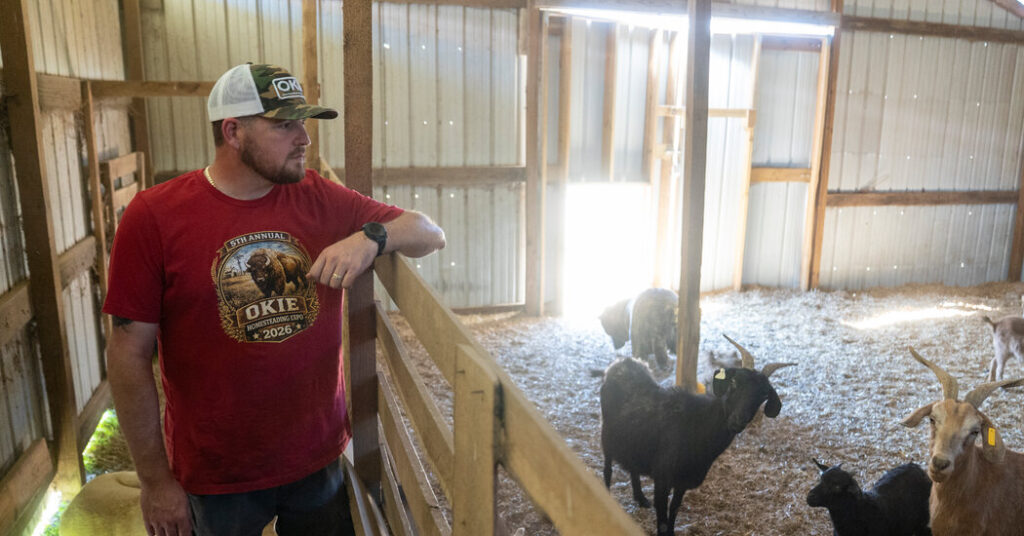
Mr. Pritchett, the Okie Expo co-founder, felt the precarity of corporate life in 2009, when he lost his job at a large Gatorade plant that was shutting down. In 2012, he bought a milk goat to feed his newborn daughter, who could not tolerate cow’s milk.
Since then, he has expanded to about 50 goats and 60 chickens, as well as three miniature donkeys, turkeys and bees. Guard dogs protect the animals from coyotes and bobcats.
But self-reliance goes only so far. There are property taxes to pay, tractors to fuel and children to educate. He works as a network engineer for a power company, and his two children attend public school.
His two emus are another concession to modern life. Emu eggs, which are the size and color of an avocado, help draw interest to his YouTube channel.
The Start
The original homesteading movement, in the 1800s, was born not of pessimism, but abundance.
Homesteaders then believed that the United States was “this boundless place of unimaginable natural resources that can never be exhausted,” said Jared Phillips, an associate professor of American history at the University of Arkansas who wrote a book on the back-to-the-land movement.
It was the duty, he said, “of Americans to go forth and settle.” The government gave away land to private ownership as part of the westward expansion.
But contemporary homesteaders are not getting land for free. To go back to the land, you need to buy land, which can be expensive, though not so much in Oklahoma as in other places.
At the expo, people often asked how much land is required to support one dairy cow, the first step on the road to self-sufficiency. (As a rule of thumb, two well-managed acres.)
One couple, Matt White, 50, a retired Air Force lieutenant colonel, and his wife, Lara, 51, a real estate broker, are buying 30 acres north of Oklahoma City.
They are thinking about buying some cows, too. “We’ve always been controlled by our circumstances,” Ms. White said. “We want to try to control our own circumstances.”
They stopped at a booth run by Beth and Shawn Dougherty, a couple in their 60s, who in the 1990s left their jobs and paid $11,000 for a house on 17 acres in eastern Ohio. They home-birthed and home-schooled eight children, wore thrifted clothes, drove a rusty car and farmed.
“We were willing to be very cash poor in order to be life rich,” Ms. Dougherty said.
At their stall, they were selling their how-to manuals for homesteaders. The pandemic, they said, had pushed people toward their life.
People turn to homesteading because they distrust authority, Mr. Dougherty said. “They’re beginning to distrust all of those systems.”
On the Homestead
On a break from the expo, Mr. Farnsworth gave a tour of his homestead. He showed off eight 300-pound pigs, including two pet pigs, Pearl and Percy. There were chickens and two goats with triplet kids, born the night before.
Mr. Farnsworth said his decision to homestead had been influenced by his time as a Marine in Iraq. “Kids were starving,” he said. “Whenever I was going to start raising kids, I wanted to be self-reliant.”
He bought land and built a house and a barn with help from friends, family and an Amish family.
He raises pigs for members of his church, asking only for the $150 butchering fee. He barters for vegetables and lets his neighbor collect eggs from his chicken coop.
“When my neighbor is not asking for eggs, we’ll eat them,” he said.
If hard times come, Mr. Farnsworth will be ready. He has a 500-gallon backup water tank and 30 days of food for himself, his wife and their three daughters, who attend a private Christian school.
He also keeps ponies and peacocks, a bow to popular demand on his YouTube channel, Keeping It Dutch. (Dutch is his nickname.) Unlike many YouTubers, he makes a healthy six-figure living at it, he said, perhaps because he is good at ratcheting up a sense of danger and suspense — like a plot thread about his dogged pursuit of a trespasser.
Mr. Farnsworth also sells merch, tees, caps and sweatshirts. But he says he has no aspirations to be, say, Hannah and Daniel Neeleman, who chronicle their life on Ballerina Farm, in Utah, to help sell all kinds of home goods, including protein powder, aprons and cutting boards.
Most homesteaders produce too little to make much money. It’s about survival.
And, on occasion, joy. One night, more than 80 people linked to the expo went to a restaurant in an unmarked Amish farmhouse at the end of a remote gravel road. At long communal tables, they passed heaping platters of mashed potatoes and gravy, coleslaw, green beans, fried chicken, shredded beef, hot biscuits and apple butter.
For dessert, there was chocolate, apple or lemon meringue pie. In the darkness outside, a row of cows watched curiously from behind a fence.
At that moment, Pryor seemed like a good place to be when the end of days arrives.
Alain Delaquérière and Georgia Gee contributed research.
Anemona Hartocollis is a national reporter for The Times, writing about public health.
The post These Homesteaders Live Off the Land (and Prep for the End of the World) appeared first on New York Times.