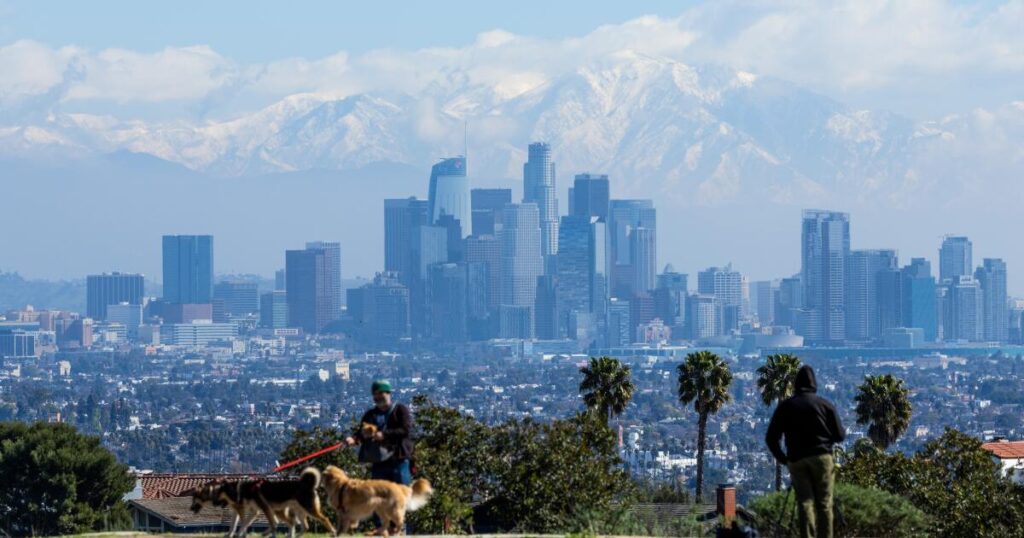
Long the epicenter of population growth in the United States,Los Angeles is slowly losing its people because of a series of demographic shifts that experts say could have profound implications for the county if trends continue.
High housing prices have led a growing number of residents to leave the region for more affordable parts of the country. Immigration — long a pipeline for population growth — has ebbed significantly under a federal crackdown. A rapidly aging population is adding to the concern over how these declines will affect the local economy.
“We’ve been depending on immigrants all along to sort of backfill our losses. As people move outward, they’re replaced by newcomers,” said Dowell Myers, a professor of urban planning and demography at USC. “If we had a continued drop in immigration for five years, it would be a major crisis. You can handle one or two years, but as long as the domestic migration is going out, you kind of need to replace those workers with somebody.”
New data from the Census Bureau show L.A. County lost approximately 54,000 people from July 2024 to July 2025, the largest numeric population decline in the nation.
A major factor in 2025, unlike previous years, was a sharp drop in net international migration. As the Trump administration launched an aggressive clampdown on immigration, L.A. County saw the number of new residents coming from abroad plummet from 92,000 people in 2024 to 29,000 in 2025.
More people also continued to move out to other parts of the U.S. than move in. L.A. County had a net loss of 105,000 residents because of domestic migration in 2025, a slight increase from the previous year when the county lost 99,629.
The upshot is Los Angeles, one of the most dynamic boom towns in U.S. history, has led the nation in numeric population loss for all but one of the last eight years. Demographers and regional planners say the slow but persistent decline raises urgent long-term questions about the future of L.A.’s workforce, social services and economy.
“We’ve been stalled out for a long time,” Myers said. After the COVID-19 recession, Myers said, things were getting back to normal, “but normal is we are dependent on immigration, have an aging population and high housing costs that discourage young families.”
While conservative critics of L.A. have rushed to frame the population loss as a “mass exodus” of people fleeing rampant crime, high taxes and inadequate services, the reality is more complex.
Los Angeles is by far the nation’s largest county, with 9.7 million people — nearly double the next largest, Cook County, Ill. In that sense, it’s not surprising that it saw a severe drop in population after the Trump administration rolled out a flurry of executive orders and new legislation aimed at restricting immigration. L.A. County is a historic hub for immigrants from Latin America and Asia, and a place where 1 in 3 residents is an immigrant.
Even so, L.A. was not an outlier. The pattern of population decline, along with a sharp drop in international migration, was seen across U.S. metropolitan areas. George M. Hayward, a Census Bureau demographer, said nearly 8 in 10 U.S. metro areas had slower growth in 2025. Even more — 9 in 10 — saw a decrease in international migration.
While L.A. County has made headlines, its 0.5% population loss was less severe, in percentage terms, than many rural counties with small populations in red states such as Florida, Louisiana and Mississippi.
One reason L.A.’s domestic population loss was moderately higher in 2025 than 2024 is that the deadly wildfires that ravaged Pacific Palisades and Altadena displaced tens of thousands of people. About 17% of the 30,000 displaced left L.A. County, according to Melissa, a global address provider. But a more long-term reason people are leaving L.A. is the high cost of housing, which makes it harder for younger Angelenos to put down roots and raise children.
Going forward, Myers said, L.A.’s top priority should be to retain people who are in their 20s and make it easier for young families to settle.
“Everyone that migrates away is a lost opportunity,” he said. “We need to keep them here, because we’re going to need them even more when they’re in their 40s. And especially if they went to California schools, we don’t want to waste our investments by letting them go to other states.”
For well over a century, Los Angeles’ population lurched upward. Propelled by the 1848 Gold Rush, the early 1900s oil boom, the rise of Hollywood and World War II naval and aerospace manufacturing, it grew from just 3,530 residents in 1850 to 8.9 million in 1990. Even as growth slowed over the last three decades, L.A. was helped by a robust entertainment industry.
“Now, Hollywood has been slumping,” Myers said. “So what is our new technology, our new economy, that’s going to be our big attractor? This is a national problem. It’s not just us, but it’s not obvious what that would be right now.”
Some demographers say L.A. does not face inevitable decline.
Hans Johnson, a senior fellow at the Public Policy Institute of California, said what makes L.A. County unique, compared with other big metros that have lost population in the past, is that the demand for housing remains pretty robust, partly because California has long had an undersupply of housing.
California has built almost 700,000 housing units over the last years as it has had hardly any population growth, Johnson said, yet its vacancy rates remain lower than the rest of the nation.
It is hard to imagine, then, that L.A. would follow the path of Rust Belt cities in the Midwest and Northeast. When Detroit and Cleveland lost huge chunks of populations as the automobile, manufacturing and steel industries cratered, entire blocks of blighted properties were demolished. But Los Angeles, Johnson noted, has some amenities that Rust Belt cities do not: a Mediterranean climate, a dynamic food and culture scene, proximity to the sea.
L.A. and California, Johnson said, are far from some sort of “death spiral.” “We don’t see people having a hard time selling their houses,” he said. “If … you go to Los Angeles and you try to find all the neighborhoods that people have evacuated because they can’t stand living here, you won’t find them.”
County leaders can take policy steps with education, child care and housing, Myers said, but the governmental units that cover those topics are fragmented into different agencies. The county, he said, needs an oversight agency.
“No one has a strategy,” he said. “Political leaders have got their hands full with problems and it’s an old truism — I won’t blame people for this — but politicians tend to focus on things that occur within their term of office. … I think people also are afraid. They don’t want to talk about it.”
A major challenge for L.A. is its rapidly aging population. By 2040, L.A.’s older adult population is projected to increase by 61% from about 1.4 million to 2.3 million, according to the Public Policy Institute of California.
This is a problem for the U.S. as a whole. But fertility rates have dropped dramatically in Southern California, from about 2% 20 years ago to 1.43% now, said Kevin Kane, regional planner in the Research & Analysis department of the Southern California Assn. of Governments. That’s a lot lower than the national fertility rate of about 1.62% and well below the replacement level of 2.1 required for population stability.
Southern California’s median age — currently 38.8 — is rising faster than regional forecasters imagined, Kane said. Four years ago, when forecasters projected the median age in Southern California for 2050, they anticipated it would rise to 43.8. But lower fertility rates and declining immigration now have them upping their estimate to 46.4.
“We’re not anticipating much job growth, either,” Kane said, noting that the only sectors projected to have substantial growth in Southern California in the long term was healthcare and social assistance. “You really can’t grow jobs without the population.”
With the first baby boomers turning 80 this year and then 18 years of boomers coming after that, Myers said, it’s vital that L.A. has a strong inflow of people ready to step up and pay the price people think their houses are worth.
“That decline in kids is going to haunt us for decades, because those are our future workers and taxpayers and homebuyers.” Myers said.
A rapidly aging population will fundamentally alter L.A.’s ratio of workers to non-workers, placing a burden on social services and thwarting economic growth. Costs will rise for programs such as Medi-Cal, the state-subsidized healthcare system that provides people with limited incomes free or low-cost medical care. Local governments and school districts across L.A. will also be strained.
Even if politicians in Washington, D.C., relax federal immigration policy, international migration is not necessarily always going to replenish L.A.’s losses, Johnson said.
The population slowdown isn’t confined to high-income Western countries, he said; it is happening all over the world. Mexico, which used to be the primary source of immigrants to California, has seen a significant slowing of population growth and now has a birth rate below the replacement level.
“There is a kind of outstanding question,” Johnson said, “of whether the number of people who want to migrate internationally will go down — probably it has already been going down — and what that might mean for countries that are seeking to find immigrants to help increase their workforce.”
For Johnson, there could be at least one potential silver lining in L.A.’s population decline.
Young Californians, who have historically lived in overcrowded housing units and haven’t been able to establish their own household, are starting to do so more now than they did five years ago. The change is small, he said, but promising. If it continues, household formation rates might start to rise for a new generation of Angelenos.
“Maybe we will see more opportunities for people,” he said, “to be able to find a house here in California.”
The post Los Angeles’ population is shrinking. Is region headed for a Rust Belt ‘death spiral’? appeared first on Los Angeles Times.