President Trump has championed the U.S. steel industry, promising to strengthen it and to impose stiff tariffs on foreign metals to shield manufacturers from overseas competitors.
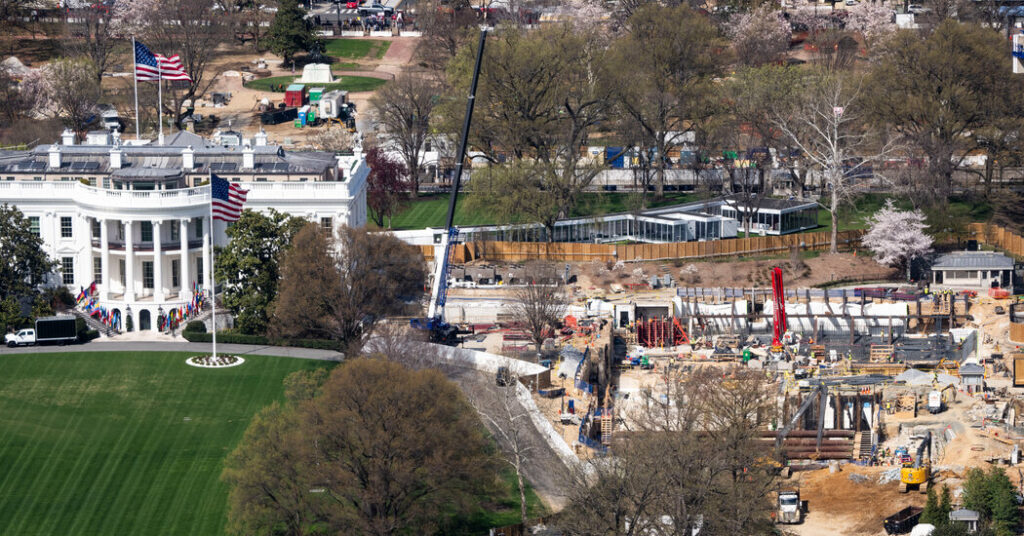
Yet the White House has secured tens of millions of dollars worth of donated foreign steel for Mr. Trump’s $400 million ballroom project, according to two people familiar with the plans who spoke on condition of anonymity to discuss sensitive and private conversations.
ArcelorMittal, a Luxembourg-based firm that is the world’s second-largest steel maker, is providing steel for the structure of the ballroom project, the people said. They said the steel was produced in Europe, where the bulk of ArcelorMittal’s production is concentrated.
The White House has not disclosed details of the donation, but Mr. Trump said last October that he had been offered a donation of steel for the ballroom valued at $37 million.
The president’s comments came just days before the White House made adjustments to its tariffs that could benefit ArcelorMittal, by cutting in half the tariffs applied to exports of automotive steel from its Canadian plant.
Mr. Trump has boasted that taxpayers are not on the hook for building his ballroom, the cost of which has risen by 100 percent, according to the president’s own estimates. But the use of foreign steel for a ballroom built at the most recognizable building in the United States may anger domestic companies and unions that are trying to promote the U.S. industry.
The president has said that he already raised the money for the ballroom from wealthy donors, including major tech and crypto companies, and that businesses pledged to donate all of the steel and air conditioning for the structure.
He identified Carrier, a U.S. company, as the donor behind the air conditioning, but did not say which business would provide the steel. The White House has made public the names of some donors to the project, but has allowed others to remain secret.
ArcelorMittal declined to comment. Davis Ingle, a White House spokesman, said that Mr. Trump was “making the White House beautiful and giving it the glory it deserves at no cost to the taxpayer — something everyone should celebrate.”
He added: “Only people with a severe case of Trump Derangement Syndrome would find a problem with that.”
Mr. Trump spoke about the donated steel at a White House event last October for wealthy donors to the ballroom, saying a “great steel company” had approached him seeking to give him a gift to facilitate the project.
“He said, ‘Sir, I’d like to donate the steel for your ballroom,’” Mr. Trump told the crowd. “I said: ‘Whoa., that’s nice.’ And I found out — ‘How much is the steel?’ I called the contractor. ‘Sir, it’s down for $37 million.’ I said, ‘This is a nice donation, right?’”
Mr. Trump described the metal as “great steel as opposed to garbage steel, because they dump a lot of garbage around. You know, steel is like everything else, including human beings. Steel could be high quality, and it can be low quality. He wants to make sure it’s high quality.”
Two days after the remarks, the White House issued a lengthy and legalistic proclamation with a provision that would benefit ArcelorMittal. The document made various adjustments to tariffs on trucks, buses and auto parts.
The proclamation contained a provision authorizing Howard Lutnick, the commerce secretary, to reduce by up to half the tariffs for aluminum or steel producers that operate facilities in Canada or Mexico and supply U.S. makers of cars or trucks. The adjustments would be limited to quantities of aluminum or steel “equal to newly committed United States production capacity, as determined by the secretary,” the document said.
ArcelorMittal makes automotive steel in Canada that is exported to the United States. The company also committed last year to expanding a facility in Alabama, which could help it qualify for the provision.
A White House official who declined to be named because he was not authorized to speak publicly on the subject pushed back on the idea that there was any connection between a donation and the tariff exemption, calling the link “tenuous.” Neither ArcelorMittal nor any other company had yet received the tariff exemption that was outlined in the proclamation, the official said, adding that the provision would benefit other steel companies, too.
Reviving the steel industry has been a focus of Mr. Trump’s trade policies. The president first imposed a 25 percent tariff on foreign steel in 2018. Last June, he doubled it to 50 percent, an effort to block foreign metals from the U.S. market and encourage more domestic production.
Representatives of U.S. steel companies said the choice to accept foreign steel for such an iconic American building could anger U.S. producers, given the sensitivity surrounding steel tariffs.
Brandon Farris, the executive vice president of the Steel Manufacturers’ Association, a trade group representing North American steel makers, said in a statement that the domestic steel industry was “experiencing a resurgence” thanks to the tariffs, and could supply whatever steel the president would need for his projects.
“Our members stand ready to supply the high-quality, American-made steel needed to bring the president’s infrastructure and manufacturing priorities to life,” he said.
ArcelorMittal is a globe-spanning metals and mining company. It produces steel in France, Germany, Brazil, Canada, India and other locations. The company completed the acquisition of a plant in Alabama last year that produces a type of steel used in electric vehicle motors, and is planning another nearby. The facilities would partially insulate it from the effect of Mr. Trump’s tariffs on foreign metals.
A White House official emphasized that while ArcelorMittal is a foreign firm, it is benefiting the U.S. economy through a joint venture with Nippon steel in Alabama and an iron mine in Minnesota. The official also denied that ArcelorMittal got anything in return for its donation.
ArcelorMittal was formed in 2007 when a steel firm owned by Lakshmi N. Mittal, an Indian-born billionaire and business magnate, acquired the European steel giant Arcelor.
Mr. Mittal, the company’s chairman and former chief executive, has been a vocal supporter of Mr. Trump, praising him in a business round table in New Delhi in 2020.
Tariffs have made exporting steel into U.S. markets more expensive. But they have also raised global steel prices as a result, benefiting Mr. Mittal’s business. Mr. Mittal commended Mr. Trump’s efforts to place trade restrictions on Chinese steel exports. And in response to U.S. tariffs, Mr. Mittal urged the European Union to step up its trade protections of European steel.
Mr. Mittal also had a long history of business dealings with Wilbur Ross, Mr. Trump’s commerce secretary in his first term. Mr. Ross sold a steel company to Mr. Mittal’s firm and served on ArcelorMittal’s board of directors until he was confirmed as commerce secretary.
Mr. Mittal is also a board member at Goldman Sachs and the partial owner of an oil refinery business in India. The Financial Times reported last October that the refinery had bought Russian oil transported on vessels sanctioned by the United States and Europe. It subsequently halted the purchases.
Kenneth P. Vogel contributed reporting.
Ana Swanson covers trade and international economics for The Times and is based in Washington. She has been a journalist for more than a decade.
The post White House Secures Foreign Steel for Ballroom Project appeared first on New York Times.