The caps said it all.
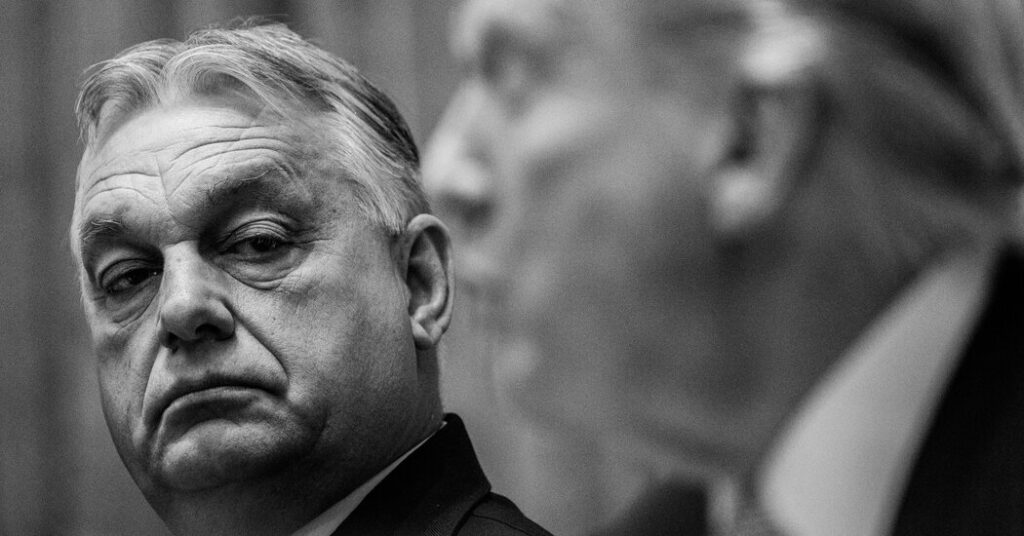
Writing on Truth Social in late March, President Trump expressed solidarity with Viktor Orban, Hungary’s prime minister. Looking ahead to Hungary’s parliamentary election this Sunday, Mr. Trump called Mr. Orban “a truly strong and powerful Leader” who “fights tirelessly for, and loves, his Great Country and People.” In case there was any doubt where his support lay, he concluded: “I AM WITH HIM ALL THE WAY!”
This was no isolated enthusiasm. Despite Hungary’s small size, with a population of under 10 million, many Trumpian figures see its longtime prime minister as a key political ally. In the fall, the administration’s National Security Strategy pledged to help “healthy nations” in Central and Eastern Europe, like Hungary, resist the “civilizational erasure” supposedly threatening the continent. “It’s in our national interest that Hungary be successful,” Secretary of State Marco Rubio summarized in February. For Mr. Trump, it’s simple. Mr. Orban is, he says, a “fantastic guy.”
His embrace may be a kiss of death for the Hungarian leader. Though MAGA supporters see Hungary as a conservative utopia, many Hungarians aren’t so happy for their country to play this role. Worse are the effects of Mr. Trump’s policies, aggravating an economic downturn and threatening the prime minister’s electoral support. In recent years, far-right parties around Europe have cultivated close ties with Mr. Trump; Hungary’s election may be a warning against getting too close. For if Mr. Orban falls, it will be in no small part thanks to his fan in the White House.
After a first term at the turn of the millennium, Mr. Orban has now ruled without interruption for 16 years. Wielding electoral majorities, his Fidesz party has remolded the country in its image. It rewrote the Constitution, forced the prestigious Central European University to leave and banned L.G.B.T.-related material in schools as part of a sweeping move against civil society. This, the all-dominant Mr. Orban claims, serves to defend Hungary’s national identity and even its independence from overbearing E.U. authorities.
All the while, the leadership in Budapest has courted international support, presenting itself as a model to be emulated. The government-backed Danube Institute sponsors National Conservative conferences, where fellow nationalists come together in major European cities to compare notes. Commuters browsing London rail-station kiosks may encounter a magazine titled Hungarian Conservative. (More rarely are they spotted reading a copy.) It’s all part of a concerted project of raising Hungary’s international prestige as a vanguard of illiberal rule.
Mr. Trump is one of many who have been convinced. The Fidesz government, in his words, has served to “Protect Hungary, Grow the Economy, Create Jobs, Promote Trade, Stop Illegal Immigration, and Ensure LAW AND ORDER!” The esteem goes both ways. Though the American president is widely unpopular across Europe, a recent poll suggested that almost one-third of Hungarians have confidence in him, especially supporters of the Orban government. Yet no matter the mutual respect, Mr. Trump’s policies are hurting Hungary.
Mr. Orban’s Fidesz enjoyed its highest popularity when it could combine culture-war messaging with a promise of prosperity. For a long time, it delivered. In the 2010s, Hungary increased the number of employed workers by almost 20 percent, reaching an impressive 4.7 million. In the decade after the financial crash, the poverty rate dropped, construction boomed and — despite Mr. Orban’s fierce criticism of the European Union — the government built up Hungary as a base for German car manufacturers. Growth rates duly rose.
That economic vitality was dented by the pandemic and became tougher to maintain after Russia’s invasion of Ukraine. Now Mr. Trump’s second presidency threatens to end it altogether. “America first,” with its penchant for tariffs and threats, is bad news for the European economy, on which countries like Hungary rely. Likewise, Mr. Trump’s push for Europe to buy liquefied natural gas from America, rather than Russia, will hit Hungary harder than most other member states. And then there’s the war in Iran, driving up energy prices and initiating an inflation spiral.
Some far-right leaders in Europe have woken up to the problem. At the start of Mr. Trump’s second term, Jordan Bardella of France’s National Rally said that his own country needed something like Elon Musk’s DOGE. Today, he seems keener to insist that he rejects “submission” to Washington. Reform U.K.’s Nigel Farage, previously happy to count Mr. Trump as a friend, vacillated on whether Britain should join the war in Iran. Even Prime Minister Giorgia Meloni of Italy, who positioned herself as the bridge between Europe and the Trump administration, has tried to keep her distance.
Mr. Orban remains keen to foreground his American supporters, such as Vice President JD Vance, who visited the country this week. Yet the claims of American admirers often ring hollow for Hungarians, not least those about Mr. Orban’s supposed pro-worker conservatism. Take Dunaujvaros, a steel town south of Budapest built in the 1950s as a socialist model city. Even after the regime transition, its steel plant continued to employ thousands of workers. But in 2022, after years of financial difficulties, production came to a stop.
Mr. Orban had his story ready. He blamed the war in Ukraine, sanctions on Russia and E.U. green policies, pledging that production would resume. But the promised investment didn’t come and the plant headed for final bankruptcy, leaving thousands of workers without jobs. Many locals blame Mr. Orban for failing to seek Brussels’s help to decarbonize the plant and keep it running. During a rally in Dunaujvaros last month, Mr. Orban avoided referring to the beleaguered steelworks, instead castigating Ukraine and leaving it up to the local candidate to make hopeful noises about jobs.
It’s in places like Dunaujvaros that Fidesz’s waning support may prove decisive. The party has long counted lower-income voters in smaller towns as its electoral bedrock — Mr. Orban recently warned that his party might be in trouble if “workers, laborers, apprentices, skilled workers and public workers don’t come to vote in sufficient numbers.” Current polls suggest that young voters and large cities may turn out in bigger numbers, to Mr. Orban’s disadvantage. Though the quantity of “don’t know”s makes firm predictions fraught, it seems clear that the Fidesz base is fragmenting.
Many international observers portray Hungary’s election as a battle of national identity versus wokeness, authoritarian rule versus liberal democracy. Mr. Orban, backed by both the Russian and American presidents, certainly has strongman support behind him. Yet it’s probable that many voters will choose on much more prosaic grounds, more related to their own living conditions. Mr. Orban’s main rival, Peter Magyar — a former Fidesz official, backed by most of the opposition — has remained coy about grand promises. His hope is that public exhaustion may finally bring Mr. Orban down.
Mr. Trump’s own election victories should counsel against any opposition complacency. Even a leader lacking majority support can win if his base is fired up, his internal critics are neutralized and the other side fails to energize its voters.
Still, however you cut it, things look bad for Mr. Orban. For more than a decade, he ruled not just through demonizing opponents and minorities but also by delivering tangible gains for many Hungarians. Today, in Mr. Trump’s world, it’s unclear whether that remains possible.
David Broder (@broderly) is the author, most recently, of “Mussolini’s Grandchildren: Fascism in Contemporary Italy.”
The Times is committed to publishing a diversity of letters to the editor. We’d like to hear what you think about this or any of our articles. Here are some tips. And here’s our email: [email protected].
Follow the New York Times Opinion section on Facebook, Instagram, TikTok, Bluesky, WhatsApp and Threads.
The post Orban’s Fate Is a Warning Not to Get Too Close to Trump appeared first on New York Times.