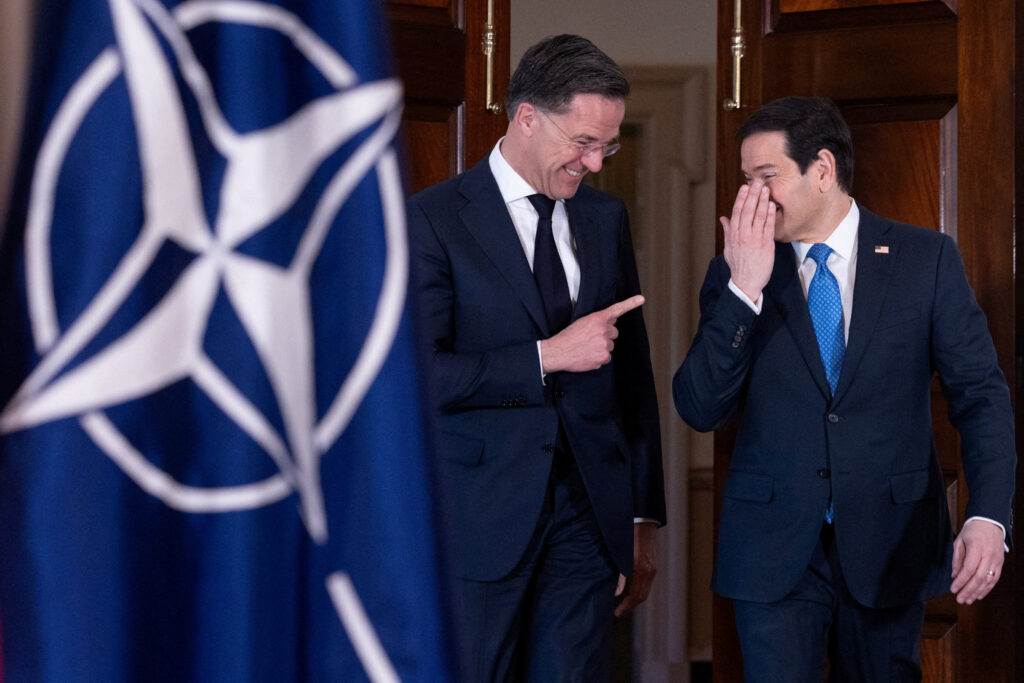
President Donald Trump appeared to hold back on Wednesday from taking dramatic action to reshape the U.S. relationship with NATO after a high-stakes meeting with its top leader, postponing for now the reckoning he has promised over Europe’s cautious approach to his war on Iran.
The White House said in advance of the meeting with NATO Secretary General Mark Rutte that Trump was planning to discuss the possibility of the United States exiting the alliance, a threat to the organization that for generations has been at the core of how the U.S. protects itself and its partners. But a Trump post on social media hours after the meeting made no mention of a pullout and simply repeated the president’s complaints about the alliance.
“NATO WASN’T THERE WHEN WE NEEDED THEM, AND THEY WON’T BE THERE IF WE NEED THEM AGAIN. REMEMBER GREENLAND, THAT BIG, POORLY RUN, PIECE OF ICE!!!” Trump wrote.
Trump, long a NATO skeptic, has been especially angry at alliance members in recent weeks for declining to take part in his attack on Iran, saying they had flunked his test of whether they would support the U.S. in a time of military need. He has said repeatedly that Europeans would soon find out his response.
Rutte, a former Dutch prime minister who has pursued such a deferential approach to Trump that last year he called the president “daddy,” has cheered the Iran war. But the campaign has strained Trump’s relations with European members of the alliance, who say the attack on Iran was both a violation of international law and bad strategy. Rising anti-American sentiment among their own voters is further limiting their appetite to defer to Washington.
“He is clearly disappointed with many NATO allies, and I can see his point,” Rutte told CNN after the meeting. “But at the same time, I was also able to point to the fact that the large majority of European nations has been helpful with basing, with logistics, with overflights, with making sure that they live up to the commitments.”
Pressed on whether Trump threatened to quit NATO, Rutte avoided answering directly, saying that “it was a very open discussion. He clearly told me what he thought of what happened over the last couple of weeks.”
Trump would face a legal fight if he attempted a formal withdrawal from NATO. But he could make clear that he wouldn’t commit the U.S. to the defense of other NATO nations should they come under attack, giving a green light to Europe’s adversaries interested in taking a bite of alliance territory. The prime beneficiary of such a change would be Russian President Vladimir Putin, who has long complained of NATO’s expansion into former Communist countries.
“It’s quite sad that NATO turned their backs on the American people over the course of the last six weeks when it’s the American people who have been funding their defense,” White House press secretary Karoline Leavitt said Wednesday before the meeting.
Pulling the U.S. out of alliance is “something the president has discussed,” Leavitt said, “and I think it’s something the president will be discussing” with Rutte.
NATO, created by the U.S., Canada and Western Europe to secure the peace after World War II, is an alliance that focuses on mutual defense — not one that envisages coming to the aid of a member that decides to attack another country. Its collective defense clause has been invoked once, by the U.S. after the attacks of Sept. 11, 2001, and members took part in the invasion of Afghanistan to dislodge al-Qaeda and the Taliban from that country. NATO did not fight with U.S. forces in Korea, Vietnam or Iraq.
Relations between Trump and many European leaders nose-dived in January, when the president intensified his effort to seize Greenland from Denmark against its will. Some European officials believe Trump was prepared to launch a military invasion of the Arctic territory — a previously inconceivable step that, if taken, would flip the U.S. from the alliance’s core defender to its chief threat.
Trump didn’t give Europeans a significant heads-up before the Feb. 28 attack on Iran to preserve the element of surprise against Tehran. But he blasted British Prime Minister Keir Starmer for initially denying U.S. warplanes the use of British bases during the attack and was angry that Europeans did not immediately follow Washington into war once the bombing had begun.
Trump this week suggested his resentment stems from Europe’s pushback against his bid to seize Greenland, and has only escalated over the hesitation to applaud the U.S. war of choice in the Middle East.
A formal U.S. withdrawal from NATO would requirea two-thirds vote by the Senate or an act of Congress — a restriction imposed in 2023 by then-Sen. Marco Rubio, now Trump’s secretary of state, who co-sponsored bipartisan legislation to bar a U.S. president from exiting NATO unilaterally. The measure was spurred by worries that Trump, if he returned to power, might try to quit the alliance.
NATO’s collective defense clause has been the principal guarantor of European security while serving U.S. military interests since the alliance’s creation. The U.S. officials who helped set it up planned a predominant military role for the United States in Europe as a bulwark against the Soviet Union. After the Cold War, it served as a stabilizing force as former Communist nations transitioned to democracy and capitalism and shifted allegiances from Moscow to Washington.
But successive presidents have pressured European members to increase their defense spending and ease their reliance on the U.S. That spending rebounded after Russia’s 2014 annexation of Crimea, accelerated after Trump won his first term in 2016 and has continued to grow. NATO leaders agreed last year to boost defense spending to 5 percent of their annual economic turnover, a significant increase that bought months of goodwill from Trump. But the president has never abandoned his core irritation with the alliance.
Formalities and legislation aside, Trump could pull U.S. troops or military assets from Europe or stop sending U.S. weapons to Ukraine paid for by the Europeans.
Already, Trump’s repeated questioning of NATO’s core collective defensepromise has spurred questions about whether the U.S. would honor its commitment to defend any inch of NATO territory that came under attack, European officials have said.
“Alliances like NATO are valuable in what is left unsaid, that is, the confidence that underlies them,” French President Emmanuel Macron told reporters last week. “If you cast doubt on your commitment every day, you strip it of substance.”
The wavering U.S. commitment has spurred European nations, wary of an emboldened Russia, to embark on a military buildup of their own.
Polish Foreign Minister Radoslaw Sikorski has implored his country, which borders Russia, to take the prospect of a U.S. exit seriously. He said Poland, which has dramatically increased defense spending since Russia’s invasion of Ukraine, needs two “insurance policies instead of putting all our cards on one option.”
“Of course, NATO is the cornerstone of our security,” he said. “Of course, we want to be a good, loyal ally of the United States, but we cannot pretend that the U.S. president isn’t saying what he is saying.”
Trump expressed his exasperation at NATO after European leaders rebuffed his calls to deploy warships to reopen the Strait of Hormuz. The vital corridor for the world’s oil supply that has been effectively blocked by Iran since the U.S. and Israel launched their attack.
The 11th-hour announcement of a ceasefire on Tuesday could help Rutte avoid a wider confrontation. The NATO chief has focused on praising Trump as a dealmaker.
But it remained unclear whether if the truce would meet conditions set by European nations before they help escort ships through the strait. Leaders in France, Britain and other nations have said their navies would help secure the waterway, but only if there is a de-escalation with Iran.
Rutte has tried to address Trump’s grievances by pointing to European efforts to rally an international coalition for the Strait. But although his strategy of flattery and transaction clinched a deal on NATO defense spending and helped find an off-ramp on Greenland, it has yet to pay off this time.
Instead, Rutte’s declarations on U.S. television networks, including Fox News, that NATO allies are “absolutely supportive” of the war have riled some European officials and raised questions about his approach to managing Trump.
“You can see it as taking one for the team, but you can also see it as going too far,” said a European diplomat, who spoke on the condition of anonymity to share internal discussions.
Several European leaders, distancing themselves from an apparently open-ended conflict that’s unpopular across much of the continent, have portrayed it as outside international law and beyond the realm of NATO.
Still, some countries, including Britain and Germany have quietly offered military support, allowing the U.S. to use bases to refuel or facilitate the war effort.
Spain closed its airspace to U.S. aircraft involved in the bombardment of Iran, drawing the administration’s ire. Spanish Prime Minister Pedro Sánchez, who has been among the most outspoken European critics of the war, welcomed the ceasefire announcement Wednesday. Still, he said, his government “will not applaud those who set the world on fire just because they show up with a bucket.”
Macron described the ceasefire as “a very good thing,” and said it “should be respected fully, across the region” in the coming weeks to allow for negotiations.
Macron said France had sought to mobilize partners in Asia, Europe and the Middle East, and that about 15 countries have joined in planning for a mission to help facilitate the resumption of traffic through the Strait of Hormuz “when the conditions are met.” He said that would happen “in coordination with Iran.”
The post Trump vents at NATO but avoids rupture after meeting with alliance’s leader appeared first on Washington Post.