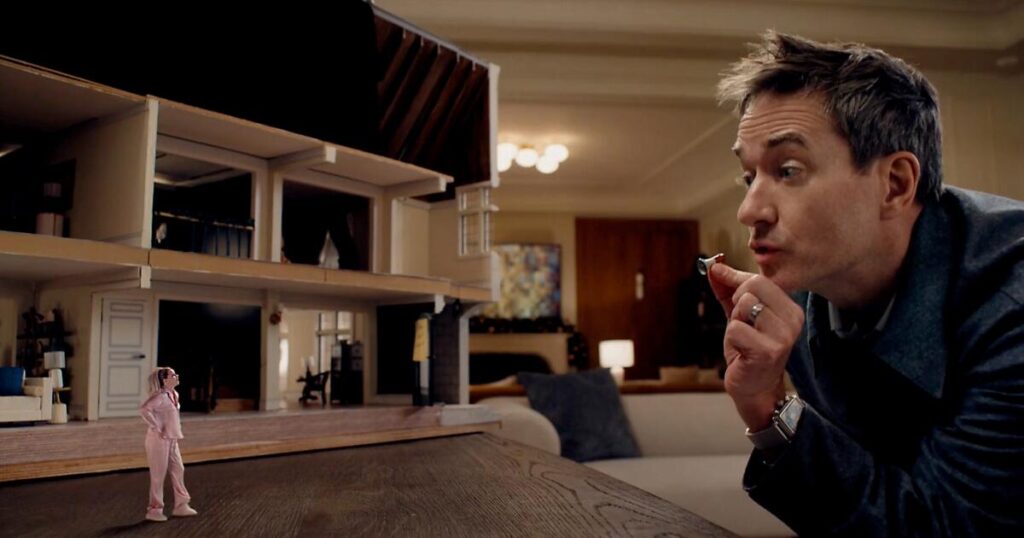
“The Miniature Wife,” premiering Thursday on Peacock, is a messy, energetic science fiction farce about a scientist who shrinks his wife to a height of six inches, or more to the point, about a woman whose scientist husband shrinks her to a height of six inches, by accident, on purpose, or accidentally on purpose. (Watch closely to make up your own mind.) Created by Jennifer Ames and Steve Turner, it’s based on a 2013 short story by Manuel Gonzales, sharing its central conceit, characters, various plot points and details to a rather different effect while adding a boatload of extra characters, plot points, details and backstory and extending the story’s arc toward a resolution fit for television.
Elizabeth Banks plays Lindy Littlejohn, the miniaturized wife, who introduces the series over a montage of future bite-sized misadventures. (Lindy is bite-sized, that is, not the misadventures.) “This is a love story,” she begins, going on to describe the ways love can make you crazy. “Fair warning, it’s going to get worse before it gets better.” The important notice here is not that it’s going to get worse, but that it’s going to get better, as you will be given much cause to doubt that it will.
Matthew Macfadyen is Les Littlejohn, the small-making husband, whose public claim to fame is a superior GMO tomato. (He has poster-sized photos of himself holding one both at home and in the office.) But, with more than a bit of desperation, he regards his work in miniaturization as his “last chance at greatness,” greatness mattering to him a great deal.
Two decades earlier, Lindy, for her part, made a smash, and a packet, with “My Rainbow Starts With Black,” a Pulitzer Prize-winning novel, seemingly based on her own dysfunctional family, and its Oscar-winning film adaptation. Though she maintains the fiction of a career, she hasn’t written a word since; but the money “Rainbow” earned — it’s still a staff pick at the local bookstore — has bought Les a flashy red sports car, an expensive wine collection and an imposing mansion clearly more his idea than hers. (They live in St. Louis because he had hoped to build “the Menlo Park of the Midwest,” creating “the bioagritech that will change the world,” but dream of returning to a house in Vermont.)
As we begin, Les and Lindy are at dinner, toasting their couples therapist; he acknowledges his “narcissistic tendencies” and her “accountability issues,” both of which we will see are still in operation and account for most of the chaos that lies ahead. Les has notions of winning the Nobel Prize for his work in size alteration — work that is somehow a secret from Lindy — though he has, so far, only been able to make things small; they blow up when turned large again. Lindy, meanwhile, is about to end an “emotional affair” with Les’ right hand, Richard (O-T Fagbenle), the only named character in Gonzales’ story.
“You were a great shoulder, an ear,” she tells him; “But I fell in love,” he replies. He’s a clingy, immature man-boy who as a Christmas present has sent a manuscript he assumed was Lindy’s — it was in fact her student’s work — to her agent (Sian Clifford), who has passed it on to the New Yorker; Lindy, enjoying the interest, neglects to correct the error. (The series is as whimsical about publishing as it is about science.)
Much of what happens proceeds from there. In the course of an argument, in which Lindy accuses Les of “sucking the life out of me and my promising writing career” and Les calls Lindy’s novel a “book report,” she is spritzed with Les’ shrinking potion. She’ll wake up to find herself in bed in a dollhouse, with working miniaturized appliances, where she’ll be left under lock and key for her “own safety,” which seems a pretty (perhaps all too) neat metaphor for marital oppression. “I’m not a misogynist,” Les will protest. “Not intentionally. If anything I’m an accidental misogynist and I too blame the patriarchy for that.” And misogyny isn’t exactly the point; he’s just a self-involved, insecure egotist. He conducts changes on a huge digital whiteboard from a podium like a conductor leading an orchestra; he regards “my John Cougar Mellencamp Velcro wallet with my high school ID still inside” as valuable enough to auction for charity.
That Les and his partner Martin (Aasif Mandvi) are running out of money brings in billionaire investor Hilton Smith (Ronny Chieng, intense in that Ronny Chieng way) and his science advisor Vivienne (Zoe Lister-Jones), whom he inserts as a watchdog into Les and Martin’s business. With her sharp features, geometric haircut and form-fitting black ensembles, she’s a Bond villain minus the martial arts skills — icy but with a flicker of feeling, which makes her interesting. Their arrival, and a contractual deadline for successfully reversing the formula that might cost Les his company, sets up a ticking clock, represented by literal ticking clocks mounted around the laboratory.
Entering the show in Episode 3 is Lulu, the Littlejohns’ daughter, back from college. She’s played by Sofia Rosinsky, so terrific and natural in the criminally canceled Prime Video series “Paper Girls” and great again here; Lulu has age-appropriate business quite apart from the sci-fi storyline, but her scenes with her parents help ground the show. She’s a valuable player.
Les and Lindy fall in and out of understanding as they drift into a state of war; she gains power, self-knowledge and self-sufficiency, even as he falls apart. Escaping her dollhouse prison, she contrives to harry him in creative and increasingly violent ways, even as she’s attempting to remotely manage her literary credit-stealing — on FaceTime no one knows how big you are — and sending mixed signals to Richard, who continues to press his suit in extraordinary ways. (It’s a very busy show.) For all of her flaws, self-delusion — she comes to think of herself as the author of her student’s work — and some knuckleheaded decisions, it’s much easier to side with Lindy as the puny partner than Les, the giant who made her small. (Gonzales’ story is told from the husband’s point of view, in the detached voice of a scientist.) It only matters to us that Les manages to return Lindy to her former status; his thirst for recognition is represented as pathetic and unseemly. It helps, of course, that Banks is a light, engaging process where Macfadyen, in the person of Les, is not.
The series is both watchable and trying, given its many tonal shifts and an able, attractive cast, some of whom are assigned to play quite annoying people. Ranging from complete cartoons to more or less fully realized humans, they don’t all fit together perfectly, and so nominally emotional moments don’t necessarily register as such. Some effort is expended to remind us that Les and Lindy have been in love and may be again, an outcome that we reflexively approve, even against our better instincts and even if we don’t feel it. Romantic comedy, which “The Miniature Wife” sort of is, demands a reunion. It’s part of the deal that things will get worse before they get better. (Though they don’t always get this bad.)
Anyways, good and bad, it’s easy enough to recommend the series. Delightful and disturbing, size-related fantasies are eternally appealing, going back to Gulliver in Brobdingnag and forward to “The Incredible Shrinking Man,” “Honey, I Shrunk the Kids,” “Ant-Man” and that scene in “Help!” where Paul McCartney is made tiny by a scientist’s ray. (It doesn’t matter much that the special effects here don’t always look convincing — better than those scenes where the people of Tokyo run from a man in a Godzilla suit, but still not quite knitted together.) Such stories play upon our own imaginings; anyone who’s run a toy car across the landscape of a floor, or pretended a planter was a jungle, or made a mountain out of a mound, or projected themselves into a model train layout — indeed, a scene here — will relate.
The post ‘The Miniature Wife’ turns a big misadventure into a nice little love story appeared first on Los Angeles Times.