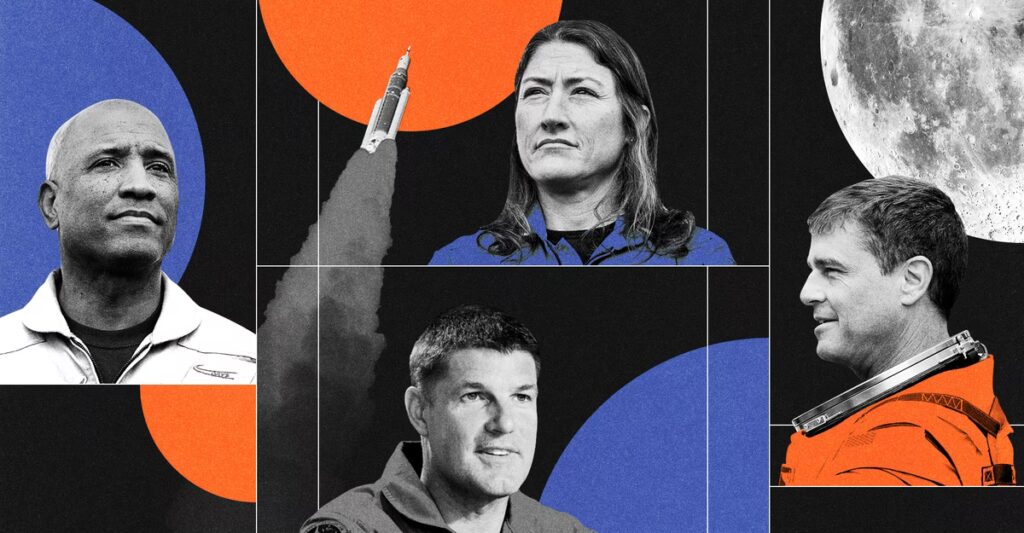
The tendrils of Christina Koch’s flyaway hair swirled about in the gravityless cockpit of the Orion spacecraft, seeming to represent all of the untetheredness of the Artemis II mission. As her mane eddied, like its own separate creature, throughout the record 252,756-mile journey to the radio-silent black side of the moon, it brought a sense of irrepressible aliveness to that dead stone up there.
Until this past week, a certain ho-humness had set in about human space flight. The International Space Station has been manned for more than 25 years, with routine trips carrying relatively anonymous men and women to a giant fan doing its repetitive circles in low-Earth orbit. NASA’s Artemis II scanning expedition to the lunar far side, using repurposed space-shuttle engines, at first seemed hardly capable of breaking an audience’s collective yawn.
Then it took off: four people arrowing atop what amounts to a bomb bound for the remotest point that man has visited in the cold, splintering sky. As they soared and circuited and sent back stirring images from their 330-cubic-foot canister, awe made its reappearance among the multitudes of casual sky watchers. So did respect for astronauts’ courage and their ancient-explorer’s hearts.
Their spacecraft’s aluminum-alloy outer hull—this was startling to relearn—is only a few centimeters thick. “Frankly, you know, Christina and crew right now are in a very precarious state. They’re in a tiny little bubble, hurtling towards Earth,” the former astronaut John Grunsfeld told me. During his own career, Grunsfeld made five space-shuttle trips and performed almost 60 hours in space-walk missions, including crucial repairs to the Hubble telescope. “There really isn’t much point in thinking about, you know, that death waits on the other side of the capsule wall,” he said. “There’s very little you can do about it.”
Over the past few days, via high-resolution cameras and hissing-clean audio that allowed for live interviews, Americans have gotten to know and care about our astronauts again, down to their tears and toilet issues and skin. Fifty years ago, astronaut communications from the moon were jumpily remote, shadowy, static-crackling affairs, in which viewers missed every other gesture and word. But this space flight, live-streamed by GoPros and other high-speed instruments, has offered an intense intimacy, helping watchers feel close to the astronauts even as they move so very far away. People around the world saw the eye-swiping grief of Commander Reid Wiseman—the widower and single father whose wife, Carroll, died of cancer at just 46—as the crew named a crater in her memory. We saw, too, the physique of the pilot Victor Glover as he toweled down during a space shower.
[Read: The most beautiful moment of the Artemis II mission]
Who knew astronauts were like that under their suit? “One giant treat for womankind,” The Daily Mail called Glover as the image went viral. But Glover is more than a beefcake: He’s a polymath who earned three advanced degrees while serving as a military test pilot, flying Hornets and Growlers and deploying with strike-fighter squadrons, yet he speaks gently as a lay preacher.
In fact, has anyone ever met a more likable cluster of superachievers than these four people? Mission Specialist Jeremy Hansen is a Canadian farm boy who had such a yearning to fly that he became an air cadet at just 12 and got his pilot wings at 16. Koch is a 47-year-old engineer and adventurer—an ice and rock climber, a surfer, and a triathlete who participated in the first all-woman space walk and who lived for 328 days on the ISS.
We have learned how they sleep, crammed together in a compartment among the vents and screens. Wiseman stretches out by the instrument panel, he said, “in case something happens.” Koch, he noted, curls up in a sleeping bag hung from the docking tunnel, “like a bat.” We heard from Koch that it was she who fixed the toilet, which had gone out for several hours, by removing and clearing the urine hose and repriming the system. “I’m the space plumber,” she said in a video dispatch. She told NBC News, “Being human up here is one of the coolest things about this mission.”
Some of us hurried to the NASA website to learn more about this frontierswoman, with the extravagant hair and the biceps of a steelworker, a photo of which also went viral. Just to be an astronaut candidate, she had to complete military-water-survival programs that included swimming three pool lengths in a flight suit and shoes, and treading water in full gear for 10 minutes. Mere “fitness for duty” meant being able to deadlift an amount equal to her own body weight and bench-press 70 percent of it.
“I always say to people, ‘Do what scares you,’” Koch remarked in a prelaunch NASA interview. As a girl growing up the daughter of a physician in Jacksonville, North Carolina, she had a poster on her wall of the famous Earthrise picture taken by the crew of Apollo 8. She cut pictures of space out of magazines and pasted them alongside it. She had a fascination with remote, unexplored places and told teachers that she would go to space. “I loved things that made me feel small,” she said in the interview. “I loved looking at the night sky, oftentimes between the pine-tree branches. Or, I love the ocean. North Carolina also has mountains, and when we go there, I just love the vastness of all those things.”
[Read: What the astronauts see that Trump cannot]
As a young researcher who held dual degrees in electrical engineering and physics from North Carolina State University, Koch spent three years in Antarctica developing and testing deep-space instruments for NASA projects. She did a year at the Amundsen-Scott South Pole Station, including a winter with no sunlight. She would ascend platforms in below-zero temperatures to adjust and repair apparatuses. “I loved soldering irons up towers, and soldered in –40-degree weather fixing things, hanging off the tower with, you know, carabiner gear and things like that,” she said in a NASA podcast.
She also wintered in Greenland and served on firefighting and search-and-rescue teams in the Antarctic. She was working in Utqiaġvik, Alaska, more than 300 miles above the Arctic Circle, when she decided to apply to the astronaut program. Finally, a job overseeing a remote atmospheric and weather-monitoring station at Cape Matatula, in American Samoa, lured her to warm weather. There, she took up surfing and diving before she got the call from NASA that she had been accepted.
Koch’s affinity for extreme experiences made astronaut training—the survivalist hikes and six-hour underwater-rehearsal sessions in a mock space station—a familiar challenge. The hardest part, she said, was learning to pilot a T-38 Talon jet despite having no previous flying experience; operating it at supersonic speed helps astronauts learn high-velocity decisional judgment. Over her NASA career, she has developed what she calls the ability “to turn fear into focus.”
According to Grunsfeld, this is what sustains the Artemis II crewmembers during fearful moments, such as when an indicator suggested a cabin leak that turned out to be a false alarm. Their trained proficiency at the technical demands is the antidote to anxiety. “There were times during a space walk,” Grunsfeld told me, “where I sort of forgot that I was in space”—so preoccupied was he with precise execution. In space, as in rock climbing, “there isn’t a whole lot of point of thinking about falling. And there is a lot of point in thinking about where your hand is gonna go next or where your foot is gonna go next. I think most astronauts that are successful are very proficient at compartmentalization.”
These are the kinds of tough-minded pressure performers whom NASA turns out in the space program, and you could be pardoned for thinking, Now, this is what making America great again should look like: people of accomplishment bringing expertise to difficult problems, not bravado. The agency seems well worth preserving in the current cultural spiral—rife with so much blowhard false valor that grappling with cage fighters is regarded as training. Yet in President Trump’s latest budget request for 2027, NASA funding would be cut by 23 percent and the National Science Foundation’s by nearly 55 percent, as space travel becomes more privatized and proprietary. Surely, we could do with more well-schooled astronauts who can publicly explain their science to us, not fewer.
If the crew of Artemis II have done nothing else, they have reminded Americans at home that comfort is not the only thing worth seeking. “I’d much rather be solving problems wearing a whole lot of equipment and in a harsh environment,” Koch said in her preflight NASA interview. As they brought us along with them in their willingness to go to a hard, remote place, they gave us an unsuspected rapture and a couple of new terms: earthset and moon joy.
[Read: Moon joy: Photos from Artemis II]
The aim of future Artemis missions will be to eventually land a crew on the moon’s South Pole and begin to develop a station there. Part of the current crew’s mission was to serve as a dry run and scouting party, examining geology and topography. They described all that they saw in reports to Houston, their human eyes sensitive to subtleties in hues and shapes—in ways that robotic probes with machine eyes aren’t. The valleys “look like black holes,” Glover marveled. “You’d fall straight to the center of the moon if you stepped in some of those.” Thanks to the astronauts’ powers of personal perception and description, the moon had color: It wasn’t just a giant piece of grey pumice but more interesting than it had ever seemed before. Poetic, even.
During her video conversation with NASA, Koch was asked what the moon meant to her. “To me, the moon, it represents history; it is a witness plate,” she said. “Everything that has ever happened to the moon is still written on the moon.” That’s exactly what it looked like.
Still, nothing compared with the image that the astronauts sent back of Earth, waning like a jewel-blue crescent, hanging above a cratered surface that looked like rain pocking giant, silver lakes. It was the equal of Apollo’s Earthrise, a striking juxtaposition. “This time in higher resolution,” Grunsfeld pointed out. It was a new view, one well worth going all that way for.
*Source Images: Miguel J. Rodriguez Carrillo / AFP / Getty; Aubrey Gemignani / NASA / Getty; Joe Raedle / Getty; Chandan Khanna / AFP / Getty; Getty.
The post The Artemis Astronauts Are Studs appeared first on The Atlantic.