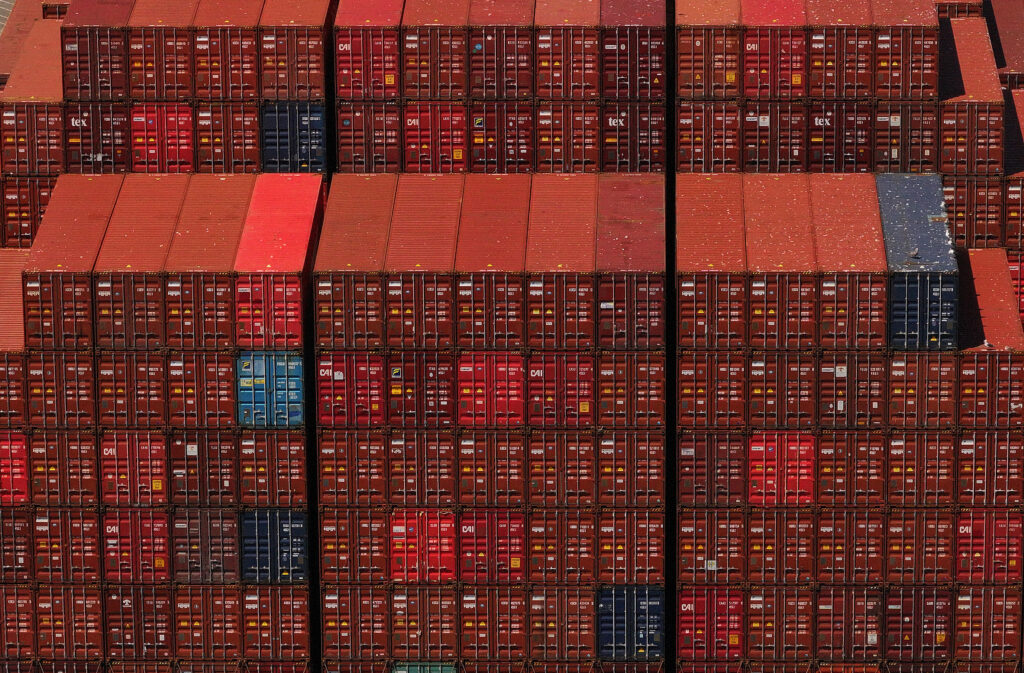
One year ago, President Donald Trump declared “the beginning of Liberation Day in America,” announcing tariff taxes on imports under the International Emergency Economic Powers Act. Trump boasted his tariffs would make Americans wealthy and claimed “jobs and factories will come roaring back.” But for America’s more than 36 million small businesses, Trump’s “Liberation Day” was “Obliteration Day.”
Over the past year, small businesses and families were forced to pay billions of dollars in tariffs, the United States lost about 70,000 manufacturing jobs and the economy tumbled.
For small-business owners such as Dahlia Rizk, who owed $93,000 in tariff taxes last year, the Supreme Court’s ruling that Trump lacked authority under IEEPA to impose his tariffs offered only temporary relief after months of pain and uncertainty. Why? Because Trump immediately signed another executive order imposing a 10 percent global tariff.
We cannot let Trump get away with stiffing Main Street — especially as small businesses grapple with skyrocketing gas prices, health care costs and energy rates amid the war with Iran. To make things right, the Trump administration should establish an automatic system for refunding tariffs to American businesses.
This administration must be held accountable for imposing illegal tariffs. I will fight alongside small businesses and families to ensure it returns every last cent.
Edward J. Markey, Washington
The writer, a U.S. senator from Massachusetts, is the ranking Democrat on the Small Business and Entrepreneurship Committee.
Trump’s uncivilized threats to kill a civilization
William F. Buckley Jr. came to mind when I read Donald Trump’s declaration that “a whole civilization will die tonight.” Buckley, a conservative intellectual revered by many Republicans today, founded National Review. In its mission statement, Buckley promised it would stand athwart history and yell “Stop, at a time when no one is inclined to do so.”
I’m neither a Republican nor conservative, but I understand the necessity of “yelling Stop” in historic moments like today. No one in the Republican Party is inclined to tell President Donald Trump to stop his abhorrent, un-American rhetoric. But by remaining silent as he threatens to kill a civilization, Republicans risk abandoning their conservative heritage. All Americans must therefore demand Trump stop his threats against Iranian civilization.
T. Michael Spencer, Washington
On Tuesday, the United States, through its duly elected president, threatened through military force to cause a “whole civilization [to] die tonight.” History attests that one can indeed kill one’s own civilization through savagery, consistent with Noah Webster’s original 1828 definition of civilization: “the state of being refined in manners, from the grossness of savage life and improved in arts and learning.”
Eric Jansson, Oxford, England
The full story of Africa’s resilience
The April 5 editorial “Africa proved resilient to U.S. aid cuts” argued that Africa largely withstood the shock of U.S. aid cuts in 2025, citing regional economic growth projections.
Aid has long played a bit part in African economic growth. Indeed, of the more than $11 billion of U.S. assistance provided to Africa in 2023 via the U.S. Agency for International Development, fully 85 percent was directed at meeting lifesaving, humanitarian needs and supporting public health. So it’s not surprising that researchers at the Center for Global Development calculated 1.6 million excess lives were lost in 2025 compared with 2024 due to cuts to U.S. humanitarian and health assistance. And it could get worse: A recent study in the Lancet projected that 9.4 million to 22.6 million people could die by 2030 — a quarter of them children younger than 5 — owing to falling assistance levels from all donors. Both sets of researchers considered assistance in the world’s most vulnerable countries, and many of those countries are in Africa. Any claim of Africa’s resilience needs to recognize the reality of millions of excess lives lost.
As the Editorial Board noted, there really is no substitute for economic growth, and certain African countries responded well to the aid cuts. Some of the worst-case projections therefore might be avoided. But it is premature to declare victory. African countries have previously failed to take advantage of commodity booms to fundamentally transform their economies.
I had hoped the administration would consider rebalancing U.S. assistance to Africa to better support economic growth. Instead, it severed trust in the U.S. as a development partner.
Brian Frantz, Rockville
The writer was the last assistant administrator for Africa at the U.S. Agency for International Development.
EPA rollbacks threaten public health
I was disappointed that Aaron E. Carroll’s March 20 op-ed, “Chronic disease rates are growing. Here’s the unexpected story.,” did not mention the reduction in environmental exposures to toxic chemicals, which is a major factor in improving public health.
Carroll pointed out one of the reasons we have more chronic diseases is that Americans are now “living long enough to accumulate diagnoses,” adding that “age-adjusted heart disease mortality fell 66 percent from 1970 to 2022. Mortality from heart attacks fell 89 percent. Cancer mortality has dropped 34 percent since 1991, averting an estimated 4.8 million deaths.” You know what health-damaging statistics also dropped in these time frames? Pollution!
Between 1970 and 2023, the combined emissions of six key pollutants dropped by 78 percent. Since 2010, lead pollution is down 87 percent, and since 1998, releases of toxics are down more than 50 percent. This cut in pollution is a huge public health success story. Air pollutants contribute to many diseases, including chronic heart disease and asthma, which, sadly, affect children.
And as the data shows, controlling air pollution did not hamper the economy, which grew robustly. But if the current Environmental Protection Agency administration has its way, many air pollution rules may be delayed, rolled back or eliminated.
And it isn’t just air pollution. The nonpartisan Environmental Protection Network showed in its recent “Terrible Toxics Situation Report” that measures that protect our water, our food and our home products are being delayed or dismantled. If these rollbacks continue, decades of progress in reducing pollution-related chronic disease could be reversed, making Americans sicker, not safer.
Betsy Southerland, Fairfax Station
The writer is a former director of the Office of Science and Technology in the Environmental Protection Agency’s Office of Water.
The post Sen. Edward J. Markey: Make tariff refunds automatic appeared first on Washington Post.