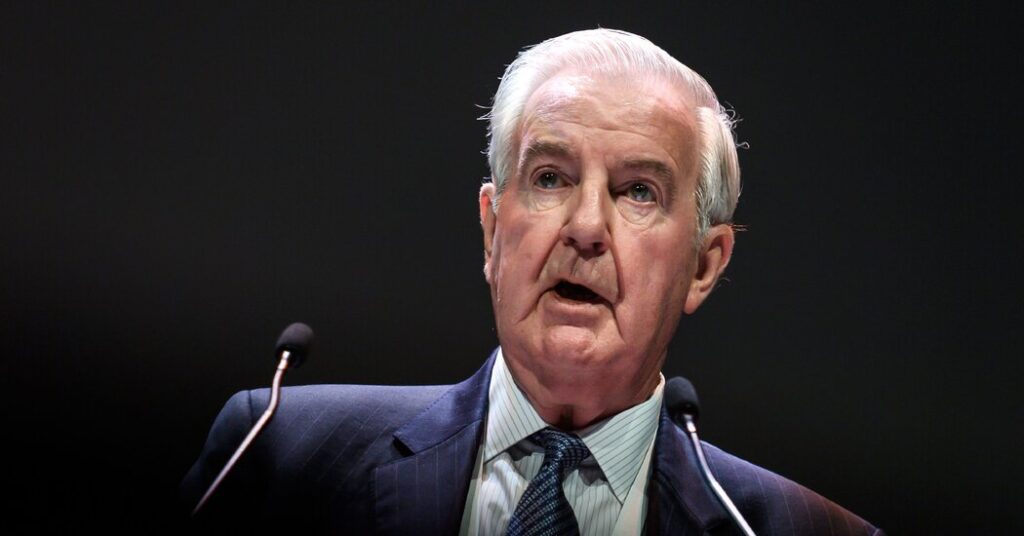
Craig Reedie, who was president of the World Anti-Doping Agency when Russia’s state-sponsored doping system was exposed a decade ago, and whose tenure reflected the struggle for credibility that officials have long faced in trying to combat the widespread use of banned performance-enhancing drugs in Olympic-related sports, died on Sunday in Beaulieu, England. He was 84.
Mr. Reedie died “suddenly but peacefully” while on an Easter holiday with his family about 90 miles southwest of London, his son, Colin, said in an email. The cause had not yet been determined, he said.
In 2016, it was revealed that Russia had orchestrated an elaborate doping scheme when it hosted the 2014 Winter Olympics in Sochi. Mr. Reedie and the World Anti-Doping Agency, known as WADA, called for a ban on Russian participation in the 2016 Summer Games in Rio de Janeiro.
At the time, the Scottish-born Mr. Reedie was a highly-regarded figure in international sport as a vice president of the I.O.C., the top international antidoping official and a key player in helping to secure the 2012 Summer Olympics for London.
The state-sponsored Russian doping scheme operating in Sochi — and, more broadly, at its national antidoping laboratory in Moscow — was particularly egregious, involving the manipulation of urine samples to protect cheating athletes. Mr. Reedie, known as a reformer who pushed for more aggressive antidoping measures, called the Russian scheme a “real horror story” that “seriously undermines the principles of clean sport.”
He and WADA had the backing of many Olympians to have Russia excluded from the Games in Rio. But the attempt failed. The I.O.C.’s executive board — led by its president at the time, Thomas Bach of Germany — decided that it would be unfair to bar all Russian athletes without proving that they were involved in the scheme.
There was a need, Mr. Bach said, to balance “collective responsibility versus the right to individual justice of every individual athlete.”
He left it to individual sports federations to decide whether to allow Russian athletes to compete in Rio. Track and field, for instance, barred all Russians, but roughly 270 Russian athletes competed in various other sports.
In a tribute after Mr. Reedie’s death, Kirsty Coventry of Zimbabwe, the current president of the I.O.C., called him a “steadfast guardian of integrity, guiding the global sporting community through some of its most challenging moments with dignity and resolve.”
That was not a universal feeling. Before Mr. Reedie stepped down as president of WADA in 2019, after serving a second three-year term, he came under intense criticism from athletes and more than a dozen national antidoping agencies related to another aspect of the Russian scandal.
In 2018, WADA recertified Russia’s discredited national antidoping agency, despite its not having met the criteria for reinstatement. Mr. Reedie faced calls to resign, including from Travis Tygart, the head of the United States Anti-Doping Agency, who said that having an I.O.C. member running WADA was a conflict of interest akin to “the fox guarding the henhouse.”
Mr. Reedie argued that reinstatement was the best way to gain access to Russian doping documents and to move the country toward compliance with antidoping protocols. Irritated, he said Mr. Tygart should work harder to help clean up doping in American professional sports, where scandals have been plentiful in baseball and football.
Mr. Reedie’s reputation suffered from the controversy, and some critics, including athletes, said they had lost confidence in WADA’s ability and resolve to ensure clean play.
Craig Collins Reedie was born on May 6, 1941, in Stirling, in central Scotland, and earned a law degree from Glasgow University in 1964. A badminton player, he served as president of that sport’s world governing body from 1981 to 1984 and championed badminton’s inclusion in the Olympics, beginning with the 1992 Barcelona Games.
He was chairman of the British Olympic Association from 1992 to 2005 and named an I.OC. delegate in 1994, serving on the Olympic committee’s executive board from 2009 to 2012 and as a vice president from 2012 to 2016. He was knighted by the British crown.
In addition to his son, Mr. Reedie is survived by his wife, Rosemary (Biggart) Reedie, whom he married in 1967; a daughter, Catriona Hillier; and four grandchildren.
As president of WADA from 2014 to 2019, Mr. Reedie encountered challenges that have dogged clean-sport initiatives since drug testing began at the Olympics in 1968: insufficient funding, irregular determination to catch those who use illicit anabolic steroids and blood-boosters, cover-ups, and an unceasing game of pharmacological cat-and-mouse, with antidoping efforts always seemingly a step behind athletes who use the latest designer substances that are not easily detected and clear the body quickly.
WADA, for instance, faced withering criticism for not holding accountable 23 Chinese swimmers who tested positive for a banned substance ahead of the 2024 Paris Olympics.
At a conference in Busan, South Korea, in December, David Howman, a former director general of WADA who now chairs track and field’s global effort to combat doping, stated what was already apparent: The international effort to catch drug cheats had again “stalled.”
“Let’s be honest and pragmatic,” Mr. Howman said. “Intentional dopers at the elite level are evading detection. We are not effective enough nowadays in catching cheats.”
That ineffectiveness, he said, was “hurting the antidoping movement’s credibility.”
Jeré Longman is a Times reporter on the Obituaries desk who writes the occasional sports-related story.
The post Craig Reedie, Who Fought Doping in Global Sport, Dies at 84 appeared first on New York Times.