Subscribe here: Apple Podcasts | Spotify | YouTube | Overcast | Pocket Casts
In this episode of The David Frum Show, The Atlantic’s David Frum opens with his thoughts on the nearly two decades of economic turmoil that has caused younger generations to lose faith in American institutions and led to the rise of populism in the United States. David argues that as the country stands on the precipice of a Donald Trump–manufactured economic crisis, perhaps we will learn to appreciate the basic ideas that led to prosperity in the 1980s and ’90s.
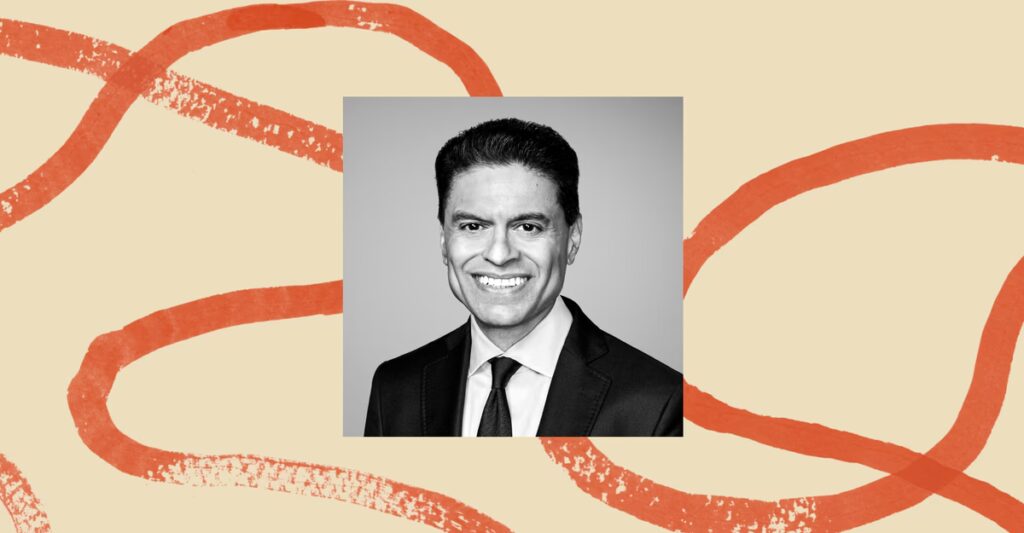
Then David is joined by CNN’s Fareed Zakaria to reflect on the American ideals that captivated David and Fareed when they first immigrated to the U.S. and whether they still ring true today. As America celebrates its 250th anniversary, David and Fareed discuss whether this country remains the same one they moved to many years ago and whether America has strayed from its foundational principles.
Finally, David concludes the episode with an examination of Italo Calvino’s 1972 novel, Invisible Cities, and a discussion about our postliterate society.
The following is a transcript of the episode:
David Frum: Hello, and welcome to The David Frum Show. I’m David Frum, a staff writer at The Atlantic. This week marks one year of The David Frum Show. I’m so grateful to everyone who has watched and listened along the way. To mark the occasion, I’ve invited my old friend Fareed Zakaria to discuss with me what it means to be an American. Both Fareed and I were born citizens of other countries—he of India, me of Canada—and we’re going to look back on our decision to join our fates to that of the United States and how we feel about it all these years later.
My book this week will be Invisible Cities, by Italo Calvino, a meditation on words and meanings that cast light on the decline of literacy in modern American society.
Before either the dialogue or the book, some opening thoughts on the economic troubles gathering for the United States. President Trump’s second term has been economically troubled from the beginning. 2025 was upended by his decision to impose high tariffs, and that crushed job creation in the United States—very little net new job creation in 2025. But things are even worse in 2026 with the president’s decision to open a major war with Iran without apparently thinking through the implications of this war for oil prices. Experts describe the largest supply shock to energy since the 1970s, maybe the largest of all time. And while this shock has only begun to be felt by Americans, more is coming. It’s like the president dropped a giant rock in a bowl of water, and it takes a little bit of time for the impact of the rock to slosh the water out of the bowl. But everyone, I think, is aware that a shock is coming, and they’re bracing for it.
I wanna put this shock in some kind of context. Over the 25 years 1982 to 2007, a quarter century—so I graduated from college in 1982, so for the 25 years of my opening adult life—the American economy lived through a time of extraordinary economic stability. In those 25 years, from 1982 to 2007, there was consistently low inflation, and only two short and mild recessions: one from the summer of 1990 to the spring of 1991 and another in the spring to the fall of 2001. Twenty-five years, moderate inflation, two mild, short recessions—otherwise sustained, continuous growth. And that was the experience that I think has formed the attitudes of many of the people of my generation.
Now, since 2008, there’s been one economic shock after another. The period opens with the Great Recession of 2007 to 2009, an 18-month-long great recession—the longest since World War II—8 million jobs lost, and the economy did not fully recover for about half a decade. Then in 2020 comes another recession: the COVID recession, the steepest collapse of economic activity ever recorded. Plus, immediately after the COVID recession is the worst inflation since the 1970s. Now in 2026, we’re looking at the possibility of another bout of inflation and possibly another recession, caused by the shock of the energy crisis President Trump didn’t anticipate and didn’t plan for.
When people look at the reasons that American society seems to have gone so off the rails since 2007, they often point the fingers at smartphones. I’m sure the smartphones didn’t help. You can blame them for all kinds of things. I’m gonna talk after the dialogue in the book segment about one of the ills that they have caused: the decline of literacy. But when you’re trying to understand why so many younger people around the world and younger Americans have lost faith in the operation of the system, basic economic management explains a part of it.
My cohort, the late Baby Boomers, Generation X, we lived in a time of great stability. It was a time of rising inequality and other economic challenges, for sure, but mostly, you could plan a life in the confidence that, at the end of 25 years, things would be clearly better than they had been at the beginning of the 25 years, and the punctuations along the way would be mild, and the inflation that so disturbs your ability to make long-term decisions, that that would be held under control. People who have come of age since 2007 have not had that confidence—two severe recessions, one bout of inflation, and now a third recession apparently imminent and another second bout of inflation apparently imminent.
The shock since 2007 ushered in this age of populism. Expertise was discredited. The people who told us back in the ’90s that they knew what they were doing, after 2007, no one believed that anymore. So we got Brexit, and we got the rise of the far right, and we got the return of socialism and communism, and we got Trump, and we got all these sort of magicians promising some kind of new magic that will liberate us all from the basic rules of how a society and an economy works, and bring back rent controls and government-owned grocery stores. All of that got its start because of the understandable disappointment that followed from the failure of economic management after 2007 and 2008.
So those people have been in charge for a while, and they have made things much worse. And so one question I have, and maybe it’s even a kind of hope, is that the experiences of 2026, maybe they’ll cure us of the idea that there is some alternative way of organizing an economy than the way that worked between 1982 and 2007, that we need to get back to some basic ideas like balancing budgets, controlling inflation, making sure that there’s free trade and free economic activity. And all the things that people thought were out of date in 2007, they look pretty good compared to the manias that have hit us from 2008 onwards and especially from what is about to happen now in the wake of this unconsidered war with poorly anticipated economic consequences by President Trump.
And now my dialogue with Fareed Zakaria.
[Music]
Frum: Fareed Zakaria is the host of Fareed Zakaria GPS on CNN, a weekly international-affairs program that airs around the world, and he writes a column for The Washington Post. He’s the author of five New York Times best sellers: The Future of Freedom: [Illiberal Democracy at Home and Abroad] in 2003; The Post-American World in 2008; In Defense of a Liberal Education, 2015, Ten Lessons for a Post-Pandemic World in 2020; and most recently, Age of Revolutions: Progress and Backlash From 1600 to the Present. Fareed is a graduate of Yale, a doctorate from Harvard University, a contributor to American letters in journalism and history and international knowledge through his long and distinguished career. I’ve had the honor of knowing him, well, more years than I think either of us would care to remember, but quite a few. And it is such a pleasure to welcome Fareed to be the guest of honor here on the one-year anniversary of this podcast.
Fareed Zakaria: Thank you so much, David. It is a huge pleasure, and I actually remember, I think, pretty close to exactly when we met. I was in graduate school and you were in law school at the same university, and somebody told me, You have to meet David Frum. You guys are gonna get on wonderfully. And as it happened, you and I were unusual in that we were both living in Boston while going to school in Cambridge, and so we were kind of neighbors for a year. And I went to your apartment, and thus began a conversation that has gone on for, I guess it’s now 35 years.
Frum: Yes. Okay. You put a number to it. (Laughs.)
Zakaria: (Laughs.)
Frum: So here’s what I wanted to ask you about. And I wanna assure listeners that I’ve precleared this because it’s going to be kind of a sensitive question, but Fareed and I are both naturalized Americans—Fareed first in 2001, me later in 2007. And I think, like all people who make that conscious decision, we began with a very particular idea of America. And in this 250th anniversary of the Declaration of Independence, I wanted to ask: Fareed, what do you think? Is the country we live in now the country you moved to, that you became a citizen of, that you’ve supported through all of your distinguished intellectual work all this time?
Zakaria: I’d say, very simply, the answer is yes. It sounds corny and cliché, but I still believe in America; I still have hope in America. But it has changed, not so much that it makes me lose faith in the country itself. But I wanna back up for a second and remind people of something that’s particularly true for somebody like me, who came from very far away and from a completely different culture. We often talk about immigration as an entirely kind of joyful process: You’re coming to America, celebration, etc., which is all true, but there is an extraordinary loss and a choice the immigrant is making. You’re choosing to leave your country, your culture, your family, your friends, and you’re making this big leap. And the reason I made it was because America seemed so attractive and it seemed so compelling. And so that piece of it has to be strong. That is one of America’s secret sauces. It may be the last one we have left, right? The rest of the world is doing capitalism pretty well. The Chinese are doing big investments pretty well. What are we left with that’s distinctive? What we have more than any country in the world is this power to bring people in, attract them, and then assimilate them.
So when I came here, I was dazzled by America. I was fascinated by every aspect of it. I thought it was extraordinary, wide, open, free—and free in every sense of the world; you were really able to be yourself in America in a way that you are in almost no country in the world. And I think some of those broad cultural characteristics, societal characteristics, I still find true. Americans are very warm, very generous, very open, very welcoming. The country is still, by and large, free and wide open, though we should get to that. In many ways, there is more of a kind of regulated nanny state than I remember. I used to go to Hertz and rent cars on my student visa and my international license, with no insurance, and they would just say, Look, if you’re willing to pay the money, take the car. Go. Enjoy yourself. That America has gone for some reasons.
There is a kind of nastiness to the populism that we’e seeing now, a kind of mean-spiritedness and an anger that I didn’t see in the America I came in. I came to America in 1980, ’81, ’82. [Ronald] Reagan’s America might have been very conservative on policy terms, which some people liked or didn’t like; I rather liked it at the time. But it was wide open in terms of hope and optimism and generosity of spirit. It’s not an accident that Reagan did an amnesty for lots of immigrants. People make it out like he was snookered into it. No, it very much came out of his basic openness and warmth and generosity of character.
The nastiness has really surprised me, stunned me, and the democratic decay. That I did not expect—the degree to which the United States has really gone down the path of illiberal democracy, the degree to which you have the president, many of his most powerful associates, many leaders in Congress actively participating in the eroding of the rule of law, the separations of power, the norms that have kept American democracy strong. All of that has really surprised me. I come to my basic positive conclusion with some caveats and a lot of sadness, but I do think that the essence of America remains.
Frum: Well, I don’t think we should be afraid of being corny at all because corny is simply a way of saying things that deeply move us or maybe sometimes we’re a little bit embarrassed of the emotion, maybe it brings the emotion a little too close to the surface for the sophistication of daily life, but it’s something real.
But let me put it to you a slightly different way. So the country marked its first centennial in 1876 with a big exhibition of arts and sciences and technology in Philadelphia. And a lot of the physical remains of that exhibition are still on display here in Washington, D.C., at the Smithsonian [Institution]. It marked the second bicentennial in 1976 with many events, but probably the most iconic, certainly the most photogenic, was a big regatta in New York Harbor of 18th-century and 19th-century sailing ships supplied jointly from the United States and Great Britain. Now, it was a big visual, but it was also a way of saying that, [in] 1976, the United States and Britain that had fought the Revolutionary War against one another were commemorating their deep partnership forged in two world wars and the Cold War.
As I understand it, the highlight of the 250th is going to be a mixed martial arts fight on the White House lawn. (Laughs.)
Zakaria: (Laughs.)
Frum: And it’s hard not to feel that from the arts and sciences to the big ship regatta to the MMA fight on the White House lawn that something has gone off the bend here.
Zakaria: That speaks to a broader shift that Trump is ushering in, which is a real kind of populous revolt against elites: elite judgment, elite technocracy, and elite choices with regard to art, culture, everything. I think for Trump, it’s intuitive because that is what he likes; he likes gold-plated Corinthian columns, and he likes MMA fights. But he does represent something real in America, which is a lot of people who look at the way in which these events are commemorated, buildings are built in America, and they think, This doesn’t reflect what I think a fancy, beautiful building should look like. And Trump, in a way, is an expression of that. And while I share with you the sense of dismay about it, I think it’s also true that, look, there is another America out there, and who’s to say that they don’t get to be represented with some of their stuff as well?
What I point to, by the way, your markers are very interesting ones, aren’t they, because 1876 is, of course, a pretty bad time in America. It’s a period of when you have this extraordinarily corrupt compromise after the Civil War, not quite a rigged election but an election that is arranged, in which the Republicans essentially agreed to give up on any Reconstruction of the South, essentially allowing formal slavery to be replaced by informal slavery, by Jim Crow, in return for which they get their president. And then 1976 is, of course, Jimmy Carter’s presidency, the stagflation of the ’70s, and everything that that conjures up—not a great time in American history. So it’s always worthwhile to look back historically because there never was a golden age; things have always been complicated.
Frum: Well, I’m old enough that I do remember the 1976 bicentennial firsthand; I was a teenager. And I was a big consumer of American media and living in Toronto; you were nearby. And I remember exactly what you described, but that’s where the contrast is. So 1976, I don’t think people would’ve described that as a good time in America: Watergate, Vietnam just behind, economic trouble of all kinds. If you watch the cinema of that period, it’s very, very dark and bleak. The official mood was, despite the very hard things the country had been through in the past three or four years, We are going to make this right, and we’re going to make it proper, and we’re going to make it kind of uplifting.
That seems to be the mood that is very much not there. In many objective ways, the conditions in 2026 are not as hard as they were in 1976, although that may be about to change as the economy moves into a slowdown. But the aspirational element, that’s the thing I’m noticing about the mixed martial arts—it’s not that America in 2026 is a more vulgar country than it was in 1976; it’s that it’s a less aspirational country than it was in 1976.
Zakaria: Yeah, and it relates, I think, to the loss of faith in elites. Because, after all, what created that aspirational sense? It was things that we aspired to, that were setting the tone for America. We tried to say, We, too, can produce great music, great art. I remember a little bit of the ’76 celebrations. I remember there was this one musical performance where they did Aaron Copland and “Rhapsody in Blue,” and the whole idea was to showcase the greatest things that American music had produced, which were high art. And that whole sense of two things, a kind of elite-driven culture and also a kind of centralized culture, have been lost. There are things you needed to know. You and I remember E. D. Hirsch’s Cultural Literacy: [What Every American Needs to Know]. There was this whole idea that, Look, there’s a bunch of things that you need to know if you want to consider yourself an educated person. That world has kind of gone away. I think it’s part of the Trump phenomenon, but it’s not intrinsically related. But it is a broader suspicion of elites and a sense that the elites have betrayed us.
I tell you—I’m free-associating here—but one of the things I have been puzzled by about the world we are living in right now, the America we’re living in, is why are Trump supporters so unconcerned with the obvious, naked, extravagant corruption of this administration? How could a working-class person in Appalachia look at these hundreds of millions of dollars, if not billions of dollars, being siphoned off in various ways, most of which seem deeply unethical, some of which make you wonder whether they’re even legal, and be okay with it. And I think the answer is, they were so disgusted by the rule by elites and the system that was in place before—let’s call it the kind of meritocratic, technocratic America—that they thought, You guys set up a system for yourselves where it seemed all rule-based, but it was all self-dealing, and somehow, you guys all did very well, and we got screwed. Well, our guys are now in power, and maybe they’re doing this more nakedly and they’re being more crass about it, but it’s our turn. And I think that there is a very powerful feeling out there about this.
Obviously, I don’t agree with it. I think that, [in] the one case, it was trying to create a rule-based meritocracy, even though it was flawed and not honored as often as it should have been, but the other is naked corruption. But I think part of it is this deep disenchantment with the system that was in place for the last 40, 50 years, a kind of administrative, technocratic state ruled by Ivy League, credentialed elites.
Frum: Let me ask you a question that draws some of these debates into your academic and intellectual work. Now, one of the main themes of your writing through your whole career has been—and in this, you are in a tradition of many internationally grounded scholars, Henry Kissinger, Zbigniew Brzezinski, who have all worried too much about the American tendency to make a morality play out of foreign policy. And that’s probably one of the things that you and I have most disagreed about over the years; I’m a little bit more attracted to that than you are. And this maybe reflects something personal.
I grew up in Toronto at a time of great prosperity and security in Canadian life. But as I look back on it, I realize everybody I knew was either themselves or the child of or married to an exile and a refugee, everybody. And from all kinds of places: Hungary, Czechoslovakia, fascism, communism, and not just from Europe, that we knew people who had been expelled from Idi Amin’s Uganda because they were South Asian; we knew people from apartheid South Africa; we knew people who were draft resistors; we knew people who had been expelled because of personal life choices. Everybody. And that tended to create, in my parents’ sort of liberal-minded circle, a certain anti-Americanism. And the thing that pushed me to the right as a young person was I had this—I don’t know where it came from—this awareness that all of this all existed, and I liked it, but all of it existed under the umbrella of American power, and that Toronto wasn’t protecting itself from the dangers of the world, and these exiles and refugees who showed up in my parents’ garden were not safe because of anything they did; they were safe because of things the Americans did. And it was that moral grounding of American power.
Now, you have written eloquently and well about the dangers of overdoing this. But I wonder, as you confront a United States that seems, at least for the moment, to utterly jettison that idea—that American power owes any duty at all to ideas of ethics and morality and something bigger than American interest at its crassest—how you assess all of that.
Zakaria: Yeah, I’m disappointed, distressed. And I think it sort of highlights the limits of the way in which a pure kind of realpolitik analysis kind of doesn’t capture what the United States has done to the world. And so let me explain for me where the realism comes in.
My view has always been that the United States has acted in a completely exceptional way in the world. When it had great power at the end of World War II, it did something no other superpower would’ve ever done, which was to try to create a new international system based on rules, laws, openness, liberty. And it did that because it thought it was a better way to organize the world. No realist power would’ve ever done that. That came out of a kind of liberal internationalist spirit. Maybe it came out of a high-Protestant belief in the universal rights of man and the ability to proselytize around the world. But it came out of a very distinct view. And my thought has always been that the United States did this extraordinary thing in creating this system, which is sort of tilted towards liberty and openness and human rights. It needs to maintain that system. What it has been able to do is create almost a machine that helps societies move in that direction. But when it overdoes it, when it goes in and tries to get rid of a dictator and say, Thou shalt be a democracy, it almost never works, because slow, organic processes of state formation and societal transformation are much more effective.
So in this sense, I’m sort of a Burkean about it, and I think if the United States created at the end of World War II this world, which slowly allowed countries from the Spains and the Portugals of the world, which people forget were fascist dictatorships until the 1970s, to the East Asian countries of the world, Taiwan, South Korea—also, by the way, very tough right-wing dictatorships—to evolve into democracies, if it then pressured the Soviet Union so much that it cracked and crumbled 45 years later and liberated Eastern Europe, this is achievement enough. You don’t need to go and invade every country where you think there’s a dictator and install a democracy. It won’t hold. It risks rupturing the whole system. And for that reason, I’m very strongly in favor of helping Ukraine because it was a fledgling democracy that wanted to be democratic itself, that is struggling and fighting mightily and losing enormous numbers of people in order to do that. All it’s asking us to do is help it with arms and money. But I look at the Iran thing, and I think to myself, The way you’re going to get democracy in Iran is not likely to be on the back of American tanks and troops. These are much more complicated processes. You might be reinforcing nationalism.
Look, every now and then, it works. I don’t dispute that. There are cases you can look at where things have worked out. But in general, I think it’s much more important that the United States devote its power to that general system-building approach rather than somewhat idiosyncratically going to countries that it happens to feel at that moment are kind of bad countries and reform them. And the track record on that is not particularly good, whether you look at Vietnam, whether you look at Afghanistan. Ironically, and you might get to this, Iraq doesn’t look so bad in that sense, where Iraq is now a democracy; it’s had something like nine changes of government. It is, without any question, a better regime than Saddam Hussein’s, both internally and externally. But the cost was catastrophically high.
And so I come out feeling like I am being a kind of idealist, but a kind of Franklin Roosevelt idealist, not a George W. Bush idealist. ’Cause Roosevelt set this whole system up, but he was realistic about the fact that he couldn’t do much about Eastern Europe; [Joseph] Stalin had his army there. And he acquiesced in that destruction of liberty. That’s life.
Frum: But I now watch the United States become, in international affairs, a kind of gangster, predatory country, where it overthrows dictator No. 1 in Venezuela to install dictator No. 2. Well, we’ve seen that before. But then it pillages the country, takes oil. We are told—this may or may not be true—that it’s taken physical gold from Venezuela. I find that a little hard to believe, but the Trump people say it. Not everything they say is untrue.
That seems to be Trump’s plan for Iran: again, to not just break the country’s military power, but to bring dictator No. 1—or, at this point, maybe No. 42—in line to replace dictator number one and pillage the country. And watching this kind of gangsterism, that is a shock to my system because I did have a very different idea of what America was supposed to be in the world. And this has now been going on for a decade, and when a country does something for a decade, under two presidencies separated by an interval of not very strong correction, you think, Well, maybe that’s at least as much a part of who America is as the America that I used to see.
Zakaria: Yeah, this is probably one of the greatest disappointments for me because you put it exactly right: The United States is acting like a 19th-century European imperialist power, which is shocking because the United States, of course, came into being, in a sense, in rebellion against an 18th-century imperialist power. And to be watching the United States behave like a rogue superpower, breaking the rules-based system that it had put into place, not even bothering to try to claim that there was some kind of broader justification, broader rule of law violation that is why we’ve gone after Iran—which, by the way, you could construct, and you could have brought some countries on board, and you could have taken all this to the UN. But it almost seems that part of the point of the way Trump is doing this is to say, I reject all that. I have absolutely no desire to appear to be behaving in a lawful, legitimate, rule-based way. I want to make the point that this is arbitrary, this is unilateral, this is self-interested, this is rapacious. And for the leading power in the world and for the power that built this system to be behaving like this is absolutely shocking.
It is also frittering away 80 years of ordered liberty that we have helped create in the world, of trust that we built among so many countries. We have 59 treaty allies in the world; China has one: North Korea. We’re giving up all of this. For what? For nothing. To my mind, Trump 2.0 has been the worst foreign policy in my lifetime, without any question, because it is system-wrecking, and it is destroying trust that took eight decades to build and I don’t think can be regained.
Frum: I find myself thinking a lot in the second Trump term about a poem written in the 1890s by Rudyard Kipling called “Recessional.” And Kipling, of course, was the great poet of British imperialism, but 1897 was the year of Queen Victoria’s 60th anniversary on the throne. There was a lot of boastfulness in the air, and somehow, in his artistic sensibility, this hit him amiss; he didn’t like it. And he wrote a poem against the kind of heavy boasting that he was hearing everywhere about the greatness and power of Britain, and wrote a poem in which he had this vision of British power melting away despite the boastfulness of the day. And I think of this poem a lot, in which he sort of begs God’s pardon for the boasting that he’s hearing. And it makes me think very much of Pete Hegseth.
When you talk about the realism versus liberalism in foreign policy, I think one of the things that we’re discovering in these Trump years is American generosity was not just a good-to-do thing; it was actually a necessary thing. It was smart politics too. When America emerged from the Second World War and for most of the time after, America was the strongest country in the world, and probably, it still is. But the world has seen strongest countries in the world before, at least in the Western worlds: Habsburg Spain, Bourbon France. But what always happened in the past was the strongest country in the world was never stronger than all the other countries put together. And one country would emerge as the strongest; the others would combine against it and rip it down. And the United States, as strong as it is, is not stronger than everybody else put together. But cunningly, in the years since 1945—and responsibly and rightly, too—the United States put together a system where most of the other strong countries were also friends. And so it was not just the strongest single country, but the head of the strongest possible coalition; no one could rip it down.
And when you jettison all of that, I’m beginning to hear—and I think the comments recently from the president about letting the Strait of Hormuz police itself—I think, like Kipling hearing the melting away of power, I’m hearing the gathering of the anti-American coalition of the second half of the 21st century, and it just fills me with foreboding, that as America becomes less attractive, it also becomes more vulnerable.
Zakaria: Yeah, no, I think you’ve put it exactly right. And maybe we have gotten to that point in our power that we were ripe for somebody to abuse it the way that Trump is. But you’re absolutely right. This was Franklin Roosevelt’s genius. This was Harry Truman’s genius. It was Roosevelt, Truman, and [Dwight D.] Eisenhower, really, collectively put in place this system you’re describing. And you’re absolutely right; it defies the logic of balance of power throughout at least modern history, since the fall of the Roman empire. The basic story has been the one you described: The rise of the great power and then what we always call the balance of power, the balancing against that power, whether it was the Habsburgs, the French, whomever—the British.
In the U.S. case, not only did it not happen, but the richest countries in the world said something extraordinary. So if you looked at the world in 1970, you’d say, Who is the richest country in the world? The United States. Who’s the second richest country in the world? Germany. Who is the third-richest country in the world? Japan. The second- and third-richest countries in the world, for most of the postwar period, had subcontracted their foreign and defense policy to the richest country in the world, the United States. This has never happened in history before. If you read Paul Kennedy’s [The] Rise and Fall of [the] Great Powers, when a country becomes rich economically, as the night follows the day, it becomes powerful militarily. It builds a huge army. It struts around. It wants to spread its influence around the world. The Germans and the Japanese say, No, the U.S. can take care of that. Now, some of that was war guilt, but a lot of it was that the United States treated them well. It said to them, We will take care of your security concerns. We promise you that if there is an attack on you, we will respond as if it were an attack on New York. And that sense of solidarity created this extraordinary Western alliance, which even today, if you add in countries like Japan and Australia, you’re talking about 60 percent of global GDP; you’re talking about 80 percent, maybe, of global military spending. And the idea that that’s all anchored together and not divided because countries are suspicious of America is entirely because of what you say: because America acted with this kind of enlightened self-interest and broad generosity.
So at some level, I am proud as an American that we’re the richest country in the world and, for most of the last eight decades, until this February, we were the most generous country in the world. We were the country that really invented foreign aid. We’ve given that up. And as you know, it costs a pittance; it’s 1 percent of the federal budget. And we’ve given that up, and that was all part of this soft power that covered our hard power, that made us seem much less threatening and much more attractive to a country like Canada, to a country like Singapore, to a country like Australia, and of course, to the countries of Europe. And Trump is actively shedding that. He’s forcing these countries maybe not to ally against the United States—they won’t do that—but to hedge. Look at what [Prime Minister] Mark Carney is doing in Canada. He’s saying, I have to reduce my dependence on the U.S. Look at what [Prime Minister Narendra] Modi is doing in India. He’s saying, I have to reduce my dependence on the U.S. We were thinking we were going to be this close alliance, but no, I’m now gonna buy more European defense equipment. I’m gonna keep some of the Russian kit I have. Look at the Europeans. The German chancellor is saying, It is absolutely clear I cannot rely on America’s nuclear guarantee. And he’s gone to the British and French, and asked them to guarantee it.
This is all terrible for America. This is the diminution of American power, the erosion of American power, and Trump is doing it willfully, with no strategic idea in his head.
Frum: I wanna double back to where we began the conversation, with the immigrant experience. And you and I shared an unusually, I think, easy and gentle path. We both spoke English, and we both came from some comfort in our native countries, and we both were able to go back and forth pretty easily. And so we were spared the worst. And both of us—I think me more than you—have written critically about some aspects of American immigration policy. And at another time, I used to make the joke that thinking critically about immigration is one of those jobs that Americans won’t do, so they have to import immigrants to do it. And George Borjas, the great Cuban-born skeptical economist of immigration, so many others of the people who have been most skeptical of unrestricted immigration have been foreign-born, and that’s not a contradiction; that actually means you think more about this problem if you are foreign-born than those who are native-born.
But I have to say, I do have this feeling, speaking of quoting poetry, that as I watch what has happened in the second Trump term, I feel like that line in T. S. Eliot, That’s not what I meant, That’s not what I meant, at all. Saying you can’t let every car that wants to go on the Hollywood freeway all enter the Hollywood freeway at the same time does not mean you should be having death squads massacring motorists. (Laughs.) I wanted those little blinking lights: Slow down the entry of cars onto the Hollywood freeway. (Laughs.) And now what we’re doing, instead of restricting immigration in an orderly way, we have these mass roundups, these mass detentions, putting people in shackles. As eyewitnesses, I feel like something horribly shameful is happening right in front of our eyes, and it’s something that, if there weren’t so many other shameful things, we’d think about it every day, but it’s not something we can forget either.
Zakaria: Yeah, look, I, too, have been fairly clear in being in favor of legal immigration—obviously not being in favor of illegal immigration—but beyond that, being in favor of reducing the family-based immigration, increasing skills-based immigration, making it more a system that helps America in more direct ways.
But even beyond that, David—and I know you’ve written about this and agree as well—look, one of my mentors in my intellectual life was Sam Huntington, who was my dissertation adviser at Harvard. And Sam’s last book, Who Are We? [The Challenges to America’s National Identity], is an argument for a kind of cultural assimilation that needs to take place in the United States, not just around political ideas, where we all believe in the Constitution, the Bill of Rights, and the Declaration of Independence. No, he argues that, at base, American culture has a kind of high-Protestant English DNA and that should not be eroded, that should not be kind of turned into some multicultural soup. And I sort of agree with him. I think that it’s a challenging question of: How you do it as people come in from more and more different parts of the world, and will naturally contribute something to that experience? You just think of the rise of Jewish Americans, and that means that Christmas is not the only holiday celebrated. That whole process of living the reality of a multicultural nation and yet maintaining some core, mainstream culture that defines your essence is a challenge. But I agree that, for those people who want to come here and create a perfect replica of Mexico or India, I say to them, Go back. Why did you come here? The whole point is you’re entering a different world.
And so I even agree with a very soft version of some of the things, but what the Trump administration seems to be doing, and you put it exactly right, is taking these ideas to an extreme, making them so coercive, nasty, aggressive, intolerant that it kind of violates the American spirit about this. It’s not only not solving the problem it’s trying to solve; it’s creating a country that is more disunified, more fragmented than the reality. The truth is, the United States has always been doing pretty well on this cultural assimilation. You know this and I know this ’cause we have children. The truth about being an immigrant parent is, the hard thing is to make sure your children retain some modicum of the old country’s culture. The assimilation machine works so well in this country. I look at my kids, three of them; they’re half Indian, right, in the sense of ethnic origin. I don’t know—my son’s 25, 26; he’s been to India 27, 28 times. He doesn’t for a second think of himself in any sense as Indian. He thinks of himself as a regular American kid who’s been to India a lot and likes it because his dad came from there. That’s it. I would’ve loved for them to know some of the language and the poetry and the music I grew up with—impossible. The machine here is so, so powerful. Hector St. John de Crèvecœur wrote about this in the 18th century, when he talked about this new American, who has been transformed from a Frenchman, a German, a Dutchman to something new called an American, and it’s still happening 250 years later.
Frum: And you remind me of a reminiscence. Shortly after I left the [George W.] Bush administration, 2003, 2004, I gave a lecture somewhere at a university, and I was met at the train station by a much fancier car than the university would normally send for a university talker—a big, gleaming car. And I discovered that the reason I had such a fancy car was they placed a call to the local limousine company, and for the usual kind of beaten-up academic vehicle, and the owner of the company, who was Egyptian-born, who had vaguely heard of me, had come out with his best car because he had a question he wanted to ask me. And he was an Egyptian. He’d migrated to the United States. He’d done very well for himself, built this successful limousine company, and he had two sons, and he wanted my advice of how they could best contribute to the defense of the United States against global terrorism. And I said, Well, there are a lot of options here. Let me ask you: Your sons, do they speak Arabic? And he replied, full of pride, Not one word.
Zakaria: (Laughs.) Exactly. Exactly. Exactly. Speaking of the tried-and-true journalistic habit of talking to cab drivers and thinking of it as data, I was in Oslo, in Norway, taking a cab, and I remember this vividly because, you see, the cab driver was of Moroccan origin, and we were chatting, and he said, Where do you live? I said, Oh, I live in New York. And he said, Oh, I have a brother in New York. I came to Norway; he went to New York. Oh, I’m thinking to myself as a social scientist, here we have a good experiment. I said—
Frum: (Laughs.) A controlled experiment.
Zakaria: Exactly, a controlled experiment. I said, So tell me a little bit about your experience compared to his. He said, Oh, there’s nothing to tell you. It’s very simple. No matter how long I stay in this country, I’ll always be Moroccan. He’s already a New Yorker. His kids don’t even think of being anything else. And that is the difference still.
Frum: But when we think about this and this Huntington point—and it’s important, and I agree with you about it, and I’ve written a lot about it over the time, as have you—but I find now the thing I am really struck by is, we are building for millions of people, maybe tens of million [of] people, who live on American soil, most not causing any problems for anyone, a kind of fear-based society, where every time they encounter a representative of the law, who may be masked and unidentified, which is pretty shocking, they have to feel something terrible could happen to them, something so disproportionate to anything they’ve done. They may have broken a rule, but they’re not a danger to anybody, and they could end up in a cage, in shackles, in a torture dungeon somewhere else, and that it changes the nature of the relationship that residents of the territory have with the authorities of the territory. And one of the things that makes a free country a free country, I think, is that you can be a little negligent in the presence of the police. You don’t have to have a shudder of apprehension every time you meet a uniform. And yet millions and maybe tens of millions of people who live on this soil do have to have that feeling.
Zakaria: This is a very important point, and this is what I was trying to get at when I talked initially about that sense of freedom when I came to America. To me, coming from India, probably the most striking difference about America was the relationship people had to the state. There was a sense in which, when you came to America, that nobody cared what the government was, what it was doing. Businessmen couldn’t give a damn who was in power. They were going about building their businesses. Whereas in India, you were constantly aware of the government. If you wanted a phone line, you had to have a connection to the government. If you were a businessman, you had to be careful to be on the right side of the government. Everything was determined, shaped; the government was the central actor in shaping civil society. In the America I came to, it was almost the opposite: The government was sort of irrelevant, and you could just go about your business.
What the Trump administration is doing, through immigration but not just through immigration, through this very activist policy in the economic sphere, where it’s punishing certain companies, it’s rewarding others, based on, honestly, how much Trump likes the CEO or maybe the industry they’re in. It’s investing in certain companies. It’s relaxing the rules so if Dave Ellison wants to buy Warner Bros., well, that’s okay, but if Netflix wants to buy it, we’re gonna make that impossible. All of this is changing the nature of the individual’s relationship to the state in America. Businessmen have to care now who is in power. They have to curry favor. You can see it in a company like Nvidia, [which] pointed out that until a year ago, they didn’t have a lobbyist in Washington. They now have an army of lobbyists in Washington. It’s almost—I hate to say that there is some essence of America, but America was, in its DNA, a country that was founded against a powerful state, that was the rebellion. It is, in its DNA, a limited state. It is, in its DNA, has a kind of libertarian feel to it. And the fact that we’ve lost that is, I think, tragic, and once the government takes these powers, it’s very hard to imagine them shedding them.
You and I have a mutual friend, or a kind of mentor, Bill Buckley, and Buckley used to often say that his favorite country in the world was Switzerland. And I asked him why, and he said, Because if you go to somebody in Switzerland and you ask them, “Who is the president of your country?,” there’s a 95 percent chance, maybe a 99 percent chance, they will have no idea. ’Cause Switzerland has this very strange rotating presidency. And it’s a very business-friendly state. And I think that’s true. The idea that you wouldn’t even know who the president of your country is, it does speak to something. It would, of course, be Donald Trump’s nightmare. Trump has such a different view,and, in that sense, is so fundamentally not a conservative and not somebody who believes in that conception of limited government. He wants to dominate everything. He wants to choose everything. He wants to build every building, cut every ribbon, be involved in every economic decision. This is terrible for liberty and for individual freedom.
Frum: Let me finish with a personal question about this 250th anniversary. Have you given any thought to how you’ll mark the Fourth of July?
Zakaria: The only thing I’ve thought about is that I’d want to do it with my kids. I will probably spend it with my brother. For me, family is very important, as it is for you, so I’m not gonna go to some public thing. I’ll just do something quietly, privately. I remember a few times in the past, I’ve done a barbecue where we’ve had somebody read the Declaration of Independence. The problem is, it’s very long, and as you know, the back half is a lot of kind of details about, King George [III]’s malfeasances, which is not very interesting. But maybe something simple like that. But maybe it is worth doing something like that to say in the end what I began with: I still have faith.
Look, I can tell you, whenever we’ve had these conversations about Trump winning or not winning and you’ve had these people talk about how they might leave America if Trump wins or go to Canada, go to Europe, I’ve never entertained that thought for a nanosecond. That’s what I mean. I still believe, I still feel very strongly about this country, and I guess I feel like, if the ship goes down, I’ll be on the ship.
Frum: Yeah, I share that feeling. When people make that point about [relocating], I always say, The fight is here. If the fight is lost here, it’s lost everywhere. If the fight is won here, it can be won everywhere, given enough time. But it’s still true that I’ll spend this Fourth of July as I spend most Fourths: on the north shore of Lake Ontario, on roads and in towns named for the losers of the American Revolution, populated by descendants of refugees from the American Revolution—
Zakaria: (Laughs.)
Frum: —where the flag they fly is the British flag as it was in 1776, which is slightly different from the British flag of today, and the American Revolution remains alive because there are people for whom it’s a live issue. And I think, in the end, it was rightly decided, and the country that was built was good and great. But there’s a shadow over it now, and that shadow does chill me.
Zakaria: It’s a bad time to be somebody who believes in the ideals of the American Revolution—individual rights, individual liberty, limited government—and that sense that they always had of being a city on a hill. I was reading the other day Perry Miller, the great Harvard historian’s book Errand Into [the] Wilderness. And the “errand into [the] wilderness” phrase comes from one of the sermons of one of the great preachers of the time—I can’t remember—and the whole idea was the Pilgrims are making this errand into the wilderness to show the world. There was always that sense that the American Revolution was about more than just this one place, this plot of land; it meant something to the world.
Frum: Fareed Zakaria, thank you so much for joining me today.
Zakaria: Such a pleasure, David.
Frum: Bye-bye.
[Music]
Frum: Thanks so much to Fareed Zakaria for joining me today. My book this week is Invisible Cities, by Italo Calvino.
Now, Invisible Cities is an extremely strange book. It’s published in 1972, translated into English from Italian in 1974. And it purports to be a kind of travelogue, a description of 55 cities as told by the Venetian explorer Marco Polo to the Chinese emperor Kublai Khan. But that’s just pretend. Marco Polo and Kublai Khan are living in a world that has nothing to do with the actual world of Marco Polo and Kublai Khan. They reference dirigibles, roller coasters, and petroleum refineries, things that did not exist in the 1200s, when the two men lived. In the evening, they smoked pipes together; China would not receive tobacco for another 300 years after the death of Kublai Khan. It’s an act of imagination. And it’s a book without really a story or a plot. We are in no different place at the end of the book than we are at the beginning. We have toured 55 cities, but what we’ve really had is a series of word poems about those cities.
So why do I bring it to your attention today? One of the things that I think about a lot, and that actually sparked the show and sparked this segment of the show, is the decline of literacy in our society. It’s just pretty obvious and it’s apparent everywhere—it’s measured in all kinds of ways—that people read less than they used to, and that literacy and text matters less to the culture of our time than it did a generation ago, never mind half a century ago. This book, Invisible Cities, helps us to understand what has been lost as we lose literacy. As I said, it’s weak on story. What it is strong at is thinking about what things mean. Again and again, the theme of the book is the connection between symbols and content, between contents and meaning. At one point, Marco Polo tells Kublai Khan a description of an arch, and he describes stone by stone the arch, beginning with the central stone and then moving to the stones on either side. And the emperor Kublai Khan protests, Why are you telling me about those stones? I wanna know about the arch. And Marco Polo answers, Without the stones, there is no arch.
A culture that is based on literacy is a culture that teaches certain things that we’re not even conscious of teaching. It teaches us to be skeptical, to understand that everything we hear is told by someone and for a reason, and to question what we are hearing. Through Invisible Cities, we meet city after city where signs and meaning are in unstable relationships. There is Tamara, a city where signs symbolize unobtainable meanings. There is Fedora, a city that preserves in glass globes models of the city that might have been, making enduring art of futures that were possible once but are possible no longer.
When Marco Polo first meets the emperor Kublai Khan, they don’t share a language and they have to communicate, says Calvino, through making gestures or displaying objects. But the objects, what do they mean? Marco Polo shows Kublai Khan a quiverful of arrows. Does that mean that war is nearing? Does that mean there’s an abundance of game nearby? Or is that just an indication that he visited an armorer’s shop and bought the quiverful of arrows there? We are invited to question again and again how we know what we know.
And although this is a pretty radical confrontation in Invisible Cities, it’s true in every novel that anybody has ever read. You always have to wonder: Who’s telling the story? Why? Can I trust them? And in the 19th century, when novels were often stacked as letters within letters—we would have one narrator, who would tell us about another narrator, who would tell us about a third narrator. I think there are three layers in Frankenstein; I believe there are three layers of narrator. We’re always forced to question: What are we hearing? What do we know? What do we think we know?
By contrast, film and especially short-form video are much more literal mediums. The camera always lies, but the camera doesn’t alert us to the fact that it may be lying in a way that text often alerts us. And the short-form video invites us just to be naive, to consume very passively what we’re seeing, to believe whatever we are shown, however it is created. And that may account for the rising susceptibility of modern people to conspiracy theories: because they are immersed in media that are designed to dull their critical faculties and they have left behind the older medium of text that invites them to exercise their critical faculties. And you will never exercise your critical faculties harder than when reading or listening to—I read it the first time and more recently listened to it—Invisible Cities.
I had seen it on bookshelves for many years. I didn’t read it until quite late in life. It was the favorite book of a very dear friend of mine who died at a prematurely early age, and his children read excerpts from the book at his funeral. And that sent me, out of love for my friend, to read the book that he had loved so well. And I was thinking about him the other day, and I returned to the book and listened to some of its sections. And I was struck again and again by its beautiful word poetry, the way that Calvino would juxtapose things. He described the city of Isidora as a city “where perfect telescopes and violins are made.” That doesn’t make a lot of sense, but it sounds very strange. Or he describes the city of Dorothea: “Four green canals span the city, dividing it into nine quarters, each with 300 houses and 700 chimneys, where the inhabitants sell bergamot, sturgeon roe, amethysts, and astrolabes.” That just falls on the ear in a way that invites us to think magically about the world around us.
I do love this book as much as my late friend loved it, but I also am inspired by this book to remember that symbols do not yield their meaning without a struggle. And in a world in which we are invited to trust more and believe more, we are deceived by symbols much more readily than when we lived in a world that invited us to test symbols, question their meaning. That’s something we all ought to be doing more. That’s why we all ought to be reading more. And this beautiful, short book is a great place to recommit.
That’s it for this week’s David Frum Show. Thanks so much for joining me. Thank you for watching and for listening. As ever, if you’re minded to support the work of this program, the best way to do that is by subscribing to The Atlantic, where you will see my work and that of all of my colleagues. See you next week back here on The David Frum Show. Bye-bye.
[Music]
The post What It Means to Be American appeared first on The Atlantic.