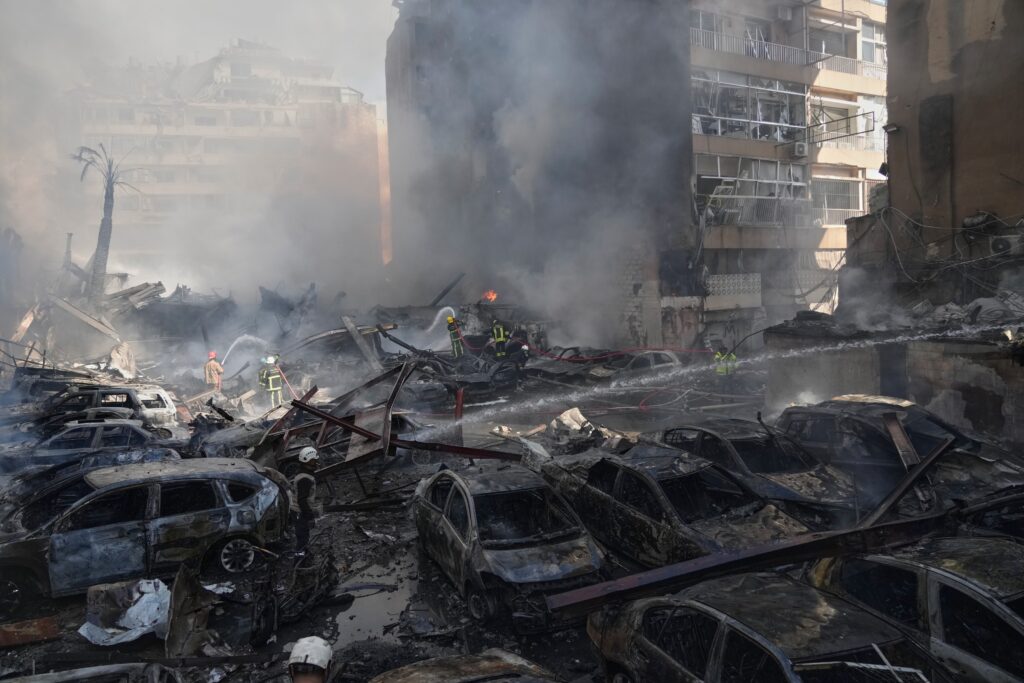
BEIRUT — Israeli forces pounded Beirut on Wednesday, killing dozens of people in an aerial barrage that Israel described as the largest yet in its current offensive against Hezbollah, hours after the United States and Iran announced a two-week ceasefire.
The office of Israeli Prime Minister Benjamin Netanyahu said the truce does not include Lebanon, as Israeli officials said it would not stop the campaign against Hezbollah, the Iran-backed militant group. The position contradicted an earlier statement from Pakistan, the main mediator in ceasefire talks. The halt in U.S.-Israeli attacks on Iran appearedlargely to hold early Wednesday.
Israeli strikes killed dozens of people and injured hundreds on Wednesday, the Lebanese health ministry said in what it described as a preliminary toll.
People across Lebanon had hoped the truce would also give their country a respite. But within hours, loud bangs rocked the capital as airstrikes hit without warning, including near government buildings, schools, commercial districts and the country’s only international airport.
Hospitals issued appeals for blood donations, and the doctors union urged health care workers to rush to medical centers to help treat the wounded. Columns of smoke rose from Beirut and other areas, including the ancient city of Tyre on the Mediterranean coast.
Israeli Defense Minister Israel Katz said forces hit Hezbollah militants and positions “in surprise attacks.” The Israeli military said it struck more than a hundred targets in a span of 10 minutes in Beirut, the Bekaa Valley and southern Lebanon.
Israel, Katz said, has “insisted on differentiating the arenas between Iran and Lebanon in order to change the reality in Lebanon.” Hezbollah fired rockets into Israel last month in retaliation for the U.S.-Israeli attack that killed its patron, the Iranian supreme leader, Ayatollah Ali Khamenei.
Lebanese Prime Minister Nawaf Salam said the Israeli attacks “targeted densely populated residential areas and claimed the lives of innocent civilians throughout Lebanon, particularly in Beirut.” He called on allies to “to help us stop these attacks by all available means.”
The Lebanese government, whose appointment had been backed by Washington, has scrambled for weeks to avert a wider escalation. Authorities have appealed to the Trump administration and Western allies including France to intervene and have offered to engage in once-taboo negotiations with Israel.
But with the Trump administration focused on Iran, Israel has rejected the Lebanese overtures, seizing on the conflict to wipe out the threat of Hezbollah’s volley of rockets and drones that have displaced residents of northern Israel in past wars.
Israel has ordered a ground invasion of southern Lebanon, directed people in Lebanon to evacuate more than 10 percent of the country’s territory, destroyed bridges that link the south to the rest of Lebanon and announced plans to raze homes in Lebanese villages near the border. Katz has said some 600,000 displaced residents of southern Lebanon “will not be allowed to return until the security of northern residents is guaranteed,” stoking fears of another long-term Israeli occupation.
The Israeli offensive has killed 1,500 people including 130 children, according to Lebanese authorities, and forced more than 1 million people to flee their homes.
French President Emmanuel Macron, who had sought to broker a ceasefire for Lebanon, welcomed the announcement of a halt in fighting between the United States and Iran on Wednesday but said including Lebanon was “indispensable.”
“The situation is critical,” he told a French cabinet meeting. “What we are seeing today, with the attacks and the Israeli occupation of southern Lebanon, cannot be a long-term response.”
Macron said France was working to ensure that a ceasefire mechanism for Lebanon that included the United States “is fully reactivated” and to boost support for the Lebanese army “to fully regain control of the territory and effectively counter Hezbollah.”
The leaders of France, Britain, Germany, Japan, Canada, Italy and Spain said Wednesday they welcomed the two-week pause in the war on Iran and called on “all sides to implement the ceasefire, including in Lebanon.”
Francis reported from Brussels. Suzy Haidamous in Beirut and Lior Soroka in Tel Aviv contributed to this report.
The post Israel kills dozens in Beirut, says Lebanon is not part of Iran truce appeared first on Washington Post.