Reopening the Strait of Hormuz — a central aim for the United States when it agreed to a cease-fire with Iran — would be the first step toward getting more energy flowing through the Persian Gulf.
But only the first step.
That is because dozens of refineries, storage facilities, and oil and gas fields in at least nine countries, from Iran to the United Arab Emirates and beyond, have been targeted in strikes. All told, 10 percent or more of the world’s oil supply has been turned off. Restarting those operations will require not only safe passage through the Strait of Hormuz, but also inspecting pumps, replacing bespoke processing equipment and recalling employees and ships that have scattered across the globe.
“It’s not a case of you just flick a switch and everything’s back up again,” said Martin Houston, a longtime oil and gas executive who now serves as board member for several energy companies.
The timeline for bringing the Gulf energy system back to some semblance of normal is highly uncertain. For one thing, the war has been paused for only two weeks.
In the cease-fire deal, which President Trump announced on Tuesday evening, Iran agreed to allow ships to pass through the strait without being attacked. Earlier that day, Mr. Trump said that if the waterway remained closed, “a whole civilization will die tonight, never to be brought back again.” He has also repeatedly threatened to strike Iranian power plants and other critical infrastructure if Iran does not allow vessels to pass through the strait — acts that could be considered war crimes.
Attacks on energy facilities continued in the days leading up to the cease-fire, including on an oil refinery in Kuwait and petrochemical complexes in Iran. How much damage has already been done to the region’s infrastructure is difficult to know because many countries have shared little information.
Once companies regain confidence that their ships can transit the narrow waterway that runs between Iran and the Arabian Peninsula, the first order of business is likely to be shipping out the oil and other fuels that countries close to the strait stockpiled in storage tanks. Then, as long as hostilities do not resume, some wells are likely to flow again within days or weeks, industry analysts and Gulf oil executives say.
But a fuller recovery will be a monthslong process, they cautioned. And even then, some infrastructure that has sustained extensive damage is expected to take years to repair.
For consumers, this means that gasoline prices at the pump — which recently topped $4 a gallon, on average, in the United States — are unlikely to return to their prewar levels any time soon, even though international oil prices fell considerably late Tuesday. Countries are using up stores of energy they had before the war, so the longer the war drags on, the stickier those high prices are likely to be.
The shuttering of oil wells has other consequences. Once idled, oil and gas wells can be difficult to restart, and the longer they remain closed, the more trouble companies may have turning them back on.
The pressure underground can get out of whack while wells are closed; water can build up. If the shutdowns last a long time, equipment might corrode after being exposed to hydrogen sulfide for too long. The toxic gas, which smells like rotten eggs, is often found mixed in with oil and natural gas. Saudi Arabia and Iraq inject gas or water into many of their wells to coax out more oil, adding another layer of complexity to re-establishing the correct pressure when the time comes to reopen, the research firm BloombergNEF wrote recently.
Kuwait, which is sandwiched between Saudi Arabia and Iraq at the tip of the Persian Gulf, is the world’s 10th-largest oil producer. Before Friday, when its Mina al-Ahmadi refinery was hit by a drone, the chief executive of the state-owned oil company Kuwait Petroleum said he expected to be able to “bring out quite a bit of production immediately, within a few days” of the war’s ending. Sheikh Nawaf Al Sabah, the chief executive, added during remarks late last month at an energy conference, CERAWeek by S&P Global, in Houston that “the full production will come within three or four months.”
The big question is how much damage has been sustained by all the infrastructure needed to get oil and gas from wellheads to world markets. Analysts say few installations appear to have suffered catastrophic harm, but they are working with limited information about most facilities.
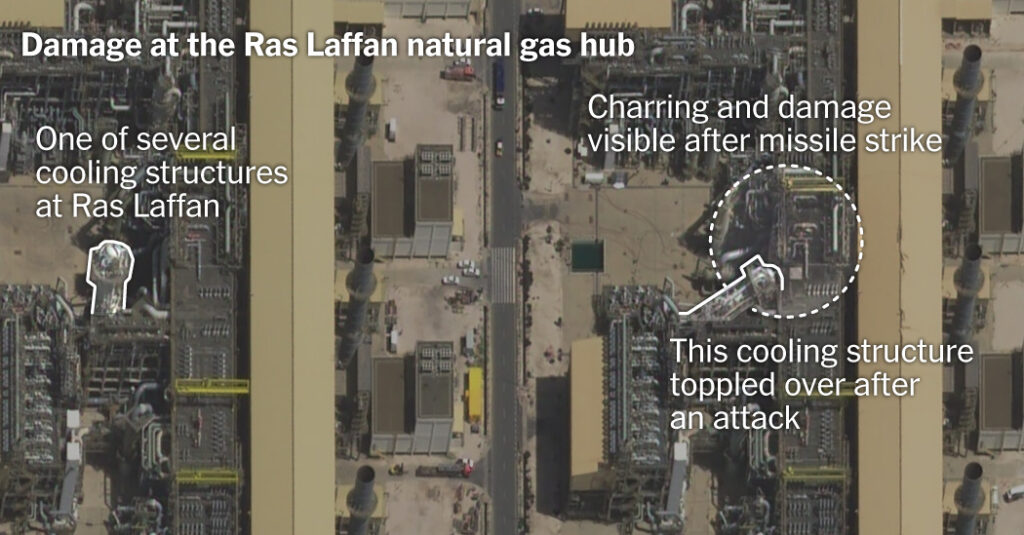
One of the most important energy assets in the region is Qatar’s natural-gas export plant, Ras Laffan. The site, which spans at least three square miles in a large industrial city, supplies countries throughout Asia and Europe with natural gas that people use for cooking, heating homes and generating electricity.
Before it can be loaded on a ship, natural gas must be turned into a liquid by cooling it at about minus 260 degrees Fahrenheit (minus 162 degrees Celsius). Qatar stopped making this liquefied natural gas, or L.N.G., during the early days of the war. Missiles later took out 17 percent of the site’s capacity.
The undamaged parts of the facility would be restarted first, likely over a period of weeks or months. Steps include reopening the offshore gas wells that feed the export terminal; restarting any utilities that had been turned off; restocking the inventory of fuels used to cool the gas, known as refrigerants; and then actually cooling the gas, said Mehdy Touil, who spent more than a decade at Ras Laffan and is now the lead L.N.G. specialist at Calypso Commodities, a Berlin company.
The damaged portions are another matter. QatarEnergy, which operates Ras Laffan, has said it will take several years to repair those areas and bring them online. (The company did not respond to requests for comment.) Ras Laffan has 14 L.N.G.-producing units. The strikes last month took out the heart of two of them — the mammoth structures in which gas is cooled — QatarEnergy’s chief executive told Reuters. That equipment can be as tall as an 18-story building, and the lead time for a new one can run two years or more, industry officials said.
“These facilities were custom‑engineered and integrated into the broader Ras Laffan complex, making them substantially more difficult to replace” than simpler kinds of energy infrastructure, said Najmedin Meshkati, a professor of engineering at the University of Southern California.
Less is known about the extent of the damage to oil-processing facilities throughout the region. A refinery on the west coast of Saudi Arabia had been operating at much lower levels after a drone strike in mid-March, according to Rystad Energy, an Oslo-based consulting firm. Rystad estimated that the refinery most likely could be fully restored within a year.
Iran has also suffered attacks on its energy infrastructure, including strikes on oil depots in Tehran that turned the sky over the capital city black.
One concern for rebuilding is that supply chains for some specialized parts have already been stretched thin. The rush to build data centers for artificial intelligence has created a demand for gas-fired power plants and other energy infrastructure. Many of those facilities rely on equipment, like gas turbines, that may also be needed to make repairs in the Gulf.
“If you have the right supply chain, you can get things built back pretty quickly,” said Mike Stice, a University of Oklahoma professor who serves on the board of energy companies including the U.S. refining giant Marathon Petroleum. But, he added, timelines will depend a lot on what has been damaged. “All it takes is one critical piece of equipment that has a two-year delivery date.”
In the end, however the conflict plays out, analysts expect energy prices to eventually fall from wartime levels, but remain higher than they would have been in the absence of war.
Analysts at the French bank Société Générale recently said they expected oil to trade around $80 a barrel at the end of 2026, up from their earlier forecast of $65. Traders will be pricing in a greater risk of geopolitical disruption in the future.
Rebecca F. Elliott covers energy for The Times.
The post It Will Take Months to Get Oil and Gas Flowing out of the Persian Gulf appeared first on New York Times.