President Trump went to war on Feb. 28 pledging to prevent Iran from getting a nuclear weapon, destroy its missile capability, break its regional proxies, eliminate its navy and create the possibility of regime change.
After five weeks of bombardment, Mr. Trump agreed to a cease-fire with none of those goals clearly accomplished.
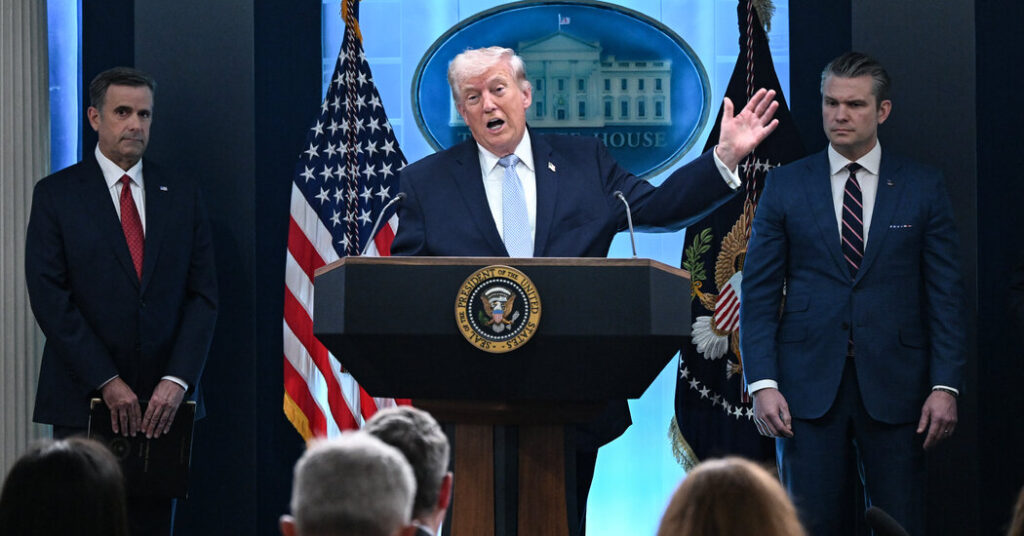
In his social media post Tuesday announcing the end of U.S. bombing, for now, if Iran reopens the Strait of Hormuz, Mr. Trump said that “we have already met and exceeded all Military objectives.” Defense Secretary Pete Hegseth told reporters Wednesday that the United States had achieved a “historic and overwhelming victory” because Iran’s military had been rendered “combat ineffective for years to come.”
Still, even supporters of the president’s decision to go to war voiced doubts that Iran had in fact been defeated. Mark Levin, the Fox News host whom Mr. Trump often praises, lamented in prime time on Tuesday night that the Iranian regime was “still surviving.” Laura Loomer, the far-right activist close to the White House, posted online that “we didn’t really get anything out of” the cease-fire talks “and the terrorists in Iran are celebrating.” Lindsey Graham, the hawkish Republican senator from South Carolina, warned that Congress would need to review any deal.
The hand-wringing from the president’s staunchest backers highlighted the disconnect between the vast firepower of the U.S. military on display over the last month and the war’s more complicated consequences for U.S. security and influence. It was an indicator of the discomfort with the outcome of a war that, for now, has left the Middle East looking markedly different from the ambitions that Mr. Trump laid out when he announced the start of “major combat operations” more than a month ago.
“This regime will soon learn that no one should challenge the strength and might of the United States Armed Forces,” Mr. Trump said in that overnight video message on Feb. 28, wearing a “USA” baseball cap.
But Iran did challenge the United States, even as the U.S. military struck more than 13,000 targets, according to the figure released by the Pentagon on Wednesday. Iran attacked U.S. partners in the Middle East and closed down shipping out of the Persian Gulf.
The result: While Mr. Trump said at the war’s start that “we will ensure that Iran does not obtain a nuclear weapon,” the president declared the cease-fire with hundreds of pounds of highly enriched uranium still in Iran’s possession. He said on social media Wednesday that there would be “no enrichment of Uranium,” and that the United States would be “working with Iran” to “dig up and remove” its stockpile, but there was no indication that Iran had agreed to such terms.
Mr. Trump also promised to “destroy their missiles and raze their missile industry to the ground.” Gen. Dan Caine, the chairman of the Joint Chiefs of Staff, said Wednesday that the U.S. bombs had hit “more than 450 ballistic missile storage facilities” and 80 percent of Iran’s missile production facilities. Richard Goldberg, a senior adviser at the hawkish Foundation for Defense of Democracies think tank, estimated that as much as one third of Iran’s missile arsenal remained intact, and cautioned that “we either get dismantlement or we don’t.”
The United States did, by all accounts, succeed in sinking much of Iran’s navy. But the cease-fire has gone into effect with Iran retaining maritime power where it matters most for the world economy: in the Strait of Hormuz, which Iran has been able to shutter with small boats, drones and missiles fired from shore.
When it comes to Iran’s network of proxy forces, Tehran’s allies are weakened but still pose a threat. Israel appears to be continuing its war on the Hezbollah militant group in Lebanon, while the Houthi militia in Yemen signaled in recent days that it could still join the fighting. Iran’s theocratic regime remains in power, potentially with even greater military control over the country, and there is no clear evidence backing up Mr. Trump’s assertion that the leaders who replaced those killed during the war are “very reasonable.”
Brian Katulis, a senior fellow at the Middle East Institute, said it was true that the war had put U.S. military power and sophistication on display, reducing Iran’s missile and drone arsenal and decimating its navy. But he noted that Iran’s military was already weak before the war, and he compared U.S. claims of victory to “Muhammad Ali going in and saying he’s beating up a teenage boxer.”
“The real threat that Iran continues to pose is asymmetric,” Mr. Katulis said, referring to capabilities like Iran’s cheap one-way attack drones, its lingering proxy network and its control over the Strait of Hormuz. “The ledger does not look great.”
Anton Troianovski writes about American foreign policy and national security for The Times from Washington. He was previously a foreign correspondent based in Moscow and Berlin.
The post Trump Says He ‘Exceeded’ His Objectives in Iran. But What Did He Accomplish? appeared first on New York Times.