You’re reading Margin of Victory, a newsletter on the 2026 midterm cycle. Click here to get the full newsletter in your inbox, including Henry Olsen’s latest election analysis.
Henry Olsen is a senior fellow at the Ethics and Public Policy Center.
It would be a stretch to say that Donald Trump’s presidency will be on the ballot in Indiana on May 5, but the difference between a good and bad night for him could certainly have major consequences for the course of his second term. A lame-duck president’s power over his party is a hard-to-renew resource.
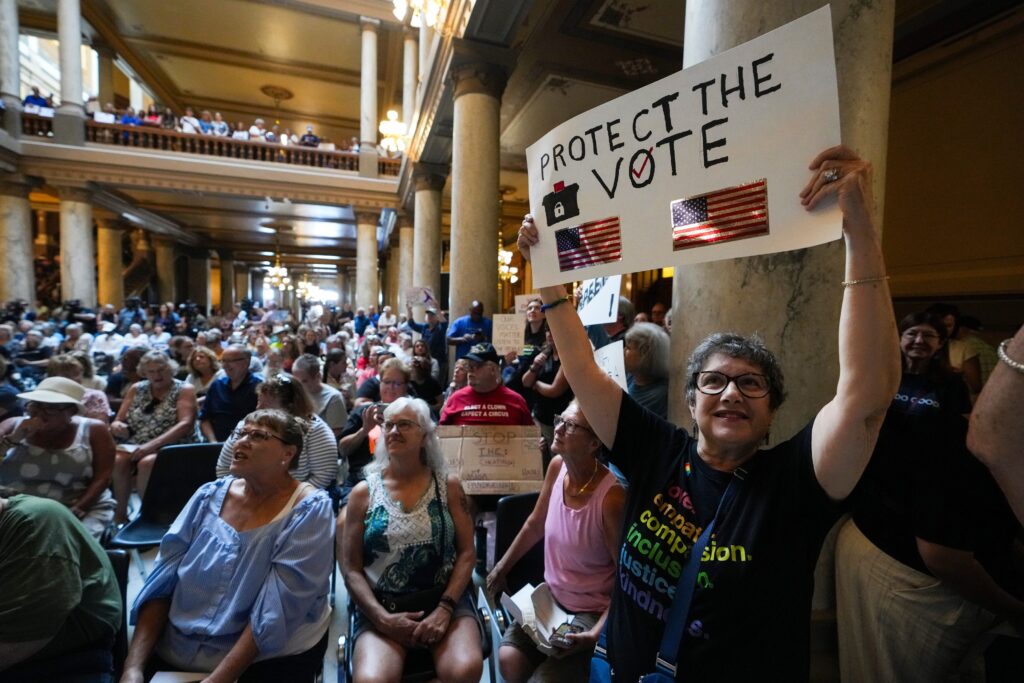
At issue in Indiana’s Republican primary is the president’s ability to play kingmaker. The world is waiting to see if his unorthodox endorsement of Hungarian Prime Minister Viktor Orban will propel his fellow populist leader to victory this Sunday. But Indiana — where Trump is trying to unseat five of the state senators who last year defied his call to enact a midcycle, pro-GOP gerrymander — surely matters more to most Republicans.
As the GOP contemplates a grim midterm result, state-level legislators have mostly fallen in line with Trump’s demand that they redraw congressional district lines to favor the party wherever they can. Texas, North Carolina and Missouri Republicans changed their maps, and Florida looks likely to follow suit this month.
But Indiana Republicans pushed back. In December, the state Senate voted to kill Trump’s gerrymander, which was crafted to send two additional Republicans to Congress, by a 31-19 vote. Republicans hold 40 of 50 seats in the body, meaning that a majority of GOP senators joined with all 10 Democrats to buck Trump. They did that despite massive public pressure from Gov. Mike Braun (R), Sen. Jim Banks (R), many outside Republican groups — and especially the president himself.
An angry Trump promptly followed through on his threat to back primary challenges against the wayward senators. He has now endorsed opponents to five of them and may back as many as three more. Outside groups aligned with Trump are spending millions of dollars against the five incumbents. Television ads have been running for weeks, and more are certainly on the way.
Those incumbents, though, have money and support of their own, and they aren’t going down without a fight.
Here’s what we’re about to learn: In year six of his nonconsecutive eight-year presidency, can Trump unseat an otherwise unremarkable conservative Republican if he wants to? If the president had not intervened, none of the threatened incumbents would be considered at risk of losing their primaries. None can credibly be labeled “RINOs,” despite the president’s attempt to do so.
This is a pure power play by a man whose political brand is built on power plays. And such is Trump’s power and prestige within the GOP that many might think the result is a foregone conclusion. But the fact is, Trump’s support doesn’t guarantee a victory in contested primaries. His choice in Texas’s 9th Congressional District, Alex Mealer, is in a tight runoff against state Rep. Briscoe Cain, and his choice in the state’s 35th Congressional District heads into the runoff there well behind state Rep. John Lujan. Trump can be beaten by candidates with their own resources and deep ties to a seat. All five challenged Indiana incumbents have those.
If Trump knocks off most of his targets, Republican officeholders across the country will see that they oppose the president at their peril. But they’ll note the opposite if he fails. That doesn’t mean that Republicans are going to suddenly rise in revolt. But it does mean that more of them, in more situations, will be more comfortable distancing themselves from Trump or even opposing him outright.
And if it starts rolling, that snowball could be hard to stop, especially given the party’s increasingly dim chances of holding the House this fall. Four or five losses in Indiana will make Trump look like the emperor who has both no clothes and a dangerously low job-approval rating. At that point, a looming defeat in November will provide strong motivations for at-risk Republicans to go their own way.
One might ask why Trump would risk his precious prestige in this way, since it wasn’t something he had to do. Given his track record of political success, though, it’s understandable that he would like his chances. It usually doesn’t pay to bet against him. But it’s hard to bat 1.000, and even the most skilled political operators can bite off more than they can chew. In 1936, President Franklin D. Roosevelt came off a landslide reelection and promptly lost his effort to pack the Supreme Court, then failed in 1938 to unseat anti-New Deal Democratic senators. If even the legendary FDR can lose at the top of his power, a low-ebb Trump certainly can, too.
There is no forever in politics. FDR, of course, went on to win unprecedented third and fourth terms, remaking the Democratic Party in his own image. Trump, even if he’s trounced in Indiana, could similarly bounce back to further remake the GOP. Surely, though, he would prefer not to have to lose to begin with.
The post Trump’s power over his party is about to be tested in Indiana appeared first on Washington Post.