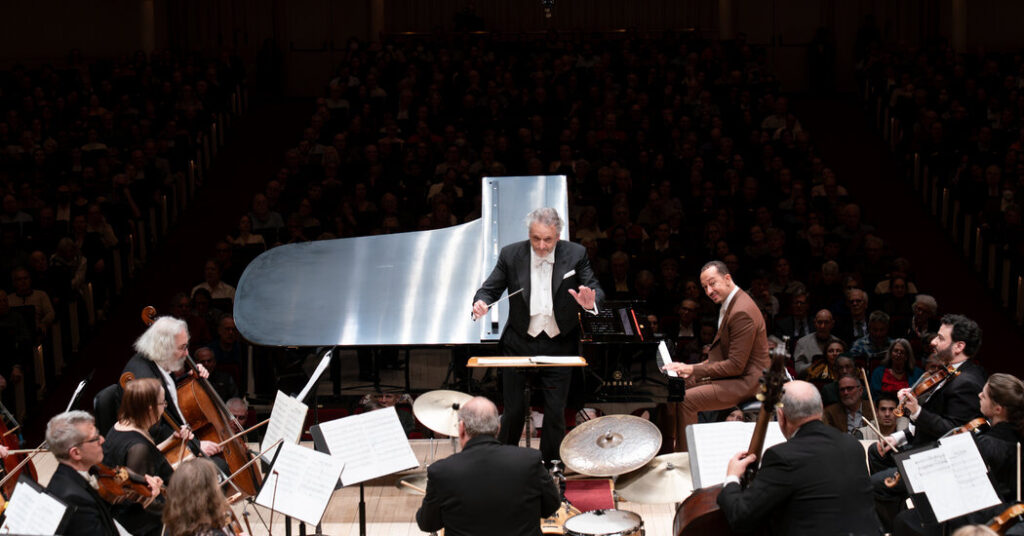
There are two Carnegie Hall dates I’ve had circled on my calendar for a long time, and both came up recently.
One was an Orchestra of St. Luke’s concert with two orchestral works by Duke Ellington on the program. The other was an appearance by the Philadelphia Orchestra, with the local premiere of a new, extroverted morsel by John Adams.
Ellington and Adams are both titans of what I think of as classical Americana. Though idiosyncratic and experimental after a fashion, they’re not willfully obscure or iconoclastic in the manner of other visionaries I also admire, like Harry Partch. So they’re excellent choices for Carnegie’s festival United in Sound: America at 250, which continues through this season.
The tunefulness, sensuous harmony and rhythmic ebullience of Ellington’s music require no special explanation. When his music is played well, it just works — as in the case of the St. Luke’s presentation of the 13-minute “New World A-Coming,” which Ellington and his own group offered at Carnegie in 1943. Then, in 1955, he conducted a version for orchestra and jazz players, the same year he brought his “Night Creature” (also on the St. Luke’s program) to the hall.
Louis Langrée, who led the St. Luke’s concert, has been working on his approach to “Night Creature” for a few years. During the pandemic, he presented a light-on-its-feet rendition with the Cincinnati Symphony Orchestra — a collaboration preserved on the album “American Dreams.”
At Carnegie, Langrée again emphasized litheness when realizing the piece. If his swing-passage tempos with the orchestra didn’t have the same drive that Ellington oversaw on various recordings, the string-section music avoided the too-sweet pops orchestra sound that held sway on the 1960s album “The Symphonic Ellington.” Also working in this take’s favor was the presence of the piano soloist Gerald Clayton, a smartly selected ringer from the jazz world.
Even more startling in its pleasure was Langrée and the St. Luke players’ take on “New World” — again with Clayton as soloist. Originally, Ellington devised this work for his standing ensemble, before later conscripting Luther Henderson to adapt it for orchestra. Its symphonic performances have also suffered from a sugar-sodden pops sound in the past, so it was a joy to hear a more recent edition of Henderson’s orchestration, edited by Jeff Tyzik, that sounded crisp in the hands of these forces.
Particularly exciting was Clayton’s way of fusing his improvisatory style and Ellington’s example during some of the piece’s solos. In one near the middle, boisterous and up-tempo, Clayton’s individual feel for the blues — filtered through the soul-jazz and post-bop of players who emerged after Ellington — came through strongly, even as Clayton paid respect to archival examples of this work. He seemed to energize the St. Luke’s players, too, in a piece that the composer David Schiff has described as “a soliloquy for solo piano amplified and extended by orchestral episodes.”
The audience gave Ellington’s music as enthusiastic a reception as it did for the more expected classical Americana fare that surrounded his pieces on the program: Ives’s “The Unanswered Question” (which came across too faintly); Gershwin’s “An American in Paris” (well played, but with the feel of routine); and a symphonic suite from Bernstein’s soundtrack for the film “On the Waterfront” (more varied than the Gershwin, and more exciting).
At the Philadelphia Orchestra’s concert, I was again enthusiastic, this time about Adams’s new work, “The Rock You Stand On.” He has written a wealth of long symphonic works and even longer operas, but this, in a nice change, was an opportunity to hear his approach to shorter forms. Sometimes, the brief scores feed the bigger ones, as in the way “The Chairman Dances” (1985) was devised, in Adams’s words, as “a kind of warm-up” for the soon-to-come opera “Nixon in China.”
Though Adams has said he wrote “The Rock You Stand On” as a gift for Marin Alsop, the Philadelphia Orchestra’s principal guest conductor, who led the Carnegie performance, it also felt like it was in conversation with his recent opera “Antony and Cleopatra.” I had some trouble with that theatrical work, which I found most impressive when I focused on the churning orchestra instead of the vocal writing. Here, it was a pleasure to encounter the sleek frenzy of Adams’s latest orchestrating ideas in a purely instrumental format.
Some early section-to-section handoffs sounded slightly tentative, but Alsop and the orchestra brought the piece across — and made me want to hear it again. I didn’t feel as enthusiastic about their take on Gershwin’s Piano Concerto in F (which had difficulties in the trumpet section during moments meant to project brassy confidence), nor about selections from Prokofiev’s “Romeo and Juliet.”
I spent portions of the performance reflecting on how the conductor John Mauceri and the Hollywood Bowl Orchestra had paired many of the composers featured in these recent concerts back in 1993, on the album “American Classics.” Bold for its time, it promoted Gershwin’s “An American in Paris,” dances from Bernstein’s “West Side Story,” Ellington’s “Harlem” and Adams’s “The Chairman Dances.”
How far has classical Americana progressed since then? Perhaps not far enough. But there is potential for future programming at a festival like Carnegie’s celebration of the United States’ 250th anniversary.
What about the pianist and composer Courtney Bryan’s soulful and inventive “House of Pianos”? Langrée knows how to conduct it, and he worked with her on his recording of “Night Creature.” Or what about composer and pianist Timo Andres’s concerto “Made of Tunes,” written for the improvising pianist Aaron Diehl? The conductor of that recent world premiere was, as it happens, Adams. (Diehl and Andres performed as a duo at Zankel Hall, underneath Carnegie’s big auditorium, in January, but it would be great to see them upstairs.)
If those pieces make it to Carnegie, they’ll certainly make it onto my calendar.
The post Two Titans of Classical Americana Come to Carnegie Hall appeared first on New York Times.