Context matters. The familiar looks and feels different when its setting has changed, and the Los Angeles County Museum of Art’s David Geffen Galleries are all about change.
Roughly 2,000 works from LACMA’s encyclopedic collection of more than 150,000 objects are installed in the new building, and each is seen in a new context, among a new constellation of related works, in exhibition spaces physically and conceptually unlike those of the past.
Concrete, the structure’s dominant material, may be a synonym for fixed and definite, but the experience within is inescapably fluid. The single-level expanse of exhibition space has two entry points and countless options for covering its formidable length. The architecture insists that you meander and loop.
LACMA is hardly the only institution to set about refreshing the narrative, but its manner of presentation is distinct, maybe even radical. Gone is the traditional museum format of organizing art in sequential, neatly contained rooms according to nationality, time period and medium. Works in the collection are grouped according to four major bodies of water—the Atlantic, Pacific and Indian oceans and the Mediterranean Sea. These determined the conditions of the art’s creation through movement of resources, exchange of ideas, blending of cultures, and forces of conflict and commerce.
By designating water as the central organizing principle, the museum is priming visitors to expect dynamism and change. The installations will continually evolve, and repeated visits are likely to reveal new work, and new affinities among them.
Water is also a guiding metaphor for passage through the galleries, both the broad open spaces and the enclosed rooms, meant for contemplative eddying. Whether you go with the flow, surrendering to its whims, or feel tossed by the unpredictability of an erratic tide is up to you. A good deal of the experience is, and that, too, is part of the museum’s intent. In spite of the commanding physical statement made by the building, agency and authority inside are diffuse and shared — with a larger responsibility than usual assigned to the individual visitor.
The following art pieces — grouped according to the section in which they are installed — are suggested stepping stones, places to pause, orient, reorient, discover, savor, question. Some of the works are new to LACMA, some are the museum’s avowed greatest hits and some are quieter pieces susceptible to being overlooked.
ATLANTIC
Francis Bacon, “Three Studies of Lucian Freud”
1969; oil on canvas
Irish-born British painter Francis Bacon (1909-1992) was haunted by many things, internal and external — at least two of which prevail in this triptych. One was a 1650 portrait of Pope Innocent X by the Spanish great Diego Velázquez, which Bacon repurposed for decades. He riffed on the seated format, the finials of the papal throne (looking here a lot like bed posts), and the psychological intensity that appearances both reveal and conceal. Bacon was also obsessed with photography, namely the 19th-century motion studies of Eadweard Muybridge that splintered the continuous movement of humans and animals into discrete frames, like the stills that accrete into a cinematic flow. Freud, a prominent painter himself, shared Bacon’s idea of the human as an endlessly fascinating package of flesh and dark secrets. This is the first work by Bacon to enter LACMA’s collection, and it’s a doozy.
Kuba peoples, Shoowa group, Democratic Republic of Congo, Ceremonial Textile Panel
Late 19th to early 20th century, raffia-palm fiber plain weave with raffia cut pile and embroidery
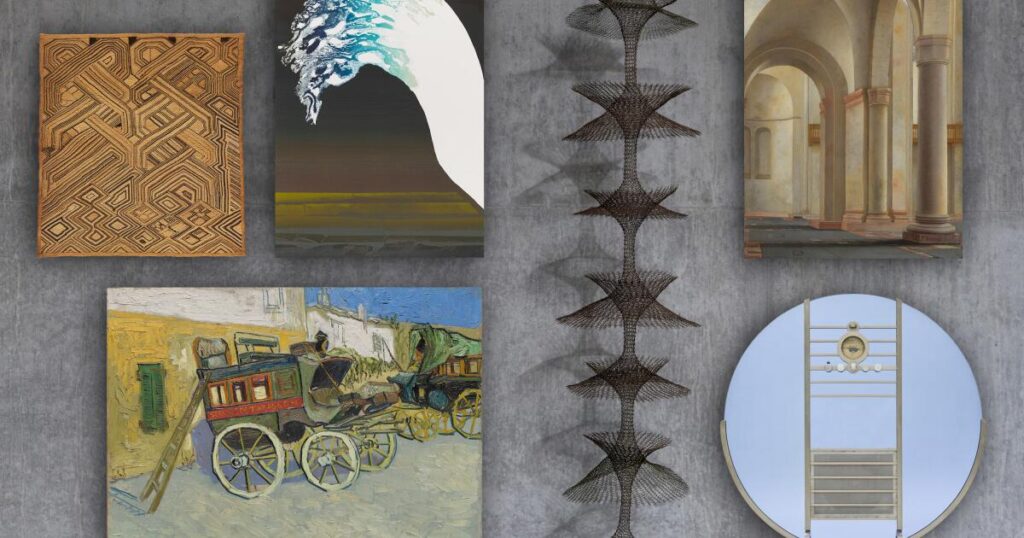
This is one of six Kuba panels on display together, each a dynamic marvel of pattern, rhythm and contrast. Lines interlace like vital circuitry. Flatness flirts with depth, and symmetry playfully tussles with asymmetry. Likely made to be draped over altars, or hung behind thrones, Kuba cloth was avidly collected by European ethnographers and missionaries in the late 19th and early 20th centuries. Henri Matisse, who had an extensive textile collection, prized his Kuba pieces, which hung in his studio as decoration and inspiration. He remarked, with a primitivist air typical of his generation, “I never tire of looking at them for long periods of time, even the simplest of them, and waiting for something to come to me from the mystery of their instinctive geometry.”
Julio Le Parc, “Mural: Virtual Circles”
1964–66, wood, aluminum, stainless steel and polished metal
Sculpture is described as kinetic when it has elements that move. In the case of this piece, we are the moving parts, activating the work’s dazzling patterns and forms. Each compartment of this open-faced, cabinet-like “mural” contains a flat panel of white half moons against black, each facing a curved mirror. When you walk along the piece’s length, the half moons appear to turn into full moons, or stretch into the shape of an hourglass. In 1960, Le Parc, who was born in Argentina in 1928 and now lives in France, co-founded a group that used the introduction of motion and time to upend the traditional relationship between art and viewer. This piece follows their stated principles spectacularly, by coming across less as a static object than the “unfolding of a given situation.”
Ansel Adams, “Surf Sequence”
1940, printed after 1972, gelatin silver prints
Adams (1902–1984) trained to be a concert pianist before turning fully to photography, but retained a musical sensibility in his visual work. This progression of five ocean views shot from atop a cliff along the Northern California coast over a 20-minute period exudes a love of rhythm, pattern and variation. Absent a horizon line, the pictures lean toward the abstract. Scale is ambiguous, and the images of waves, wet sand, rocky shore and shadow also read as bands of tone and texture. “He entered photography as a performing artist and still sustains the role,” wrote photographer Minor White of Adams.
Walter Dorwin Teague, “‘Nocturne’ Radio, Model #1186”
1934, tools and equipment, powered devices, colored mirrored glass and chrome-plated and lacquered metal
If an early 19th-century luxury ocean liner parked itself in your living room, it might look something like this. Advertised by its manufacturer, Sparton, as “A Vision in Midnight Blue Crystal Mirror Glass and Satin Chrome,” the Nocturne epitomized Art Deco elegance. It sold for $350 when it was made (equivalent to nearly $10,000 today), and was marketed in advertisements for the “Smart Home with Moderne Appointments — for Studios and Clubs — for Connoisseurs of Beauty and Originality.” Fewer than 25 of these vintage entertainment centers are believed to still exist.
Betye Saar, “I’ll Bend But I Will Not Break”
1998, mixed media including vintage ironing board, flat iron, chain, white bedsheet, wood clothespins and rope
Saar’s sculptural tableau visualizes a bitter irony: “The woman who irons the sheet that the [Ku Klux Klan] person wears,” the artist has explained, “is a Black woman and is a slave.” A crisp, white KKK-monogrammed sheet hangs here on a makeshift clothesline, behind a worn wooden ironing board. The board’s surface is imprinted — branded, as it were — with the infamous 18th-century engraving illustrating how tightly Black bodies could be packed on a single deck of a slave ship. Saar, who was born in 1926, has been repurposing the material detritus of racism and oppression to poetic and piercing effect for much of her 60-year career. She is a living treasure of L.A.
Vincent Van Gogh, “Tarascon Stagecoach”
1888, oil on canvas
Van Gogh (1853–1890) moved to Arles in the south of France in 1888, drawn to the landscape, the light and the rustic lifestyle. Rustic is the operative word in describing the stagecoach portrayed here. The establishment of rail travel in the 1870s had rendered such coaches secondary, mostly used to reach small towns not served by the train. Tarascon, a village north of Arles, was just such a spot, a quaint area Van Gogh described in a letter to his brother Theo as “something out of Daumier come to life.” In the same letter, the artist refers to a popular satirical novel about the inhabitants of Tarascon, in which a carriage complains about its hard life. Van Gogh imbued his portrait of the stagecoach with empathy for the worn and tired conveyance. He makes up for the subject’s humility with juicy brushwork and a palette long on verve.
MEDITERRANEAN
Damascus Room
1766–67
The home this room once belonged to was likely austere and simple on the outside, no advertisement for the gasp-worthy elegance within. Installed here as a free-standing space, the room again has a humble exterior, like the bare backside of a stage set. The original setting and this new one aim for a similar sensation — the revelation of a plush secret. Every square inch of the interior, meant for receiving and entertaining guests, is embellished with floral designs, geometric patterns and also calligraphic panels of Arabic poetry. The walls abound in textural variety, some areas carved and painted, and others with shapes built up using gypsum and animal glue, then glazed. The material richness broadcasts affluence, but also exquisite taste. Quite the time capsule.
Georges de La Tour, “The Magdalen with the Smoking Flame”
Circa 1635–37, oil on canvas
This is a portrait of a soul examining itself, which makes it instantly relatable in spite of the symbolic elements not typical of our time and world: the skull resting on Mary’s lap (a reminder of mortality); the penitential whip on the table awaiting its violent use. Mary’s story is suggested, rather than told. Instead of situating her as witness to Christ’s crucifixion and resurrection, De La Tour (1593–1652) focuses on Mary as witness to her own inner transformation. The candle burns steadily and generously, a literal source of light as well as an emblem of spiritual illumination. Its mesmerizing hold renders Mary utterly still, and amid the visual commotion of 21st-century life, perhaps us as well.
Clara Peeters, “Still Life with Cheeses, Artichoke, and Cherries”
Circa 1625, oil on wood panel
Few schools of painting are as sensorily gratifying as 17th-century Dutch still life, where feasts for the body are transformed into feasts for the eye. Peeters (c.1588/90–1636) was an early adopter of the form, and the rare female artist still recognized four centuries later. Each element in her painting is a vehicle for the sumptuous invocation of texture: reflective metal of knife and platters; shiny skins of those juicy little orbs of fruit; a dome of crystalline salt; softly collapsing petals of butter; furry fibers lining the artichoke’s heart. Legible on the surface as pure domestic bounty, each scene is also densely coded with signifiers of class and conquest. That diamond-like pile of salt, for instance, was actually as precious as diamonds. It was harvested by enslaved workers in Africa and the Americas and imported, not just to enhance flavor, but as a preservative before the advent of refrigeration.
Pieter Jansz. Saenredam, “Interior of the Mariakerk, Utrecht”
1651, oil on wood panel
This spare, hushed interior wasn’t always so visually restrained. The Protestant Reformation stripped the formerly Catholic Church of its stained glass, paintings and statues. Saenredam (1597–1665) made meticulous drawings and perspectival studies of the 11th-century Romanesque structure, then distilled the interior further to a state of quiet purity, a light-suffused, sacred shell. Saenredam made only about 50 paintings in his lifetime, many of them depicting houses of worship. A contemporary of the artist wrote of his images of architecture: “Their essence and nature could not be shown to a greater perfection.”
INDIAN
Map Shawl, Kashmir region, Jammu and Kashmir, India
Second half of 19th century, goat hair, embroidered
Queen Victoria was gifted one of these rare, labor-intensive embroideries, and now LACMA has one too. Somewhere between a diagram of the city of Srinagar and a diary of its everyday life, this shawl is a thorough delight to explore. A large square roughly 6 feet per side, it’s displayed flat atop a platform and invites scrutinous circling. Follow the meandering aqua waterways, ribboned with fish and boats all equal in size. Spot the hunters, hoisting muskets toward their prey, the loungers lifting a cup, the riders on their horses. Scale and perspective shift (some subjects are seen from above, some head-on) according to the demands of the design, which vibrates with vitality and ingenuity. It’s not surprising that works of this sort can take decades to complete.
Do Ho Suh, “Jagyeong Hall, Gyeongbok Palace”
2026, polyester fabric on stainless steel and aluminum frame with ceramic coating
There’s a ghost in the new David Geffen Galleries. It’s not a human spirit, but the specter of a building, part of the Joseon Dynasty’s royal palace in Seoul. Suh was born in Seoul in 1962, but has lived in numerous cities around the world. Since the 1990s, he has re-created many of his own residences at full scale in translucent silk or polyester. His works of “fabric architecture” conjure places, but also memories, specific, yet elusive. This piece, a LACMA commission, behaves like any good ephemeral spirit and appears to pass through a wall. Pale white, tinged with pink, the apparition has both delicate beauty and a formidable presence.
PACIFIC
June Wayne, “White Tidal Wave II”
1972, lithograph
Wayne (1918–2011) was a force of nature who, as here, was fascinated by forces of nature. She founded the Tamarind Lithography Workshop in 1960, bringing artists and printmakers together to experiment, significantly advancing the range and stature of the medium. Tamarind was based in L.A. for a decade before relocating to New Mexico, where it remains, as the Tamarind Institute, a vital, ongoing testament to Wayne’s legacy. The tidal wave in this print (which hangs among five more of Wayne’s odes to monumental tidal energy) starts out as the blank white of the paper, almost an absence, before heaving upward to its frothy height at the very top edge of the sheet. Leaving the white of the paper untouched was a technically and formally adventurous move typical of Wayne, who asked, “What does a negative shape mean? I want to explore the thing you don’t know about.”
Ruth Asawa, Untitled
1954, iron, copper and brass wire
It took the art world — both museums and the market — until relatively recently to fully incorporate Asawa (1926–2013) into the dominant history of postwar American art. As a Japanese American woman using craft-related working methods, bias thwarted recognition on every level. This untitled hanging piece epitomizes the ingenuity and distilled beauty of Asawa’s best work. She studied at the famed Black Mountain College and became close to Buckminster Fuller and Josef and Anni Albers, absorbing their ethos of resourcefulness and experimentation with common materials. She learned the technique of using continuous looped lines to build planar surfaces from basket-makers in Toluca, Mexico, in 1947. This became the basis for a spectacular array of sculptures of repeating, interpenetrating and nesting geometric forms, suspended works that engage rhythm and reversal, palpability and porousness.
Diego Rivera, “Flower Day (Día de flores)”
1925, oil on canvas
After spending 14 years in Europe, Rivera (1886–1957) returned post-Revolution to his native Mexico in 1921, and experienced an internal revolution of his own. As he later described it, “My homecoming aroused an aesthetic rejoicing in me which is impossible to describe … Everywhere I saw a potential masterpiece — in the crowds, the markets, the festivals, the marching battalions, the workers in the workshops, the fields — in every shining face, every radiant child.” He started to align art with social change, and was central to the flourishing of Mexican muralism. “Flower Day” embodies Rivera’s newfound appreciation for the Indigenous population, as well as the rhythms of everyday life. He repeatedly painted Calla lily vendors, rendering them, as here, with heroic, sculptural monumentality in a scene of organic interconnectedness and unity.
Kimsooja, “A Needle Woman”
2005, Six-channel video installation
We see the artist from behind in each component of this video installation, standing still in the midst of urban bustle, a stone in the relentlessly churning stream. Kimsooja, born in 1957 in Taegu, Korea, filmed these performative scenes in major cities around the world over the course of 10 years, exhibiting them in different iterations and scales. The LACMA work includes footage from Nepal, Cuba, Brazil, Chad, Yemen and Israel. In other works, Kimsooja has used the needle as a tool in gestures of mending and joining. Here, the needle’s straightness refers to her own posture, a steady vertical within the horizontal flow. Because our position as observers roughly echoes her own, she becomes something of a stand-in for the universal woman, a self-possessed presence within and yet apart from her surroundings. The needle as an instrument of repair has metaphorical significance here, too. These works, she has said, capture her sense of solitude. Creating them cast her as witness to “humanity’s ephemerality and suffering,” yielding in her a deep compassion.
The post 17 must-see artworks in LACMA’s new David Geffen Galleries—and why you won’t experience the same thing twice appeared first on Los Angeles Times.