Pakistan’s role as a key mediator between the United States and Iran followed months of cultivating ties with the Trump administration and years of building deep bonds with Iran, enabling it to place itself at the center of efforts to resolve this conflict.
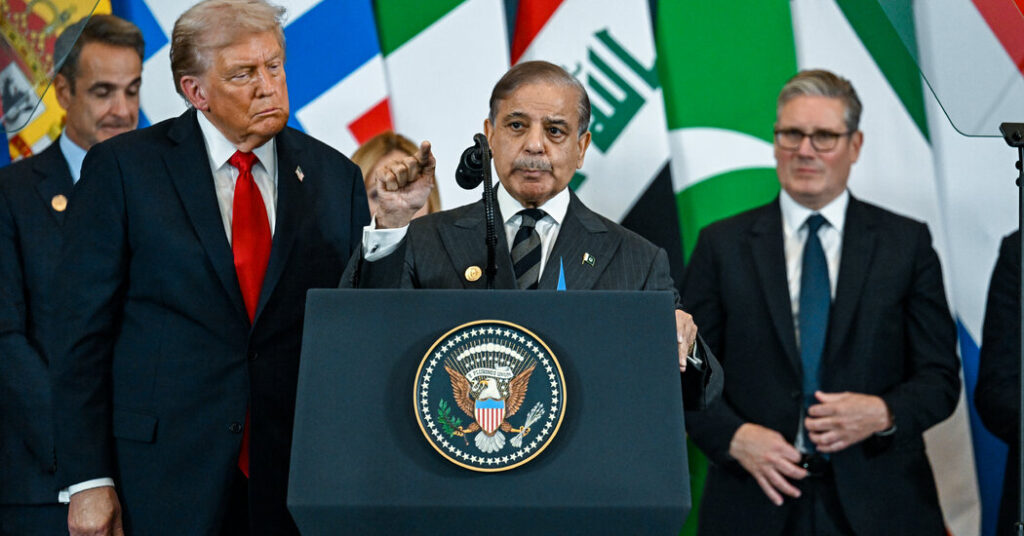
“I am pleased to announce that the Islamic Republic of Iran and the United States of America, along with their allies, have agreed to an immediate cease-fire,” Pakistan’s prime minister, Shehbaz Sharif, said on social media. “EFFECTIVE IMMEDIATELY,” he added in capital letters, echoing President Trump’s typographical style.
An hour earlier, Mr. Trump had said he had agreed to a cease-fire after speaking with Mr. Sharif and Pakistan’s army chief, Field Marshal Syed Asim Munir. Iran’s foreign minister, Abbas Araghchi, confirmed that an agreement had been reached and thanked the Pakistani leaders for their “tireless efforts.”
In mediating between these two parties, Pakistan pulled off one of its most resounding diplomatic victories in years. It is a stunning reversal of fortunes for a country that Mr. Trump once derided as offering “nothing but lies and deceit” and that the Biden administration shunned.
“For Pakistan, it really is a large feather in the cap,” said Michael Kugelman, a senior fellow for South Asia at the Atlantic Council, a research institute. “Pakistan has long grappled with a very poor global image, where countries didn’t see it as being able to be influential regionally or even globally.”
Until last year, Pakistan was perceived as an unreliable partner that had played a double game by offering support to the United States in the war in Afghanistan, one of its neighbors, while also backing the Taliban. That perception still holds in some diplomatic and defense circles in Washington, according to current and former Pakistani and U.S. diplomats as well as analysts.
After the U.S. withdrawal from Afghanistan in 2021, Pakistan became an afterthought in Washington as American officials focused on strengthening ties with India, Pakistan’s archrival.
But Pakistani officials began courting Mr. Trump and his inner circle shortly after he was re-elected and have secured deals on crypto and critical minerals. They have joined Mr. Trump’s Board of Peace, they nominated him for the Nobel Peace Prize last year, and they have effusively thanked him for helping to end a short-lived conflict with India last May — even though Indian officials say he did not.
Mr. Trump has called Pakistan’s army chief his “favorite field marshal,” and the two have met at least three times over the past year.
“Pakistan has been willing to engage in unconventional diplomatic tactics that score points in Washington — including excessive flattery and commercial opportunities with Trump’s inner circle,” said Mr. Kugelman.
Yet the cease-fire announced late Tuesday arrived with lots of uncertainty about its details, raising questions about where it would hold.
Israel disputed parts of Mr. Sharif’s statement by saying that the deal did not include Lebanon, where it has conducted a military campaign in recent weeks and which it continued hitting on Wednesday. More than 1,400 people have died there, according to the Lebanese government.
Pakistani leaders have been relaying messages between the Trump administration and the Iranian government for weeks, with Mr. Sharif and his foreign minister, Ishaq Dar, calling dozens of foreign leaders, while Field Marshal Munir has focused on U.S. officials.
Field Marshal Munir had been discussing Iran with Mr. Trump for nearly a year, including at a lunch at the White House last June after which Mr. Trump said that Pakistani officials “know Iran very well, better than most.”
Decades of deep bonds with Iran and a 565-mile border help explain why Pakistan has such knowledge, and Pakistan has long conveyed messages to the United States on Iran’s behalf.
“Pakistan has represented Iranian interests in Washington for decades, like the Swiss have done so for the United States in Tehran,” said Azeema Cheema, the founding director of Verso Consulting, an Islamabad-based research firm.
Pakistan inserted itself as a mediator in the Iran war with the backing of China, where Mr. Dar traveled last week to meet his counterpart, Wang Yi.
Ms. Cheema also pointed to other international connections. “For Pakistan, there are obvious shared interests with the Turks and Egyptians: The three are middle powers that form the current geographical borders of this war,” she said.
Mr. Sharif invited U.S. and Iranian officials for talks in Islamabad on Friday. President Masoud Pezeshkian of Iran confirmed that Iran would attend, Mr. Sharif said on Wednesday after the two spoke on the phone. As of Wednesday, the United States had yet to confirm that its officials would attend.
Elian Peltier is The Times’s bureau chief for Pakistan and Afghanistan, based in Islamabad.
The post How Pakistan Became Key Mediator Between U.S. and Iran appeared first on New York Times.