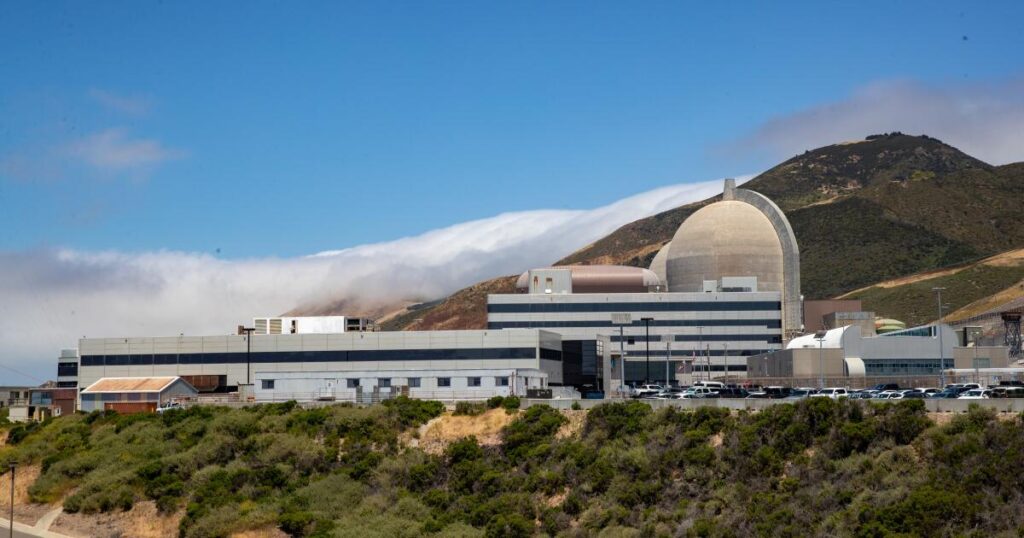
A report released Wednesday alleges that Pacific Gas & Electric is overcharging customers to run the Diablo Canyon Power Plant, the state’s only remaining nuclear power facility. Just last week, it received final clearance to operate through 2030.
Diablo Canyon was originally supposed to close in 2025, but lawmakers extended that deadline by five years in 2022, fearing power shortages if a generator that provides more than 8% of the state’s electricity were to shut off.
At the time, PG&E asked the state Legislature for a $1.4-billion loan to prolong the plant’s life. That was granted with the understanding the utility would pay it back with federal grant money it was seeking. Lawmakers also created a set of ratepayer fees that PG&E said were needed to support the extension.
Nuclear reactors do not produce carbon dioxide while operating. That means Diablo Canyon contributes very little to climate change.
In the new white paper from UC Santa Barbara’s 2035 Initiative, three climate policy experts analyzed PG&E’s public filings and the Department of Energy’s evaluation of plant costs. They find that PG&E inflated costs when it requested the state loan and is likely to come up $685.6 million short in repaying it, which will be borne by taxpayers unless the Legislature takes action.
They also find the additional fees aren’t necessary for plant operations, and without them, Diablo Canyon is profitable and could cover its costs just by selling electricity. If the fees were eliminated from 2027 to 2030, the authors find, it could save California utility customers an estimated $1.84 billion.
“Why, at a time of these record electricity rates, at a time when we are having insane heat waves and kids could really benefit from air conditioning in their schools, are we handing out billions and billions of dollars to these utilities?” said Leah Stokes, the report’s lead author and a professor of environmental policy at UC Santa Barbara, who noted several energy efficiency and building electrification programs at risk of losing funding this year. “We have to have a public conversation around that.”
The loan
Consumer advocates have long criticized the deal that allowed California to keep its plant running with the large loan to PG&E, along with additional fees.
In 2022, officials in Gov. Gavin Newsom’s administration promised the Legislature that PG&E would pay back the full $1.4-billion loan when it received a federal grant. But the same day the Legislature approved the loan, PG&E asked for only $1.1 billion from the Energy Department.
Later the Department of Energy determined the plant needed only $741.4 million to keep running through 2030, with more funds possible if there were unscheduled outages, emergencies or unforeseen rules before the end of 2026.
“Given that these conditions are extremely unlikely to be met, PG&E is not expected to receive the full $1.1 billion in DOE funding,” the report said. That means the gap between the federal grant and Legislature’s loan could be as much as $658.6 million.
PG&E Chief Executive Patti Poppe said in a February interview with Politico that she thought it should be taxpayers who cover the $300-million difference between what the state lent PG&E and what the company requested from the Energy Department.
PG&E has enjoyed record profits the last three years, so lawmakers should pass legislation to make company shareholders cover the full gap, the report authors said.
“It’s a pretty small portion of shareholder profits,” said Arjun Krishnaswami, a former climate policy advisor to the Biden administration who co-wrote the report. “If you spread it out through 2030, it’s 6.25%.”
A spokesperson for PG&E said that the utility did not inflate Diablo Canyon’s costs, and that all the loan money will be spent on eligible projects and activities by the end of the year.
“Over the last 2.5 years of audits, the Department of Water Resources [which administers the loan] has found PG&E’s loan expenditures to be reasonable with no disallowances,” Lynsey Paulo said in a statement.
She noted that legally, the loan can be paid back only with federal grant money and excess revenues from the plant’s electrical generation. But she did not answer whether PG&E expected those sources to cover the full $1.4 billion. The current default per the law would be for the state, and therefore taxpayers, to swallow the costs if the loan is not repaid.
The fees
The authors dug into a facet of Diablo Canyon finances that has received less attention among lawmakers than the loan: the customer fees set up in 2022 related to the extension.
PG&E argued at the time for a new deal that let it recoup investments from customers as soon as they were spent and collect fixed fees instead of returns on investment spread out over time, which is how utilities typically earn money on infrastructure upgrades.
Lawmakers set up two fees to be collected from all utility customers, not just those with PG&E. More than $100 million is collected each year for shareholders. The second fee collects $260 million to $270 million a year for PG&E to spend on grid projects that need not be related to Diablo Canyon.
Critics have argued these fees, established by statute, rather than through the California Public Utilities Commission, are far above what the utility would make through the regular rate-making process and excessively benefit shareholders.
“They picked a really high number for their incentives that was out of whack with what they could have earned,” said Matt Freedman, an attorney with the Utility Reform Network consumer advocacy group, who reviewed and provided the authors feedback on the report.
Two more fees, paid only by PG&E customers, raise $300 million total to cover PG&E’s liability if Diablo Canyon goes out of service, and about $56 million a year to supplement employee pay at the plant before it closes.
The report authors found that without the fees from 2023 to 2030, Diablo Canyon would cost over a third less to run, and electricity sales would exceed its cost by $164 million.
If all the fees were eliminated from 2027 to 2030, the authors found, PG&E customers would save about $250, Southern California Edison customers would save $80, and San Diego Gas & Electric customers would save $60. Community Choice Aggregator customers would also save money.
PG&E disagreed with the assertion that the fees are unnecessary or excessive. Paulo noted that the fees are set by statute and also said that state law “expressly prohibits profit by PG&E shareholders” from the fee that goes toward non-Diablo Canyon grid projects.
Stokes said paying attention to Diablo Canyon finances is particularly timely as lawmakers eye a possible extension to 2045, with a bill expected to emerge in the next few weeks.
“This isn’t about shutting down this nuclear plant, which is a useful asset and provides clean electricity,” Stokes said. “This is about financial oversight and spending dollars responsibly.”
The post PG&E is overcharging Californians to keep Diablo Canyon open, report alleges appeared first on Los Angeles Times.