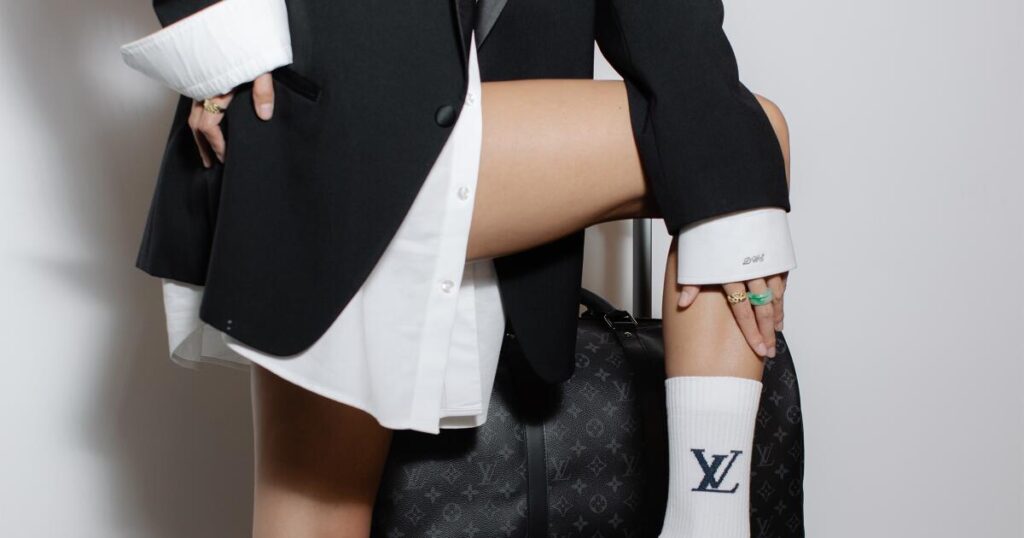

The monogram is not something that instantly screams “Los Angeles,” though the iconic Dodgers logo — interlocking white letters on a blue hat — is one of the most memorable monograms in the world. A combination of letters signifying a person or brand feels Old World rather than the shiny new feeling that defines our casual, everyday West Coast lifestyle. A lifestyle unburned by history and more connected to the mundane and the tangible. Monograms have been around for centuries, dating all the way back to ancient Greece. They became popular symbols of royalty, and in more recent times, were adopted by the upper class for use on stationery, clothing and accessories. They’re symbols of the elite, of status and success. Monograms are luxury typed and typified. Perhaps that’s why so many luxury fashion houses have employed monograms to build their aesthetic identity. None more so than Louis Vuitton, which is celebrating the 130th anniversary of its LV logo. But why do brands and individuals alike feel so compelled to write their names on anything and everything?
The LV monogram was designed in 1896 by Georges Vuitton, the offspring of the brand’s namesake founder. The logo was created in the style of Japanese family crests, with quatrefoils embellishments and stylized flowers. It found its way onto the sumptuous luggage that became the house’s trademark. It’s been tweaked and freshened up a few times since, and became a signature of the brand’s first forays into ready-to-wear apparel under the guidance of Marc Jacobs. Unlike other luxury brands that have toyed with new logos and typefaces in the last decade, the LV monogram has carried down through the various changes in leadership at Vuitton. The latest collection from men’s creative director Pharrell Williams continues to lean heavily into that visual identity on bags, puffer jackets and sunglasses.
It’s not hard to see why Vuitton has continued to rely on the LV emblem for its branding. Monograms are simple to understand. They communicate easily, and more literally than an abstract symbol like Nike’s Swoosh or Adidas’ Three Stripes. It’s part of why I put my initials on items like my wallet, the cuffs of my bespoke shirts, my sleepwear and my towels. It’s a way to signify ownership, but also a sense of clear identity. These objects are mine, and this is who I am.
Not everyone is compelled to spend the extra money on a monogram for their jammies, but the impulse comes from the early days of life. When your parents shuttle you off to school for the first time, practically everything you own has your name written on it — your T-shirts, pants, lunch box and water bottle. The cubby hole where your backpack (which also has your name on it) has a label to remind you which one is yours. We teach the idea of ownership to children early. This belongs to me. It’s the fundamental principle of our society. I own this. And what you own eventually defines you. The kind of car you drive, the music you listen to, the furniture you sit on. It’s impossible to separate objects from meaning because meaning in our modern world comes from objects, whether we support that notion or not.
Memories, associations and context all go into assigning value and meaning to an object. If an old girlfriend buys you a set of cocktail glasses from a flea market, those glasses will always evoke thoughts of that person. If you ordered Taco Bell at a drive-thru the day a loved one died, unfortunately, that might ruin Taco Bell for you forever. By monogramming something, the first thing you think about is you. Maybe that sounds a bit narcissistic, and I certainly have been accused of such things once or twice (sorry, I’m a writer, this is just part of it), but it’s never been more important to assert your sense of personhood and independence.
Technology and social media and artificial intelligence have turned us into widgets or worse, vessels for “engagement.” Even if social media affords you the opportunity to put a picture of yourself and your name on your account, you’re still liable to be drowned out by the crashing wave of millions of other people doing the exact same thing. And these worlds aren’t even real, just ones and zeros merged to form a network of communication that sometimes feels like incoherent gibberish.
Monograms are ancient. They’re tangible. They can and do mean something powerful. After 130 years, the Louis Vuitton monogram still carries weight, hearkening back to an era of remarkable craftsmanship. Instead of just looking at it like a logo that’s there to adorn a sweatshirt or a water bottle, think about what it stood for at the start — the labor and artistry that built an enduring legacy. Symbols lose their value if we forget where they came from, if we lose connection with their primordial origin.
If you step into a Louis Vuitton store today, the LV monogram is omnipresent, the symbol of a powerful luxury house. But it also stands for the man who created the company, the family that helped it grow, and the craftsmanship that brought it to market. It was built by hand, with care and attention. That’s what a monogram can do. It reminds us that a human being exists, or in the case of Louis Vuitton, existed. Not just a multinational conglomerate. A person.
I don’t monogram my clothes for myself, even if it seems like it from the outside. I do it for my son, who will have nothing left of me but memories one day — memories that live inside objects. My pajamas. My towels. My shirts. My legacy. He’ll be able to wear those clothes, look at the initials on them, and say, “These were my dad’s. And I loved him.”
The post The case for monogramming everything you own and love appeared first on Los Angeles Times.