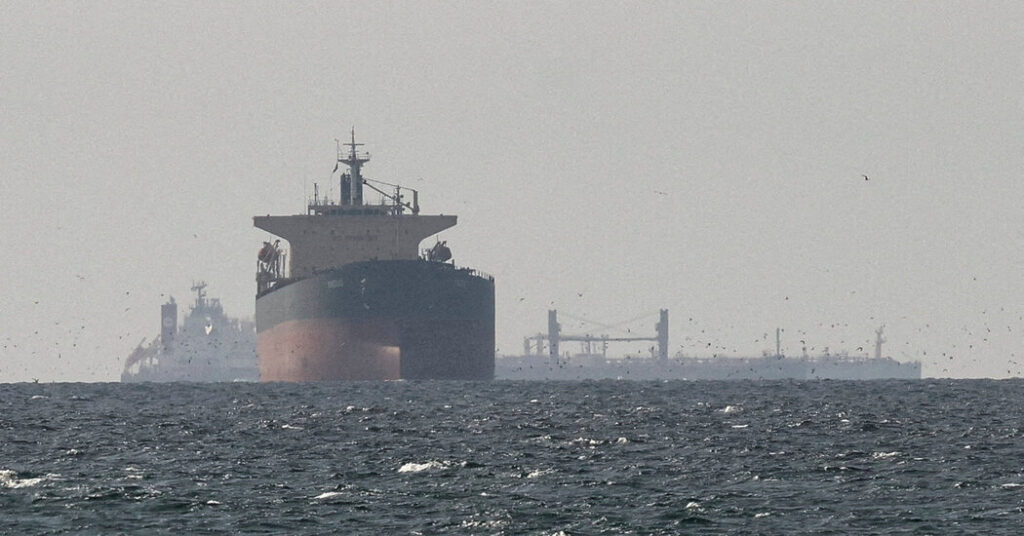
There were few signs on Wednesday of a large-scale return of shipping through the Strait of Hormuz, after Iran promised the “safe passage” of vessels in the crucial waterway as part of its cease-fire with the United States.
That could change, experts said, if shipping operators concluded that the terms of making the passage were clear and the risks of attacks were reduced. Global shipping traffic and energy flows could yet take months to return to prewar levels, they added.
Iran has blocked the strait, which carries a quarter of the world’s seaborne oil and one-fifth of its gas, throughout the war by laying mines and launching sporadic attacks on ships.
A Greek-owned bulk carrier and a Liberia-flagged vessel crossed the strait on Wednesday, according to Kpler, a global ship-tracking firm. But there were also “no clear signs yet of large-scale positioning or queuing that would indicate ships are preparing to move through in significant numbers,” said Dimitris Ampatzidis, a senior risk and compliance analyst at Kpler. “Most operators appear to be holding back.”
Around 800 tankers have been waiting on either side of the strait to pass through, according to S&P Global Market Intelligence.
Even if ship traffic ramps up, the damage and disruption to energy infrastructure in the region during the war means that stabilizing the global fuel supply remains a costly and time-consuming project.
Iran has said that it will have a role in organizing traffic through the strait. Shipping companies may balk at negotiating with Iranian authorities, especially if the terms of a passage are not clear and require large payments.
Iran’s foreign minister said in a statement early Wednesday that safe passage through the strait would be possible if coordinated with Iran’s military and with consideration of “technical limitations.” President Trump said on social media that the United States would be “helping with the traffic build up in the Strait of Hormuz” and “hangin’ around” to ensure everything goes well.
But the lack of clarity about Iran’s “limitations” and what exactly the military coordination would look like has left the industry wary.
“Shipping companies will be keen to understand: ‘What exactly does that mean, and what does that require?’” said Jennifer Parker, a former naval officer now at the University of Western Australia’s Defense and Security Institute. “There will be some uncertainty in terms of whether Iran can be trusted on this point.”
Mr. Ampatzidis said a public declaration from Iran stating that it would stop targeting vessels would help reassure shipping operators.
Before the war, more than 130 ships typically crossed the Strait of Hormuz each day. Only about 120 ships in total have made the passage since the start of the war more than a month ago, Ms. Parker said.
For shipping to return to normal, insurance for vessels and their cargo must be available at affordable rates. Insurance has been provided for at least some of the recent passages through the strait, according to industry participants. But insurers are looking for signs that the cease-fire will hold.
“Time will tell whether it is a pause or a peace but, in the meantime, it is highly unlikely that trade into the Gulf will simply resume,” Neil Roberts, the head of marine and aviation at the Lloyd’s Market Association, a trade body for insurance underwriters in London, said in a statement. “The region remains at heightened risk with none of the underlying tensions resolved.”
The shipping giant Maersk said in a statement on Wednesday that it welcomed the cease-fire agreement but that it did not yet have full certainty that passing the strait would be safe. It said it was not making any changes to specific services, saying it would continue to assess the risks before making any decisions.
Another shipping giant, Mitsui O.S.K. Lines, said in a statement that it was still suspending trips through the strait while “closely monitoring the situation.”
“Based on our current risk assessment, we are currently refraining from transiting the strait,” Leon Schulz, a spokesman for the shipping giant Hapag-Lloyd, said in a statement, adding that whether the announced opening will actually hold will become clear in the coming days.
Shippers could easily lose confidence amid the fragile situation, Malcolm Davis, a senior analyst in defense strategy at the Australian Strategic Policy Institute, said.
“All it will take is one incident with the Iranian forces maybe harassing a ship or a mine hitting a ship,” he said.
Even if the strait is reopened, it is likely to face persistent threats, including from Iran-backed proxy militias, for the foreseeable future, said Zhuwei Wang, director of research and analysis at S&P Global Energy, a research firm.
The broader, global supply of fuel will take even longer to restore. Strikes on refineries, storage facilities and oil and gas fields around the Persian Gulf have caused at least 10 percent of the world’s oil supply to be turned off, and extensive equipment repairs are needed before operations can restart.
Global jet fuel supplies, for example, could take months to return to normal even after the Strait of Hormuz reopens because of the disruptions to refineries, said Willie Walsh, director general of the International Air Transport Association, which represents more than 360 airlines.
While crude oil prices might continue falling, the costs of jet fuel — a highly refined product derived from crude — will remain elevated, Mr. Walsh told reporters in Singapore on Wednesday.
Alex Travelli contributed reporting.
John Yoon is a Times reporter based in Seoul who covers breaking and trending news.
The post After Cease-Fire, Ship Traffic in Strait of Hormuz Remains Throttled appeared first on New York Times.