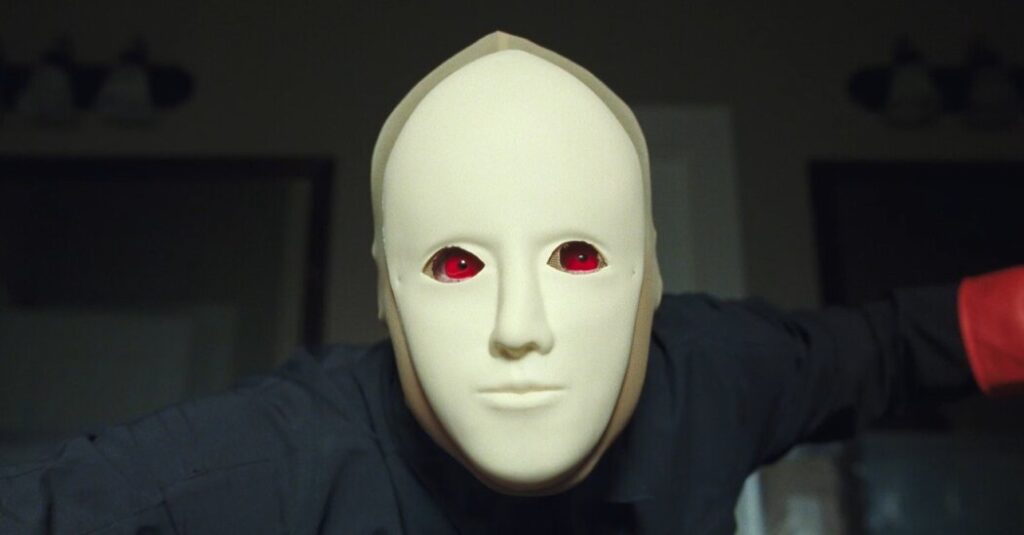
A few years ago, producers approached the filmmakers Daniel Goldhaber and Isa Mazzei with an idea. They had secured the rights to “Faces of Death,” the 1978 cult horror movie that even some of the most hard-core fans of the genre have been wary of watching. In it, a deadpan narrator named Dr. Frances B. Gröss (ha, ha) guides the viewer through a series of gruesome, “real” depictions of animals and humans shuffling off their mortal coils. The producers wanted to know if Goldhaber and Mazzei were interested in making a new “Faces of Death” for a new moment.
The first thing the pair did was watch the original for the first time. “I realized, ‘Oh, I’ve seen parts of this already,’” Mazzei, 35, said in a video interview. As a millennial who spent her formative years immersed in early iterations of social media, she had seen isolated clips from the film around the web.
Goldhaber, 34, and Mazzei were already mulling a project about living online. His experience as a content moderator for friends’ fly-by-night social media start-up in the 2010s showed him a venue in which digital expression and human nature elevated snuff videos and pornography.
The duo had made “Cam” (2018), a mystery about a sex worker on a webcam site, and would next release “How to Blow Up a Pipeline” (2023), which told the story of young environmental activists carrying out the act of the title. (Goldhaber directed; Mazzei was the screenwriter on “Cam” and a producer on “Pipeline.”) Both films embedded polemical social commentary within hardy commercial genres — the thriller and the heist movie.
Might the deep things they wanted to say about the internet — about the attention economy and its perverse incentives, about the bending and burning of shared facts — fit into a new take on a decades-old, decidedly low-fi simulated snuff film?
Apparently yes. The new movie, in theaters April 10, follows a content moderator at a TikTok-like app who suspects that viral videos re-enacting scenes from the original “Faces of Death” are actually films of real murders. She sets out to track down the ostensible killer. A scary cat-and-mouse pursuit ensues.
“Faces of Death” is a horror film at a moment when horror films are the closest thing to box office slam dunks and a reboot at a moment when franchises are everything — and at the same time a meta-commentary on all of the above. As one character says: “The algorithm loves remakes. People love remakes. If it’s a remake, you can get away with murder.”
“We’re intending to ask the question in this film: Why remake ‘Faces of Death’?” Goldhaber said in an interview. “It’s a bit telling that a large corporation thinks that’s monetizable I.P.”
The original “Faces of Death” thrived among horror aficionados browsing video-store aisles at a time when rumors circulated about its authenticity. Adam Lowenstein, a University of Pittsburgh professor who directs the school’s Horror Studies Center, recalled that “Faces” was one of the first movies he wanted to watch when he received a VHS player for his bar mitzvah in the 1980s.
“There’s something about movies being in this intimate space in the home that’s different than going to a theater,” Lowenstein said. “The cultural imaginary was affected by that — watching movies became a private thing.”
As part of the horror subgenre of faux-documentary, the original “Faces of Death” (which will be released on 4K Ultra HD this month through Vinegar Syndrome) further undermined the viewer’s ability to feel safe knowing that real is real and fake is fake.
“When a horror film is presented in the form of a documentary,” said Cecilia Sayad, a senior lecturer in film at the University of Kent, “it disrupts our expectations about the reliability of documentary.”
But Goldhaber and Mazzei’s “Faces of Death” is different. “They pitched this really on-the-moment take that stood out from everybody else’s,” said Susan Montford, one of the film’s producers.
Combining heartfelt argument with compelling narrative is the stock-in-trade of Goldhaber and Mazzei, who have known each other since high school in Boulder, Colo.
“Cam” originated conceptually as a documentary about cam girls, Mazzei said, before evolving into a narrative feature. “How to Blow Up a Pipeline” was a 2021 work of nonfiction by a Swedish academic, Andreas Malm, that made the argument for illicit sabotage in the name of the environment, while the film is a narrative about young activists and their motivations — “‘Ocean’s 11’ about eco-terrorism,” as Goldhaber put it on the New Models podcast.
“What is the best way to get the audience to relate to an experience that maybe they want to instinctively demonize?” Mazzei said. “The answer is genre — a film where you are baking the audience inside that idea, you are raising their adrenaline, they are scared with the character, they are rooting for the character and they come out of it with a new understanding and empathy.”
So it figured that when confronted with “Faces of Death,” Goldhaber and Mazzei had the instinct not to remake it strictly, but rather to use it as a jumping-off point to examine contemporary issues of violence and media distribution. This is a “Faces of Death” in which the characters watch the original “Faces of Death” (on VHS, of course).
Shooting began days after “Pipeline” hit theaters in the spring of 2023. The next year, the film was pulled from the South by Southwest festival slate days before a scheduled screening, Goldhaber said. (Legendary Entertainment, the initial producer, did not reply to a request for comment.) It took a while for the film to be acquired for distribution, by IFC and Shudder. In a turn that could have been borrowed from the film itself, earlier this year YouTube pulled its first trailer for content violation, Goldhaber said.
There are actual corpses shown in this “Faces of Death,” Goldhaber said, in glimpses of real viral videos that the lead character, Margot (Barbie Ferreira), encounters as a content moderator and in some original “Faces of Death” footage. .
“That’s the provocation,” said Goldhaber. “We’ve all accepted this stuff on our phones, because large corporations depend on our attention and our addiction to looking at our screens. But we have this older form of media, cinema-going, where it feels more taboo.”
Squabbling over real video can feel quaint today in an era of ever-more-compelling deepfakes. “The movie is set in 2024, and we didn’t update it when we came out in 2026, because everyone would be like, ‘Oh, it’s A.I.,’” Goldhaber said. “But I think the disruption of reality we are pointing out was evident two or five years ago.”
“Faces of Death” provides all the ingredients of a horror-flick recipe. There is an antagonist (played icily by Dacre Montgomery); there is a scary house; there are terrified women fleeing from heated pursuit.
But it is difficult to overlook a moral streak that runs throughout the film. A world that places a premium on social media clicks is, it turns out, not a great place. “We say that if you’re getting attention, you have value,” Goldhaber said. “If you commit an act of mass violence, you will receive a tremendous amount of attention. So we’re telling people, If you commit an act of mass violence, you have value.”
That dynamic, the filmmakers are saying, risks making attention-mongers of everyone.
“He’s an extreme example of that, but there are definitely aspects of Arthur that I relate to,” said Mazzei of Montgomery’s character. “I am someone who posts on social media. I am someone who wants attention online. Aren’t we all?”
Marc Tracy is a Times reporter covering arts and culture. He is based in New York.
The post ‘Faces of Death’ Set the Bar for Hardcore Horror. It’s Baaack. appeared first on New York Times.