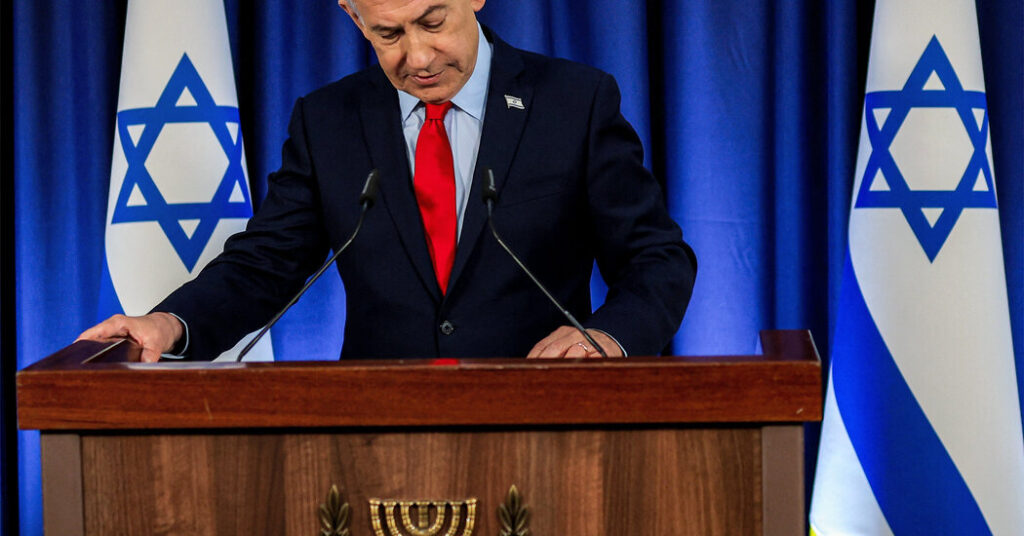
Prime Minister Benjamin Netanyahu of Israel clearly stated his goals for the war against Iran, saying that the attacks were “designed to remove the existential threats” to Israel.
That, he said, meant removing Iran’s nuclear threat and destroying its ballistic missile program before their components were buried deep underground, protected from aerial attack. Mr. Netanyahu added that it also required “creating the conditions” for the Iranian people to topple their government.
On Wednesday morning in Israel, hours after President Trump announced a two-week cease-fire, the sirens warning of incoming Iranian missiles may have gone silent but there was no guarantee that any of those goals had been achieved.
Mr. Netanyahu’s office issued a dry statement, in English, saying, “Israel supports” Mr. Trump’s decision, along with the U.S. effort to ensure, through further negotiations, that Iran would no longer pose a threat.
But Mr. Netanyahu’s critics were far from convinced.
“There has never been such a diplomatic disaster in all of our history,” Yair Lapid, the centrist leader of Israel’s opposition, said in a statement.
“Israel was not even at the table when decisions were made concerning the core of our national security,” Mr. Lapid noted, adding that the prime minister had “failed diplomatically, failed strategically, and did not meet a single one of the goals that he himself set.”
With elections in Israel due before the end of October, Mr. Netanyahu has much riding on how the outcome of the war is perceived at home.
The war likely degraded Iran’s nuclear and missile capabilities, but there were no signs that the Iranian government was about to fall. Many analysts argue that by merely surviving, the Islamic republic has actually become stronger than before Israel and the United States launched their military offensive in late February.
Freedom of movement through the key maritime route of the Strait of Hormuz, which Iran effectively blockaded for several weeks, and the global energy crisis that the bottleneck caused were more pressing issues for the United States than for Israel.
Israel was more concerned about the fate of Iran’s stockpile of some 400 kilograms, around 900 pounds, of highly enriched uranium that was buried beneath a nuclear facility near the city of Isfahan during strikes last June. What happens to that stockpile is unclear.
The 12-day war in June was waged largely by Israel. The United States joined toward the end and dropped the bunker-busting bombs that did the bulk of the damage at Iran’s nuclear sites. That conflict came to an abrupt halt when Mr. Trump announced a cease-fire.
Israel was then surprised at how quickly Iran began to reconstitute its ballistic missile production industry, Israeli experts said — a factor that Mr. Netanyahu said precipitated his decision to launch a new military offensive alongside the United States.
Mr. Netanyahu has championed his close partnership with Mr. Trump as his prized asset, but analysts say the relationship also comes with constraints: The Israeli leader can prod and lobby the White House, but Mr. Trump ultimately calls the shots.
Though Wednesday was a Jewish holiday and many of Mr. Netanyahu’s right-wing and religiously observant coalition partners did not immediately weigh in, there were some early signs of disgruntlement even from within his government.
Tzvika Foghel, a lawmaker from the far-right Jewish Power party led by Itamar Ben-Gvir, the ultranationalist national security minister, sharply criticized Mr. Trump in a social media post. “Donald, you ducked out!” Mr. Foghel wrote. The post was later deleted.
Hezbollah, the Iran-backed armed group in Lebanon, had joined the latest conflict by firing rockets at Israel in solidarity with Tehran, prompting a new, broad Israeli offensive in Lebanon.
Mr. Netanyahu’s office said on Wednesday that the two-week cease-fire did not include Lebanon, contradicting Prime Minister Prime Minister Shehbaz Sharif of Pakistan, who said in a statement that the cease-fire applied everywhere.
After the war with Iran last June, Mr. Netanyahu declared that Israel had achieved a “historic victory” that would “stand for generations.” But following weeks of missile and rocket fire from both Iran and Lebanon, a declining number of Israelis say that they believe the threats from Iran will be significantly reduced or that this latest war will be the last on either front, according to a recent survey.
“We didn’t believe it then, and we don’t believe it now,” said Danielle Leshem, 34, a lawyer in Tel Aviv. She was speaking after her neighborhood was hit by part of an Iranian missile last month, and before the cease-fire came into force.
Unless the Iranian people “toppled the regime,” she said, it would be a matter of time until Israel was back at war.
Rawan Sheikh Ahmad contributed reporting.
Isabel Kershner, a senior correspondent for The Times in Jerusalem, has been reporting on Israeli and Palestinian affairs since 1990.
The post Iran Cease-Fire Does Little to Sway Netanyahu’s Critics in Israel appeared first on New York Times.