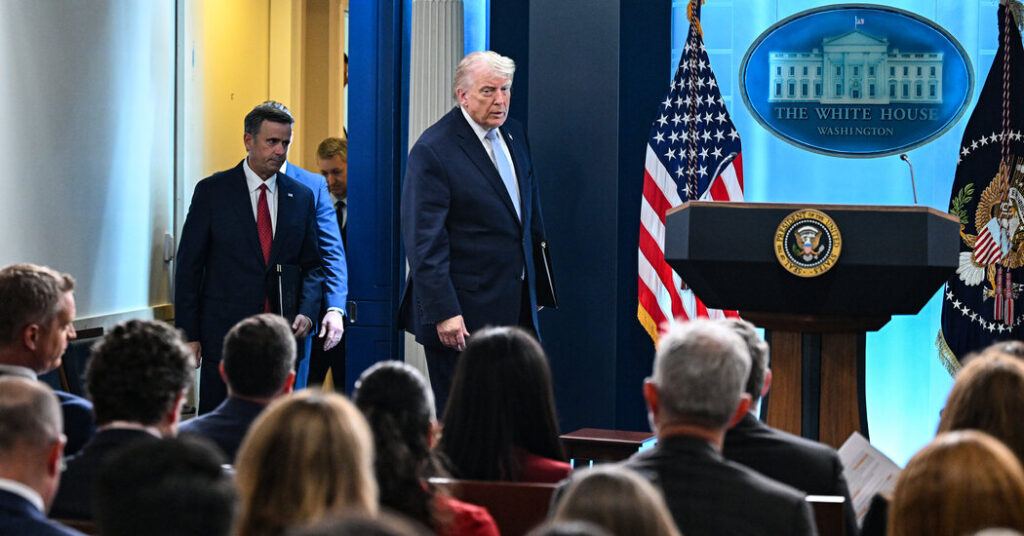
World leaders expressed relief on Wednesday that the United States, Israel and Iran had agreed to a temporary cease-fire, with President Trump backing off his apocalyptic threat to escalate a war that had already set off a cascading series of global crises.
But the relief was tempered by the profound powerlessness that most countries have felt over the last six weeks as they watched Mr. Trump wage a war that has rattled their economies, their energy supplies, their domestic politics and their relationships with the world’s pre-eminent superpower.
Even if the two-week cease-fire becomes permanent, those leaders, particularly in Europe, will be left to repair the cracks this war has caused in the global economy and security environment.
They will also be left searching for better ways to navigate the new world order that Mr. Trump has brought to bear in his second term in the White House, in which the president whipsaws friends and foes alike. Other countries have found few ways to buffer themselves, even as they express alarm at Mr. Trump’s actions.
“Is the world a better place today than yesterday? Undoubtedly,” the Danish foreign minister, Lars Lokke Rasmussen, wrote on the social media platform X. “Than 40 days ago? More than doubtful.”
Pedro Sánchez, the prime minister of Spain, an outspoken opponent of the Iran war, lauded cease-fires as “good news, especially if they lead to a just and durable peace.” But he added a harsh condemnation of Mr. Trump’s military campaign.
“The momentary relief cannot make us forget the chaos, the destruction, and the lives lost,” he wrote. “The government of Spain will not applaud those who set the world on fire just because they show up with a bucket. What is needed now: diplomacy, international law and PEACE.”
Beyond Europe, the cease-fire drew praise from countries including Oman, Japan, Malaysia and Australia.
Anthony Albanese, the Australian prime minister, told Sky News that he welcomed the agreement and hoped for an end to the war, “because this is having a big impact on ordinary citizens in Australia and in our region.”
But Mr. Albanese had also directly criticized Mr. Trump’s pledge on Tuesday, before the cease-fire was announced, that “a civilization will die tonight” in Iran if no deal was reached, saying it was not “appropriate to use language such as that from the president of the United States.”
Other leaders nodded heavily to the war’s ongoing disruptions of global energy supplies, which have sent fuel prices soaring, caused shortages and pushed many governments to take costly measures to soften the burden on drivers and other consumers.
That is largely because of Iran’s efforts to snarl shipping traffic in the Strait of Hormuz, a crucial oil and gas corridor. The cease-fire agreement allows ships safe passage through the strait if they coordinate with Iran’s military.
“The goal now must be to negotiate a lasting end to the war in the coming days,” Friedrich Merz, the chancellor of Germany, said in a statement on Wednesday. Those negotiations, he added, “can avert a severe global energy crisis.”
To their frustration, leaders appear to have little ability to influence Mr. Trump, in this war or any other conflict. The difficulty of parsing Mr. Trump’s bellicose and often shifting pronouncements has been a monthlong challenge. Other leaders have adopted a variety of responses, including mild support, measured pushback and sometimes just public silence, hoping Mr. Trump will change his mind on his own.
Take Tuesday, for instance, when Mr. Trump made the apocalyptic threat to Iran, saying the U.S. would wipe out its civilization. Neither Mr. Merz nor Keir Starmer, the British prime minister, responded publicly to the statement, nor did Emmanuel Macron, the French president.
That appeared to be a deliberate silence, avoiding any possible provocation of the American president, while diplomats — led by the Pakistani government — worked behind the scenes to secure the cease-fire. Instead, Mr. Macron and Mr. Merz posted unrelated comments on the social media platform X.
Officials across Europe have tried for the last month to blunt the economic and political impacts of the spiking price of oil and gas, driven by the war.
In Italy, the president of a teachers’ union has warned that students might have to return to remote learning in the final weeks of school if fuel shortages continue and made it difficult to keep buildings open. The crisis has hit Prime Minister Giorgia Meloni at a vulnerable time politically, after she lost a referendum to overhaul the Italian judiciary.
Ms. Meloni’s cabinet has cut fuel taxes through at least the end of May to provide some relief for consumers. Spain has similarly cut energy taxes. German officials have limited gas stations to only one price increase per day, and they are debating further measures to help consumers. The European Trade Union Confederation estimated Wednesday that a prolonged crisis could raise energy costs by nearly 2,000 euros, or around $2,300, this year for a typical European Union household.
Experts warn more help could be needed, even with the progress in negotiations.
“What has been done so far has created deep damages to the energy infrastructure,” said Tito Boeri, a professor of economics at Bocconi University in Milan. “So even if the Hormuz Strait is reopened it will take time before these countries go back to full capacity.”
Mr. Starmer of Britain was set to travel to the Persian Gulf on Wednesday to meet with allies and discuss how to keep the strait permanently open to international shipping, government officials said. His trip was planned before the cease-fire was announced. It follows discussions on the strait hosted by Britain over the last week among diplomats and military planners from more than 40 countries.
Those talks had yet to produce a full plan of action.
Motoko Rich in Rome, Carlos Barragán in Madrid, Laura Chung in Sydney and Michael D. Shear in London contributed reporting.
Jim Tankersley is the Berlin bureau chief for The Times, leading coverage of Germany, Austria and Switzerland.
The post Even as They Praise Iran Cease-Fire, World Leaders Are Whipsawed by Trump appeared first on New York Times.