For years, China has been one of Iran’s most important lifelines. China has bought almost all of its oil exports, shielded it diplomatically and helped it weather international isolation. Now, according to three Iranian officials, Beijing has used that influence for a different purpose: to press Iran to accept the cease-fire with the United States.
Iran’s decision to accept the two-week cease-fire proposal brokered by Pakistan came after diplomatic efforts by Pakistan and a last-minute push by China, according to the Iranian officials. China asked Iran to show flexibility and defuse tensions, they said.
The intervention reflects not only Beijing’s influence over Tehran but also its own stake in preventing a protracted war that could disrupt energy supplies or set off a global recession, as well as hurt Persian Gulf countries, with which China also has close relations. The deal also calls for the immediate opening of the Strait of Hormuz.
Chinese officials have not publicly described Beijing’s involvement in the lead-up to the deal announced by President Trump on Tuesday night. Asked on Wednesday if China had helped persuade Iran to agree to the deal, a foreign ministry spokeswoman in Beijing neither confirmed nor denied its involvement, saying only generally that China would continue to “maintain communication with all parties and continue to work toward de-escalating tensions and bringing about a comprehensive cease-fire.”
The deal, which Iran described as a victory in which Washington had accepted its terms, came 90 minutes before a deadline set by Mr. Trump for Iran to accede to his demands or risk widespread devastation.
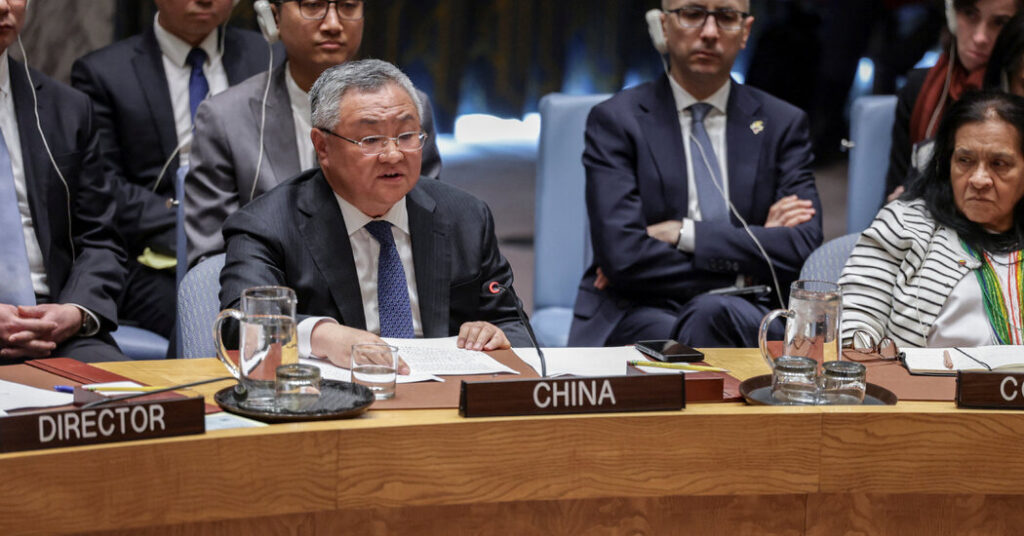
China’s moves in recent days reflect the delicate balance that Beijing is trying to strike. At the United Nations on Tuesday, Beijing backed Iran by joining Moscow in vetoing a Security Council resolution that could have paved the way for military action to open the Strait of Hormuz. But behind the scenes, by the Iranian officials’ description, China also urged Tehran to pull back from escalation.
Wu Xinbo, a prominent foreign policy expert at Fudan University in Shanghai, said he believed that China had played an active role in achieving the cease-fire, not just by encouraging Pakistan to play a role as a mediator but also by directly encouraging Iran to strike a deal.
The top Chinese foreign affairs official, Wang Yi, made a flurry of calls to his counterparts in the region emphasizing the need for a cease-fire and for countries not to resort to force to reopen the strait, according to the foreign ministry. Last week, he met in Beijing with Pakistani officials, who came to the Chinese capital after hosting a meeting in Islamabad with officials from Turkey, Saudi Arabia and Egypt to discuss a possible resolution of the conflict.
Pakistan and Iran are both heavily dependent on China. Loans from China have become vital to keeping the heavily indebted Pakistani economy afloat. And China has played a central role over the last several years in supporting the Iranian economy, by buying almost all of its oil exports at a time when many other countries avoided doing business with Iran because of its nuclear weapons program.
Shen Dingli, an independent international relations scholar in Shanghai, noted that China had sought to distance itself from Iran since the war began. Beijing sent only a vice foreign minister to the Iranian Embassy to express condolences on the death of Iran’s supreme leader Ali Khamenei, who had been killed in U.S.-Israeli strikes on Iran.
Mr. Wang, the foreign minister, in one of his calls with his Iranian counterpart, even urged Tehran to “pay attention to the legitimate concerns of its neighbors,” meaning the Gulf nations, Mr. Shen noted.
China has often tried to cast itself as a mediator on the world stage and a responsible global power, in unspoken contrast to the United States. It helped broker a surprise rapprochement between Saudi Arabia and Iran in 2023, for example. But other attempts have been less successful. Beijing set forth a 12-point peace plan for Russia’s war in Ukraine, and a three-part proposal for a two-state solution between Israel and Palestine, both of which were vague and saw little apparent follow-up.
Berry Wang contributed reporting from Hong Kong and Siyi Zhao contributed research from Beijing.
Keith Bradsher is the Beijing bureau chief for The Times. He previously served as bureau chief in Shanghai, Hong Kong and Detroit and as a Washington correspondent. He lived and reported in mainland China through the pandemic.
The post China Pressed Iran Toward Cease-fire, Iranian Officials Say appeared first on New York Times.