There is a reflex that kicks in when someone questions whether you belong. You start assembling evidence. You cite your credentials and your patriotism. When Rep. Andrew Ogles (R-Tennessee) declared last month that “Muslims don’t belong in American society,” I noticed this reflex in myself. I wanted to prove I belonged, for those who believed that I didn’t. I suspect many Muslim Americans did the same. We have gotten good at this over the years — too good.
Ogles is not alone. The Sharia-Free America Caucus has swelled to 60 House members. Sen. Tommy Tuberville (R-Alabama) recently said, “I’m ready to get rid of the Muslims.” The instinct, when faced with this, is to marshal the evidence. Over the past decade, surveys have shown that American Muslims are patriotic, civically engaged and more likely than the U.S. general public to say that political violence is never justified. You’d think that would be enough. Except it shouldn’t have to be. And this is where it gets uncomfortable — for me, at least.
The assimilation defense — look how well we’ve integrated — is satisfying to make. But it concedes a premise I no longer accept: that a minority community’s right to be in the United States depends on its willingness to converge with the cultural mainstream. It shouldn’t depend on that. It shouldn’t depend on anything. But there’s something else going on that makes the picture messier. On the questions where Muslim Americans remain religiously conservative — sexuality, gender identity and family structure — their views don’t diverge much from the Republican base. They haven’t assimilated as much as liberals might like. You’d think Republicans would sense an electoral opportunity.
According to the Pew Research Center’s 2023-2024 Religious Landscape Study, 55 percent of Muslims Americans say homosexuality should be discouraged by society; Republicans and those who lean Republican are at 47 percent. On whether growing acceptance of transgender people has been a change “for the worse,” 48 percent of Muslims say yes. Meanwhile, 63 percent of Muslims say children are better off when a parent stays home to focus on family.
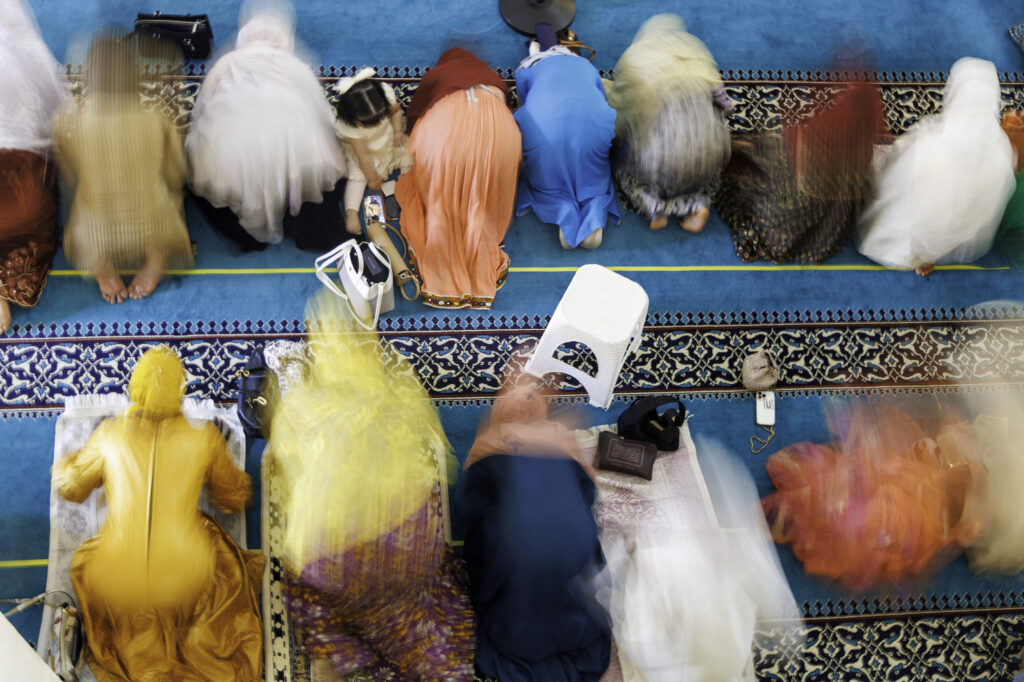
This is where the conversation needs to shift, and where it becomes less about politics and more about culture: Muslims are different in certain ways. How could they not be? Islam shapes how its adherents think about family, sexuality and what it means to live a good life. Simply put, Islam is also a more public religion than Christianity. Muslim prayer is visually striking and often communal. If a Muslim doesn’t drink alcohol or fasts during Ramadan, that will be more noticeable to others. Moreover, practicing Muslims — despite being repeatedly asked to — can’t disavow “sharia” even if they wanted to. Sharia, roughly translated as Islamic law, includes guidelines on how to pray, fast and otherwise observe what it means to submit to God in daily practice.
These commitments are not incidental to Muslim identity. For believers, they are the point. Two-thirds of American Muslims pray at least once a day — compared with 44 percent of U.S. adults overall, down from 58 percent in 2007. The Muslim percentage, by contrast, has barely moved. The country is becoming less religious. Muslims, by and large, are not. Meanwhile, 38 percent of Americans say religion is very important in their lives. For Muslims, the figure remains far higher — at 60 percent.
This is a community that has increasingly integrated into American civic life, but it has done so while holding on to its religious commitments in a way that most other groups haven’t. Whether you think that’s admirable or worrying probably says more about you than it does about them. The question I keep returning to is: Why do Muslims need to be like everyone else?
A similar demand is directed at other minority groups. Latino immigrants arrive in the U.S. with conservative instincts. But generation by generation, those commitments erode. Catholic identification among Latinos has fallen from 67 percent in 2010 to 42 percent in 2024. Acceptance of homosexuality climbs from 53 percent among first-generation Latino immigrants to 63 percent by the third generation.
This trajectory deserves a blunt name: assimilation. And assimilation tends to mean secularization.
Jewish Americans lived through a more wrenching version of this story. Waves of German Jews in the 19th century assimilated eagerly into the Protestant mainstream. When Eastern European Jews began arriving after 1880, they faced pressure not just from gentile America but from established Reform Jews who felt their Yiddish-speaking cousins were both an embarrassment and a threat to the acceptance they had worked so hard to achieve. And assimilation worked in the way assimilation usually works.
In 2013, intermarriage rates for Jews reached 58 percent among those who married after 2005. The Jewish population declined from its mid-century peak, leading some Jews to lament a “lost generation.” American acceptance offered belonging, but the belonging came at the price of distinctiveness. That many Jews later returned to traditional practices — rediscovering kashrut, Hebrew study and Shabbat observance — suggests an essential surrender in the bargain, and that some who made the trade came to feel its cost.
What strikes me about these stories is how much they resemble each other. The deal is always the same: You can stay, but you have to become less yourself. Less distinctively Muslim, less traditionally Jewish, less recognizably Latino. The specifics of your faith and culture — the things that make your community a community rather than a collection of individuals — are treated as obstacles on the path to real Americanness. The left and the right enforce this expectation. The right says: Assimilate or get out. The left, more gently: Assimilate and we’ll celebrate you. But the endpoint is the same.
It is still too early to tell, but Muslim Americans may prove to be more resistant to the secular pull of American culture than other groups. They will continue to stand out in ways that make people uncomfortable. This is why the defense of any community should not rest on how “mainstream” its members have become. A Muslim who prays five times a day and believes homosexuality is sinful is not less American than a Muslim who drinks alcohol and hasn’t been to a mosque in years. An evangelical Christian who believes marriage is between a man and a woman and home-schools his children is not less American than a mainline Protestant who marches in Pride parades. These are deep disagreements about how to live, and a country that is serious about pluralism shouldn’t treat them as problems to be solved.
I’ve written before about what I call “democratic minimalism” — the idea that the purpose of democracy is not to resolve our deepest disagreements but to make them survivable. It means accepting that some of our fellow citizens will hold views we find abhorrent and that their holding those views is not a reason for wanting them out. I realize this sits uneasily. But a country in which belonging requires signing on to specific social views is not pluralist. It’s something else, and I don’t think it’s something we should want.
America was not founded on the assumption that its citizens would eventually come to agree on foundational questions. It was founded on the more radical proposition that they wouldn’t — that people who disagree about God, religion and the good life could share a country anyway. Not because they would converge over time, but because convergence was beside the point. The question isn’t whether Muslims, Jews or Latinos will change. They will. The question is whether America will let them do it on their own terms.
The post I’m tired of proving I belong in America appeared first on Washington Post.